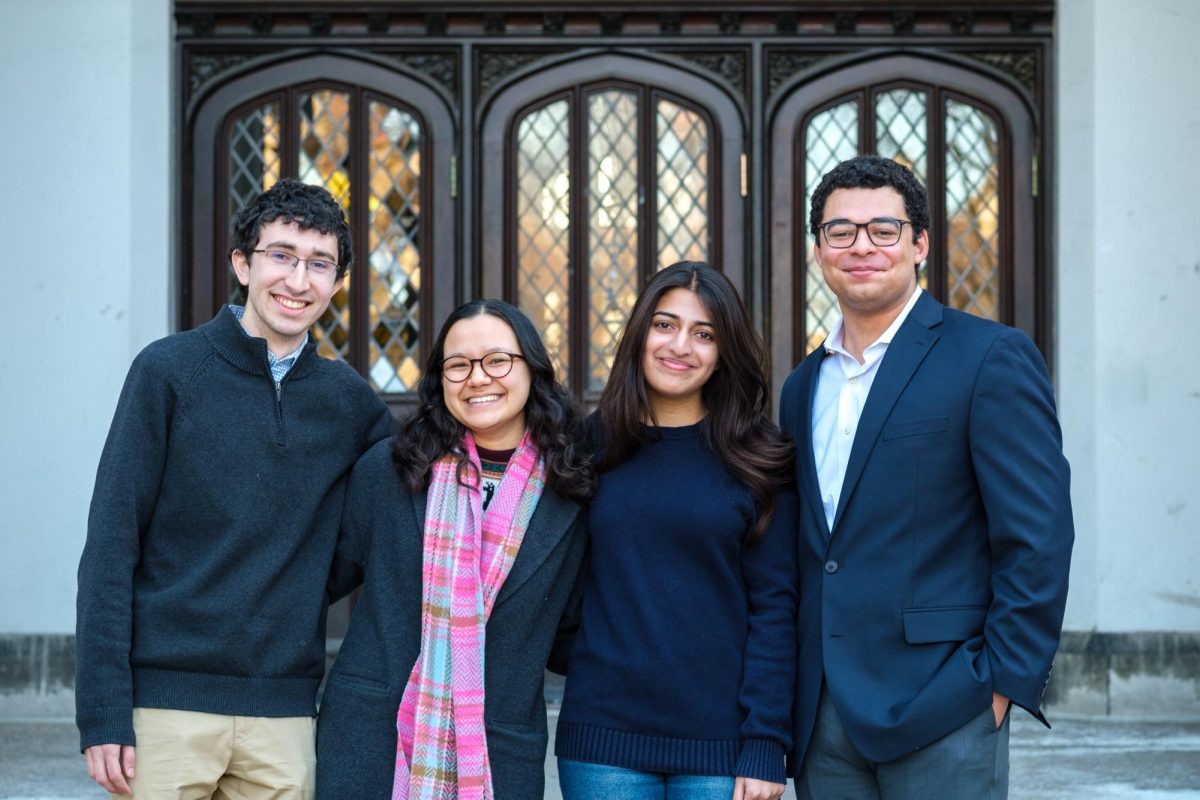
In a unanimous vote, Maroon staff elected third-years Celeste Alcalay and Anika Krishnaswamy as co-editors-in-chief of the Chicago Maroon for the 2026–27 term, and fellow third-years Gabriel Kraemer and Nathaniel Rodwell-Simon as co-managing editors, on February 7.
The four will lead the Maroon through its 134th year and will replace fourth-years Tiffany Li, Elena Eisenstadt, and Evgenia Anastasakos, who currently serve as editor-in-chief, deputy editor-in-chief, and managing editor, respectively.
The incoming slate, which will begin its tenure on March 14, ran on a platform of increasing collaboration and aligning internal standards among the Maroon’s editorial sections. Other plans include increasing the Maroon’s social media presence, soliciting “Letters to the Editor,” and launching an annual campus climate survey.
They will be joined by second-year Eliot Aguera y Arcas as chief production officer, who said she hopes to bring the Maroon’s biweekly print edition back to its original broadsheet format. The paper switched to the tabloid format in 2019.
Second-years Adam Zaidi and Arav Saksena will lead business and strategy for the Maroon as co-chief financial officers. They plan to increase the business team’s integration internally and with other sections of the Maroon. They also plan to decrease reliance on advertisements for revenue.
Alcalay currently serves as a Grey City editor and senior news reporter. She has covered immigration on the South Side and University property expansion in Hyde Park. She also has contributed to the Maroon’s investigations team, writing about University disciplinary procedures for student protesters and the University grants terminated by the Trump administration, and she has published over a dozen podcasts.
During the election, Alcalay spoke about her passion for local journalism and her desire to support writers and editors, including in expanding coverage on the University’s relationship with the neighboring South Side communities.
“Here, on campus, students and faculty deserve to know how national politics will affect their learning and teaching activities, how administrators make decisions about University operations, and who sits on the Board of Trustees,” she said.
Krishnaswamy is also an editor for Grey City as well as co-head editor of the news section. She has written long-form articles about student culture on campus, covering UChicago traditions like Scav and Kuvia, perceptions of the business economics major, emerging pre-professionalism on campus, and free speech at UChicago and Columbia.
She highlighted the slate’s plan to create a more unified culture at the Maroon.
“Whether that’s by increasing Maroon events or changing how we approach new reporter training, we want writers to feel like they can write a news piece one day and a concert review the next,” she said.
Rodwell-Simon is the head editor of photo and video as well as a news editor. He started at the Maroon as a photographer before finding his voice in reporting, covering the 2024 pro-Palestine encampment on campus, Immigration and Customs Enforcement activity in Hyde Park, plans to restructure the Division of the Arts & Humanities, and relationships between University trustees and Jeffrey Epstein.
“Part of the reason I decided to run for slate is to ensure that those opportunities and this community get to continue so that future generations of students can fall in love with journalism as I did or just find a place on campus where they feel comfortable,” he said in his speech.
Kraemer, who is co-head editor of the news section, has covered the University’s responses to the Trump administration’s attacks on higher education, reductions in the University’s budget deficit, labor union contracts, and College Council elections.
Kraemer, Alcalay, and Rodwell-Simon all emphasized the importance of protecting and sustaining independent, community-based journalism amid a changing media landscape. “I’ve been thinking this week, in the wake of the layoffs at the [Washington] Post, that the least we can do is try to protect our little slice of journalism on campus,” Kraemer said.
“The Maroon can and will continue to be a hub for both community and for journalism,” Rodwell-Simon said. “That is my commitment to all of you.”