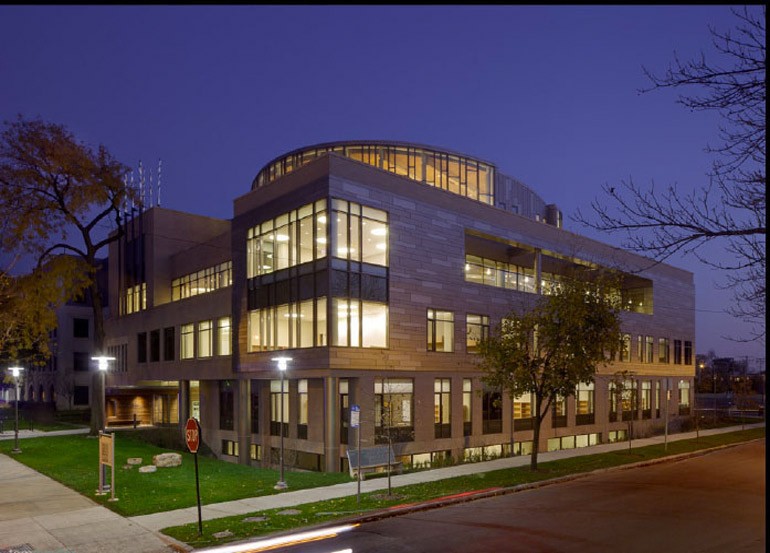
The 2018 opening of UChicago’s Level I trauma center led to a 3.9 percent decrease in firearm deaths on Chicago’s South Side, according to a study published in the Journal of the American Medical Association in February.
The study said that its findings could help inform planning for trauma care systems in other cities with “trauma deserts,” areas with limited access to trauma care, similar to Chicago’s South Side. To be designated as Level I, a medical center must provide all essential trauma services in-house, 24 hours a day. However, the South Side remained without easily accessible adult trauma services for 27 years prior to 2018. UChicago Medicine (UCMed) operated a program between 1986 and 1988, and the only other trauma center—at Michael Reese Hospital in Bronzeville—closed in 1991. Without a local trauma center, gunshot victims were transported to hospitals on the North Side.
When it comes to firearm trauma, “people talk about the golden hour, but really, it’s minutes,” Michael Poulson, a UChicago surgeon and coauthor of the study, said in an interview with the Maroon. “Any decrease in [travel] time to a trauma center makes a big difference, and there have been studies showing that shorter distance and shorter travel times are associated with lower mortality. I think ours is one of the first to show an actual drop in mortality with the opening of a trauma center.”
The study found that, between 2010 and 2018, the average distance to trauma care in what later became the UCMed service area was eight miles, and the average travel time exceeded 21 minutes. After the center’s 2018 opening, the average distance dropped to less than five miles, and travel time fell to just over 13 minutes. “For context,” the study said, “in a year with 2000 firearm injuries within the catchment area, this would yield about 79 lives saved.”
UCMed’s trauma center in Chicago’s South Side sets an example of how mortality in trauma deserts can be reduced through “[t]houghtful and intentional design of trauma systems,” the study said.
Still, Poulson said, expanding care access in trauma deserts is complicated by the fact that neighborhoods in other cities lack institutions like UChicago that can facilitate such programs. “A lot of the best medical care is centered where the money is,” he said.
According to the study, U.S. trauma care’s “inequitable landscape… has been characterized by the proliferation of trauma centers based more on the ability to provide care rather than the need to do so.” Trauma deserts lack care despite often having the “highest risk for traumatic injury in the first place” and heightened trauma mortality rates, it said. While the number of U.S. trauma centers is increasing, they are opening disproportionately in more affluent areas with preexisting centers.
There are “many different [public and private] stakeholders that really need to think about where [trauma centers are] placed, and not necessarily just [in] the hospitals that have the infrastructure,” Poulson said. “Luckily for Chicago, the University of Chicago has a tertiary care center that had a lot of the resources and could easily implement [changes]. But I think the same could happen with even smaller hospitals, with investment in [their] infrastructure” in trauma deserts in other cities and in rural areas.
Beyond institutional planning, Poulson said UChicago’s trauma center demonstrates the role of community activism in driving change.
The University’s trauma center opened after years of community pressure. The 2010 death of community organizer Damian Turner, who was shot four blocks from UCMed but was transported nine miles to Northwestern Memorial Hospital downtown for treatment, spurred backlash from neighborhood residents who believed he would have lived if UCMed had the proper resources. The University initially resisted reopening a trauma center, citing high costs, but in 2015, following a series of protests and sit-ins, it announced plans to open its center.
“I think this is a good example of how community activism can really change things and can really shape the way that even these big, large, economic, corporate hospitals function and… provide community service,” Poulson said. The case of Chicago’s South Side “is a model for other cities, not only for addressing trauma deserts, but also [for] the community activism that can direct change.”
“A lot of communities… have been ignored by cities, or [by] institutions that are even located within [them],” he continued. “There are a lot of very great people who pushed for this trauma center to be open.… I think the community should be proud [of] what they’ve done.”
Beyond helping the South Side at large, Poulson said he thinks the trauma center benefits UChicago by broadening the University’s community impact: “I hope it’s made UChicago a better symbol for the community that it’s a part of.”