



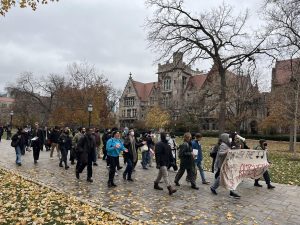
UChicago Students for Justice in Palestine (SJP) and UChicago United for Palestine (UCUP) led a march from the main quad to the Institute of Politics (IOP) on Tuesday in protest of John Kirby’s appointment as the IOP’s new director.
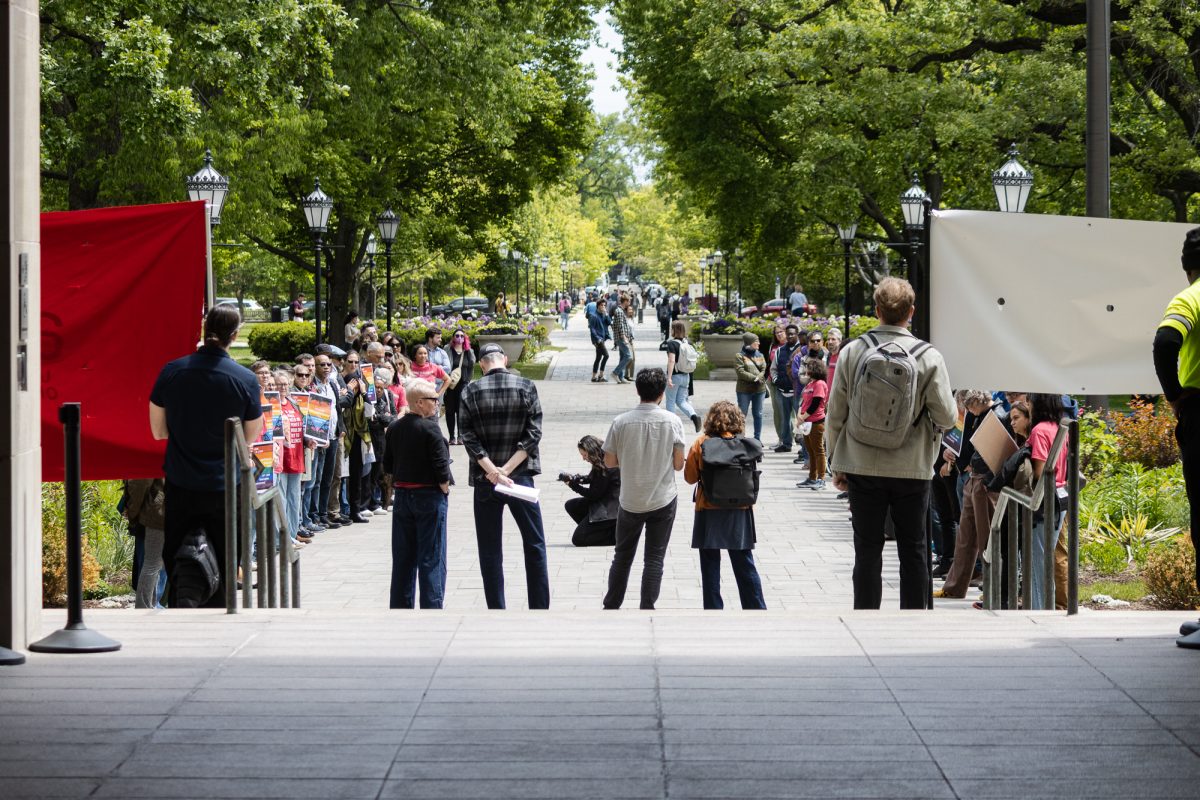
The demonstration began at 12 p.m. Organizers from SJP and UCUP used megaphones to lead chants and address the crowd of nearly 50 people while three deans-on-call and four UChicago Police Department (UCPD) officers monitored the area.
Since his appointment last month, Kirby has faced criticism over comments, made during his time as the national security spokesperson in the Biden Administration, regarding the Israel–Hamas war in Gaza.
When asked in 2024 about the International Criminal Court’s issuing a warrant for Israeli Prime Minister Benjamin Netanyahu’s arrest for war crimes, Kirby responded, “We don’t find [Netanyahu] to be a war criminal. He’s an ally, a partner, and a friend.”
SJP has opposed the University’s decision since Kirby’s appointment, writing in a Maroon op-ed that “[n]ot only did Kirby repeatedly deny that a genocide is taking place; he also repeatedly insisted that Israel had not violated the laws of war or international humanitarian law at all.”
At the march, a speaker from SJP echoed this sentiment, adding that “[Kirby is] justifying ethnic cleansing, genocide, and mass displacement.”
The protesters also denounced the Board of Trustees. “We hold the Board of Trustees at the University of Chicago responsible for genocide in Palestine,” a speaker from SJP said.
On its Instagram page, UChicago Alumni for Palestine had previously accused Board members of actions such as donating to the Israel Policy Forum and holding senior positions at companies whose technologies have been used by Israeli forces in Gaza, such as Northrop Grumman and Honeywell.
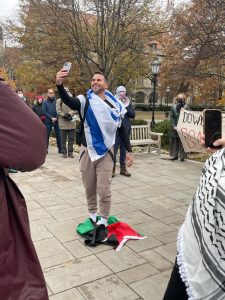
Protesters remained on the main quad until 12:35 p.m., chanting “John Kirby, you can’t hide, you invest in genocide.” One counter-protester, wearing an Israeli flag, stepped on a Palestinian flag while yelling “fuck Palestine.”
The group then began its march towards the IOP, where two UCPD officers were stationed directly outside the entrance and multiple Chicago Police Department officers monitored the immediate area as speeches continued. “[John Kirby] spent months denying and excusing the occupation and genocide in Gaza and serving alongside Biden and his allies,” another speaker from SJP said.
Speeches then shifted to concerns in Hyde Park, including the impact of the new Quantum Center on community members. “Not only does our higher ed institution support genocide, they are actively harming our community,” a speaker said.
The protest concluded at 1 p.m.
SJP called Kirby’s appointment “undemocratic” in a statement to the Maroon after the demonstration. “Kirby belongs on trial to be executed for facilitating genocide, not on campus or in Chicago. He will be met with protest as long as he works here.”
The IOP did not respond to the Maroon’s request for comment.
Editor’s note, November 27 9:30 a.m.: This article was updated to clarify the accusations SJP made against the Board of Trustees.




Matthew G. Andersson, '96, Booth MBA / Nov 20, 2025 at 10:02 pm
The responses from many parts of the University due to this appointment, or any other partisan choice, are usually predictable. Students need to ask themselves if protesting a single appointment–rather than the larger assembly of Institute corruption–has utility both in corporate terms, and symbolically in political ones. Various appointments are less important than the fundamental presence of such an institute on a college campus. There are hundreds of them across the country, and they represent an effective intellectual infection. The UChicago IOP is otherwise a vanity project of David Axelrod, established in part to memorialize his public affairs career, while erecting an ideological marketing center, made more effective by its linkage with general degree-seeking malleability. Decades ago, a member of the Committee on Social Thought, and Nobel author, Saul Bellow, wisely referred to the “backflow” of political contention that interferes with, and deforms, higher education: this is an excellent example, which serves the political class and provides its fundamental source of oxygen: social division. The protestors are providing precisely their expected utility. What value the IOP otherwise provides is interesting in that it has no education function. It appears merely an expensive, tuition-subsidized revolving door for political and government actors who otherwise have difficulties functioning legitimately in an arms-length private sector. Universities are full of them. The IOP’s multi-million dollar operating budget is also a curious friction in rational university cost management. Students may otherwise enjoy “Democracy and the Party System in the United States: A Study in Extra-Constitutional Government,” by political sociologist Moisey Ostrogorsky (1910).