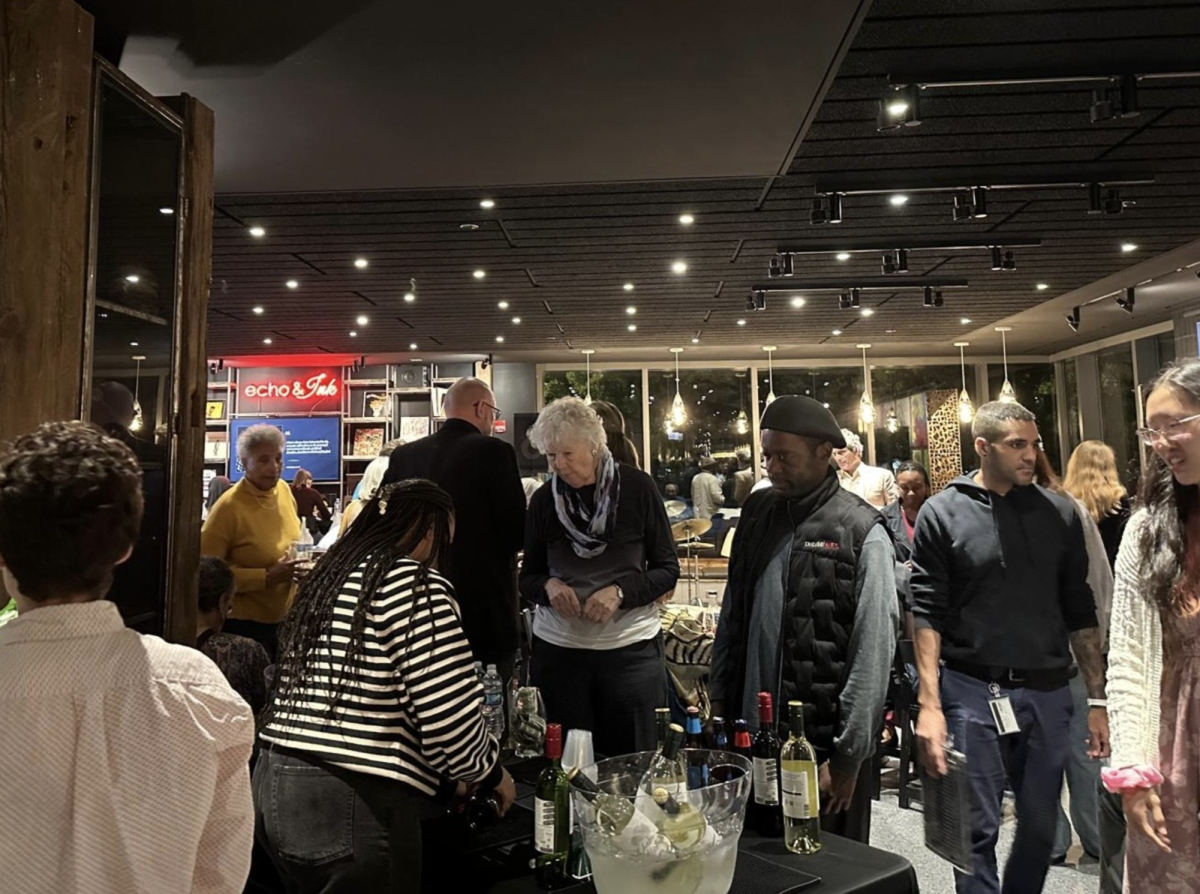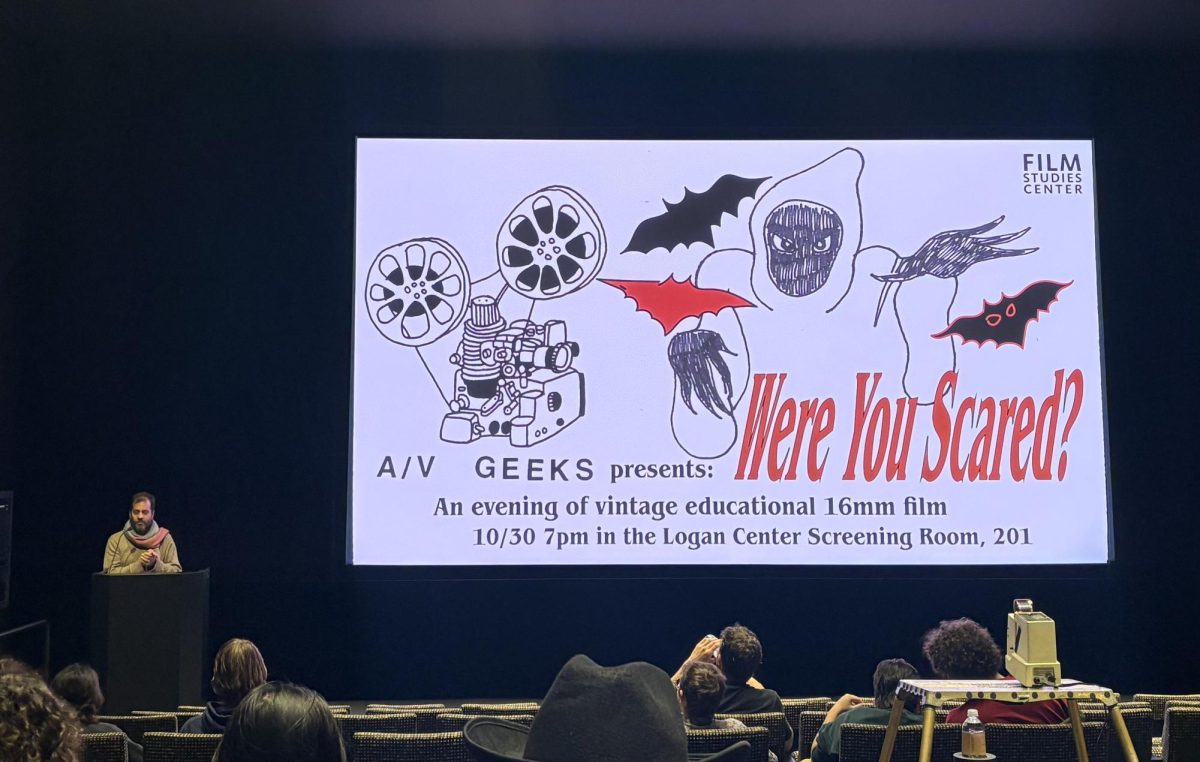
There is always a tangible buzz on the night of October 30. Costumed college kids shuffle down the streets on their way to an All Hallows’ Eve Eve party, spiderwebs envelope shrubs, pumpkins line porches—Halloween is in the air, and everyone seems to be itching to celebrate. Watching mid-20th-century educational films is not, perhaps, the kind of spooky movie night one would expect on a night like this. Skip Elsheimer, founder of the A/V Geeks film archive and programmer for the screening, begs to differ.
A/V Geeks’ Were You Scared? hosted at the Logan Center, describes its central theme as, “the fears, anxieties, dangers and everyday disasters of growing up.” The lineup included six 16mm educational films, but it began with a vintage slideshow on a seemingly unrelated subject: laughter.
Unlike your typical screening, audience participation was very much encouraged at the event. In fact, the woman sitting closest to the slideshow’s projector was asked to click through it, and each slide was read off by an audience member. Even for the younger audience members, there was at least an imagined sense of classroom nostalgia.
After the slides were read out, the screening of the films began. With the classic, old-fashioned whirring of the projectors as a backing track, the first film, “I Used to Be Afraid,” appeared on screen. The film features a charming animation accompanied by a catchy song about a young boy who is “no longer afraid of anything” (or so he claims). The boy tells his younger brother that, now that he is eight years old, nothing scares him anymore—that is, until the comical ending, where he shrieks and zooms away from a monstrously dramatized shadow of a kitten.
Elsheimer speculates that the next film, “The Creeps Machine,” is a student film. This mainly stems from how deranged it is, in an almost experimental, Lynchian way. Clearly, much creativity was used in the prop design of this film, with an elaborately detailed haunted doll house standing as its focal point. The film opens with a wide shot of the house, and proceeds to cut to close-ups of painted hands emerging from the door, a puppet monster, and a painting of what seems to be some sort of ghost. These clearly homemade visuals are accompanied by creaking, growling, and screaming. Something like this, Elsheimer believes, could only emerge from a young, broke student filmmaker.
The following two films, “Don’t Be Afraid,” and “I’m Feeling Scared,” were somewhat less memorable, but remained an entertaining glimpse into the mid-20th-century, with their comical, singalong songs and vintage frocks. “I’m Feeling Scared” stars a medley of young, perhaps not yet vocally trained actors singing about their fears, which include heights, getting lost, and being called into the principal’s office. What seemed to resonate the most with the audience of UChicago students, though, was the girl who sings, “Why am I scared of meeting new people?”
The two closing films were the stars of the screening. Though the earlier film, “The Creeps Machine,” was visually remarkable and bizarre, the fifth film, “I Wasn’t Scared,” was undoubtedly the most ridiculous. Elsheimer himself introduced the film by stating very bluntly, “The little kid in this film is an asshole.” The audience would soon find his assessment correct. In the film, a stubborn younger brother (Todd) and a responsible, older sister (Debbie) are fishing when they stumble upon an old, unignited bomb.
This film’s absurdity results in some truly hilarious moments, a personal favorite being when Debbie tells Todd not to touch it for fear that she’ll “get the blame” if it blows up, to which Todd responds: “You wouldn’t get the blame if you’re dead.” Of course, like any adolescent boy would, Todd ends up not only igniting the bomb, but also stuffing the ignited bomb in his backpack and attempting to bring it home with him. Debbie, thankfully, notifies the police, who save the day right before the bomb explodes. Though the children and officers escape unharmed, there was a brief moment in the film where the audience held their breath. The handling of the ignited bomb was enough to wince at, but the hilarity of the dialogue quickly diffused this tension.
The screening closed with “Fears of Children,” which was also the oldest of the night. The film was so old, in fact, that during screening, the projector “lost the loop,” and a few other technical difficulties with the audio and visuals ensued because of the film roll’s age. Besides this small hiccup, it was one of the most engaging of the lineup. As Elsheimer commented during the screening, the informational film was “amazingly progressive at the time.” Upon reflection, Assistant Director of the Film Studies Center Douglas McLaren agreed, stating, “I felt like that had, even today, a pretty progressive view of allowing children to have feelings, and to sort of sit with those feelings, and it’s okay to have negative feelings—those are just as valid.”
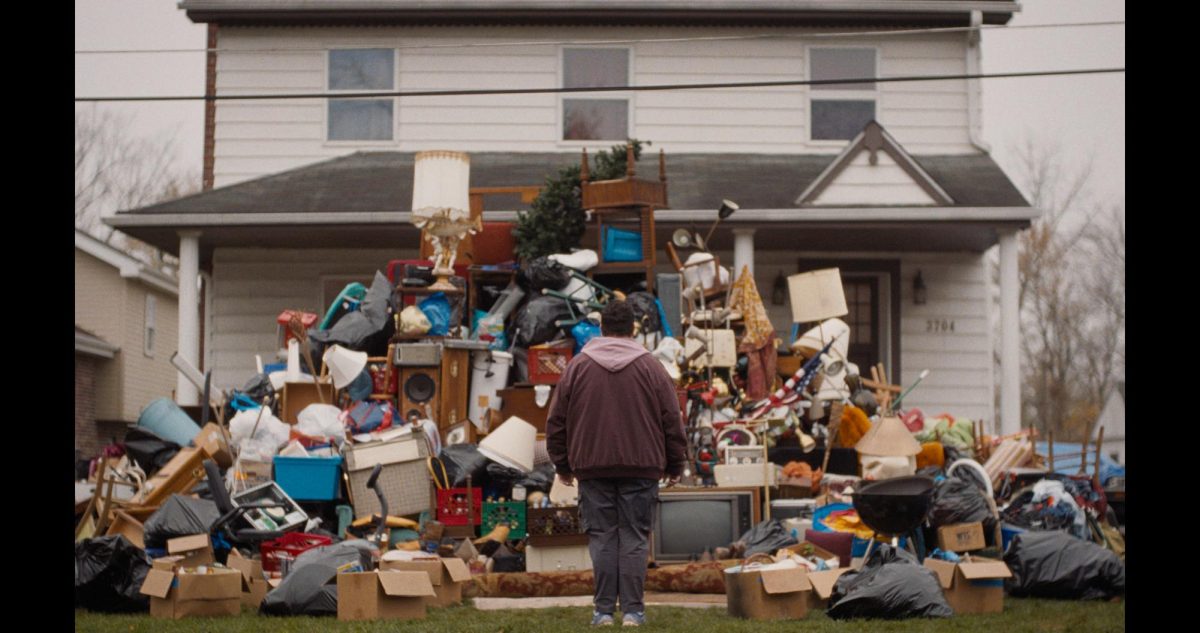
The film centers on a young boy’s anger towards his father, as well as how his mother’s constant concern prevents him from taking risks and stepping out of his comfort zone. All of this is surprisingly similar to the kind of family dynamics one would find today. At one point, the boy has a disturbing dream in which a slobbering, roaring grizzly bear lunges to attack him. Afterwards, he takes the teddy bear his father gifted to him and attempts to drown it in the bathroom sink. When his father tries to comfort him later on, the boy seems to not recognize him and screams for his mother to save him from “the bear”—the viewer comes to realize, in this moment, that both the stuffed and the bear from his dream represented his father. McLaren noted, “it feels almost like a Twilight Zone episode.”
From the beginning, the audience had to wonder: how does the kind of fear these films portray relate to the kind of fear kids are experiencing today? In other words, how and why are these films still relevant?
Perhaps the kids in the films don’t look exactly like the kids of the present day. Perhaps the families and gender roles displayed are not the same as they would be now. Still, the messages the films teach remain just as relevant—it’s okay to be angry with your parents; it’s okay to take risks (as long as they don’t include bombs); and it’s okay to be afraid sometimes. As Elsheimer put it, “I think it’s very relevant to talk to kids about processing their feelings of fear and anxiety. Because there’s a lot of things for kids to be anxious about, both real and imagined.”
“I think there’s kind of a direct connection between adult fears and childhood fears,” said McLaren. Just as these films can continue to teach children about fear, they can also encourage a sort of self-reflection in adults. How different are our fears now compared to when we were children? This is perhaps this screening’s underlying question, and one that audience members were left contemplating on this night before Halloween. “I like showing these films, because we have the benefit of hindsight,” Elsheimer said. “Showing films to adults about little kid fears is a wonderful way to review your own fears.”