

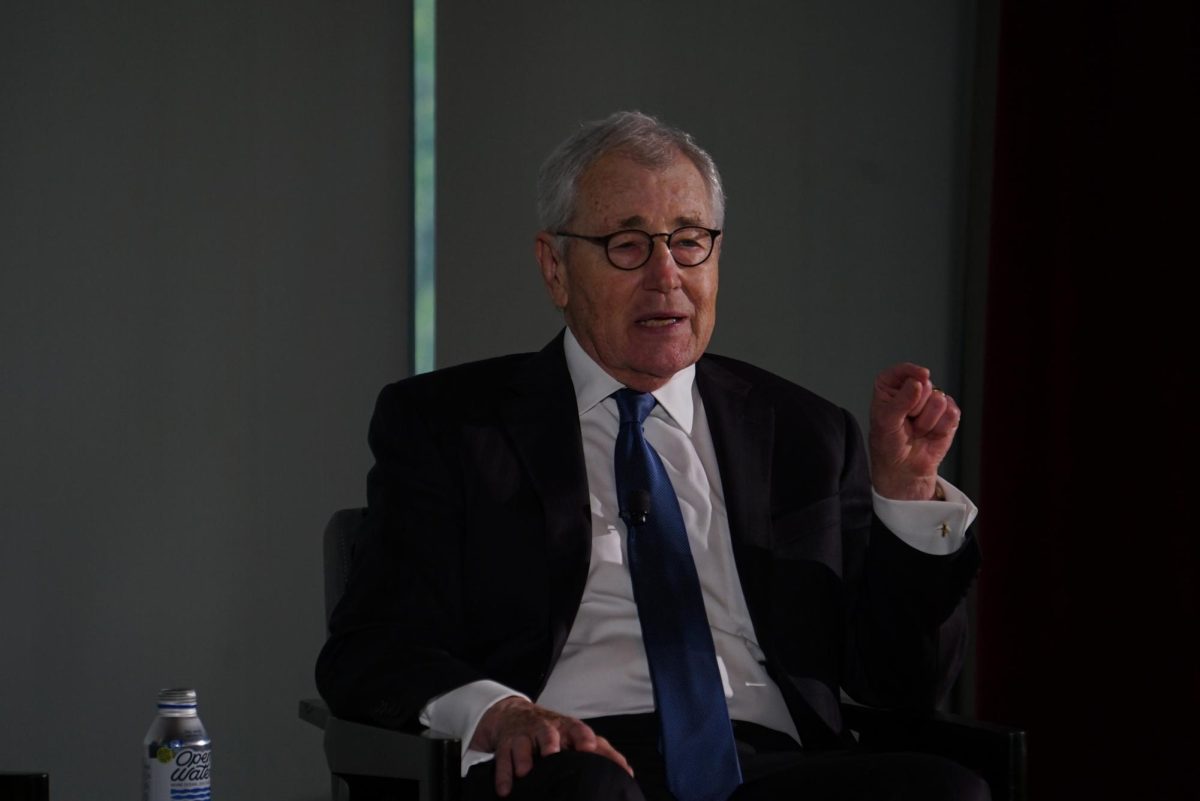
The Chicago Project on Security and Threats (CPOST) hosted its fifth annual Hagel Lecture on April 17 at the Rubenstein Forum. Robert Pape, a UChicago professor of political science, moderated a conversation between former Secretary of Defense Chuck Hagel and former Deputy Secretary of State Kurt Campbell, entitled “America’s Role in Asia in the Context of War With Iran.”
Pape began by asking the speakers to contextualize the progression of the war. “This is nowhere near being done,” Campbell said. “We are at the very early stages of the last phase of this conflict, and diplomacy really is only the beginning.” Hagel echoed that it could take years to fully assess and repair the damage to diplomatic relations, the global economy, and infrastructure in the Middle East.
Campbell said the conflict will leave lasting mistrust between the U.S. and Iran. Given Iran’s blockade of the Strait of Hormuz, he predicts that U.S. forces may remain stationed in the Middle East for the long-term—even without support from allies, whom he described as wary of President Donald Trump’s foreign policy.
Both speakers warned that unraveling the post–World War II alliance system could have negative consequences. “If there was ever a time when America really needed allies and friends, it’s certainly now,” Hagel said. “Anyone who believes that America doesn’t need anybody else had better go back to the history books.”
Hagel then said that redirecting U.S. intelligence and military equipment toward Iran has reduced the country’s ability to support Ukraine in its war against Russia.
Campbell recalled a visit to Denmark’s ambassador to the United States, whom he described as a close friend. The ambassador asked him to leave his phone in a safe, citing concerns that the U.S. is increasingly perceived as a potential security threat to Greenland.
The conflict has also disrupted global trade. Iran’s leverage stems from its control of the Strait of Hormuz, a chokepoint for ships carrying petroleum exports from the Persian Gulf. “The level of commercial constipation in the system is profound,” Campbell said, warning of widespread price increases on thigs like air travel to food grown with fertilizer.
Campbell expressed concern about taxation on oil shipments through the strait, particularly if the U.S. were to be involved. “Almost invariably, there will be some sort of tithing associated with the ships and petroleum leaving the Persian Gulf, and that is antithetical to everything that we have worked on in our history,” Campbell said, referencing Trump’s suggestion that the U.S. could split the proceeds of a toll with Iran.
They also discussed the U.S.’s attempts to cripple Iranian nuclear development. Campbell pointed out that “Iran had the ability to build a nuclear weapon for a substantial period of time, and for a variety of reasons, chose not to.” However, Iran maintains the capacity to produce enriched uranium, and he expects that Supreme Leader Mojtaba Khamenei will try to resurrect their nuclear program. “The new leader of Iran was there when the bomb struck that killed his father, his mother, his brother, his wife, and one of his sons. Now, can you imagine how open-minded he is to want to work closely with the United States?” Campbell said. He said that as Iranian youth witness their families being killed, the conflict is “manufacturing new terrorists.”
Nevertheless, the speakers sounded notes of optimism. “This country has always had the unique ability to self-correct,” Hagel said. He believes that Congress, which he called the “people’s house,” will need to take on more responsibility. “Politics doesn’t ever rule anything, it just reflects society—it’s the people that go to the ballot box and use politics as the process.”
The discussion concluded with a Q&A session.
One audience member asked about Congressional perceptions of China’s technological advancement. Campbell described Chinese innovation as “incredible” and Chinese officials as determined to support China in surpassing the U.S. technologically. Despite public fears that American GDP is in decline compared to China’s, Hagel added that American GDP has actually remained stable in recent years. “Rather than refer to China as the enemy, I think we should be smart: they’re the competitor.”
Another audience member asked about access to reliable journalism. “I don’t know of a war or a conflict that the United States has been involved in in which the information has been so carefully withheld from the American people,” Campbell said. “I don’t think we actually have a clue what’s going on in a number of places.”
The event concluded with a question about forging new alliances. While Campbell has observed that Trump is drawn to authoritarian leaders like Vladimir Putin, Kim Jong Un, and Xi Jinping, he argues the U.S. should find common cause with countries that share the values of a pluralistic democracy. “I was with some diplomats this afternoon, and I asked each of them, ‘How do you feel about living here?’ They felt welcomed, and they had neighbors and people who they loved and respected,” Campbell said. “That is who America is, and I’m confident that we can recapture that character.”





Matthew G. Andersson, '96, Booth MBA / Apr 23, 2026 at 12:59 pm
Why the CPOST exists on the UChicago campus is an interesting question. It was formed after the 911 program to promote synthetic GWOT policy. Like the IOP, it has oblique if any academic content. CPOST and institutions like it are postings for partisan broadcasting, acting under academic pretense. They also serve as whitewashing platforms for prior irregular political behavior. It is difficult to discern what value students could acquire from this—except perhaps as clinical psychology. Speakers moreover, were repeating retail observations which stem from second-hand data interpretation. In the case of the Middle East, if you don’t know Farsi, Hebrew, and Arabic, with access to Russian and Mandarin, the information signals can be corrupted, deceptive, or false. Booth’s CDR is otherwise an actual academic/scientific platform at UChicago that provides primary technical, theoretical bases for understanding political and state behavior, decision and choice. Moreover military operations, which are ninety percent supply chain, logistics and operations research problems, rest squarely on the business school platform, or the undergraduate business economics track. The front end of military operations moreover is technology, which makes engineering an optimal pairing, especially in system-of-systems. Mr. Pape’s recent interview over Lebanon was also curious: there is no sectarian cooperation in its partition. It is absolute. His bombing target analysis is interesting, but may not provide reliable bases for reasoning about advantage or response in terms of more critical alliance mobilization, horizontal escalation or so-called distributed retaliation. MIT’s Ted Postal takes a similar approach with isolated blast radius analysis. Concerning the Ukraine, there are no amounts or forms of EU or proxy aid that can resist RU acquisition of the territory. Moreover, the EU is a dead money organization which will eventually be collapsed with NATO. There is otherwise no such thing as legitimate US-based politics, security and terrorism studies unless it derives ideologically from domestic border enforcement, which at Chicago, and at Law, it does not. There is little sovereignty conviction in higher education culture which makes security moot. UChicago otherwise hosts Army and Air Force ROTC programs which include more effective political science student learning platforms.