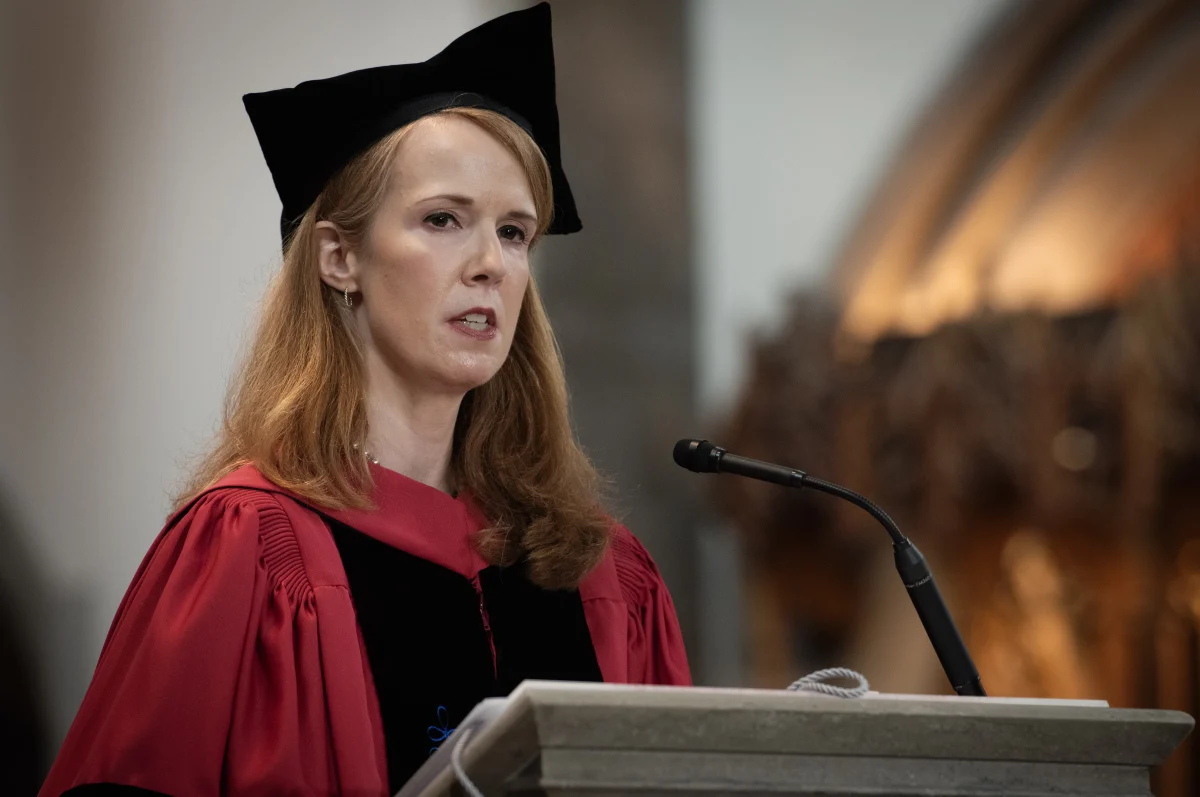
Alison LaCroix, the Robert Newton Reid Professor of Law at the University of Chicago Law School, will deliver the Convocation address for the Class of 2026. In addition to teaching, LaCroix has published two books: The Interbellum Constitution: Union, Commerce, and Slavery in the Age of Federalisms and The Ideological Origins of American Federalism. She sat down with the Maroon to discuss her writing process, her approach to reaching an undergraduate audience, and UChicago’s role as a place of serious discourse.
Note: This interview has been edited for clarity and brevity.
Chicago Maroon: Can you tell me about your positions at UChicago and outside the University?
Alison LaCroix: I’ve been at the University of Chicago since 2006, so 20 years this summer, which is a while, but it has not felt that long, which is a good thing. I started at the Law School in 2006 as an assistant professor, and then around 2010–11, I got a joint appointment with the history department. So, I’ve been here for that period of time, mainly teaching [at] the Law School, but I also have grad students [and] sometimes undergrads who take legal history and other courses. In the Law School, they teach constitutional law, federal courts, legal history, and various versions of those topics. Before that… I was finishing my history Ph.D. at Harvard [University], and, in my last year of grad school at Harvard, I was doing the Samuel [I.] Golieb Fellowship at [New York University] Law School, which is a legal history fellowship.
CM: Why did you end up moving from academic writing to books?
AL: It wasn’t really a transition for me because I’m a historian as well as a lawyer. Since history is a book discipline, the training that I had in my history Ph.D. focused on book production. Dissertations are book-length manuscripts, and most people revise and submit [them] for book publication. Sometimes, when you’re trying to tell a sustained story and give a sustained analysis and embed an argument in a story, you need just more scale. One of the things I like about books is that chapters stand on their own, but you can also tell a longer story with more of an arc. And, also, I think book writing affords more opportunity to try to do some literary things, which I aspire to as well.
CM: You recently published a second book. What was it like for you to turn this manuscript into a book?
AL: So I was finishing [my] Ph.D. dissertation for the Harvard history department when I was teaching on the Chicago faculty, which was an intense first few quarters doing both. I taught a seminar during the day and tried to finish the dissertation at night. When I was doing that, partly because I was already on the faculty, I thought the next step is for [the dissertation] to be a book because it will count in a different way as a kind of act of scholarship if it’s a book. The Ph.D. dissertation was important to finishing my Ph.D. training. You sometimes hear that [law schools] maybe just only want their faculty to publish law review articles; [that’s] not at all the case here. I spent a year or so doing pretty substantial revisions [on the dissertation], adding a chapter, and making it read like a book as opposed to a dissertation, and it came out in 2010. It attracted some notice, had some interesting reviews, including one I got to write a reply to in the University of Chicago Law Review.
CM: Usually, for the Law School [diploma ceremony], it’s a class of older students or people already in the workforce. What have you had to keep in mind when addressing the younger crowd of the College?
AL: [The] audience is really important. I remember my college graduation very, very clearly and differently from [my] law school or Ph.D. [graduations], where you aren’t sharing in the same way with a bunch of your college classmates… this incredible formative process together.
CM: How do you approach the process of writing an address like this? Where do you start? What do you observe first when you begin writing?
AL: I like stories. I like concrete details. Those are important to me. It’s not easy to give a graduation speech in any sense. One can think I have to lay down these fundamental truths from the mountaintop… which is nice to do, but I think it’s also nice to have a story or some concrete scenes to stay in people’s minds. Everybody has a lot of things going on that day… the excitement, the emotion, the logistics of herding family members and maybe dealing with weather…. And so, I think that’s a big part of how I think about speeches as well. You’re trying to create a picture in the audience’s mind that then leaves them with some idea or question.
CM: Was that on your mind as you came up with the idea for this convocation address?
AL: It’s a tough act to think about intellectually when you spend a lot of time reading 19th-century writing, because there was such a school of public speaking in the service of the republic. There [were] some great speakers and orators in the 19th century. I find [these orators] very inspiring to read because [they weren’t] always presidents and Supreme Court justices. You have people at county fairs getting up and talking about the Constitution. That’s a real sense of ownership about government and the system and democracy that we could use some more of. The sense that we’re invested in that project and we should be thinking and talking about it… I hope to bring a little bit of that to the quad.
CM: Do you think that there’s something missing with how people talk about the republic nowadays?
AL: It’s certainly part of the explanation for division. One thing to note is that 19th-century and 18th-century newspapers were partisan. People in Chicago or New York or Richmond, [Virginia], might have five daily newspapers, and everybody knew [the papers’] party affiliation or group affiliation. So, once upon a time, that was bemoaned: How do you look at the olden days when people were just reading something that was put out by their party, their team? I think we’re back to that. We’re reading those things, of course, much more in isolation. It isn’t as though people are sitting in a coffeehouse or a public square. [The news is] consumed individually. And that, I think, just makes people less able to share ideas.
CM: How do you view your audience?
AL: It’s all of us [with] that sense of investment, which can feel a little bit corny to say. It’s also an “if not us, then who?” question. That’s important to say to a younger generation, which I find myself now in a position [to say to] a younger generation. The sense of ownership, too. It’s hard to figure out what’s going on, and I think people in their teens and 20s have strong opinions, but also, they know that there’s a lot they don’t know; both of those things are important. Try to find out as much as you can but also know what you’re reading. Don’t just read stuff that’s just coming across the screen.
CM: I read your Law School address. You used a historical anecdote, and then you went into the rest of your speech. What is the value of anchoring something in history in that way?
AL: I just love history so much, [and] I think that enthusiasm for a topic can be very infectious, and that’s a good thing. Speakers should embrace that. I think there’s a real hunger for history right now. America in general is a conflicted place, [full] of division and even disagreement about what U.S. history is and what world history is…. I’ve always found that if you can come up with… not an analogy, because often part of history is saying, “Well, this thing that we think is similar was actually different in these significant ways,” but… thinking about other times of turmoil or moments when people have been courageous or have had to deal with difficult problems. I think that that can be both interesting [and] knowledge-producing. And frankly, it can give some degree of encouragement about where we all are and where we’re going.
CM: What would you have sought out in someone as a convocation speaker?
AL: What I would have wanted [in a speaker] was some sense [that] nobody has figured it out yet… something between a kind of reassurance and “look at everything you’ve achieved.” You’re sitting there, and you’re 21 or 22 years old. You’re not supposed to have everything figured out, and that’s all right. And it isn’t that you then have to go find your passion, because sometimes that can feel like a very high burden. Keep learning and find things you’re interested in and people who make you feel like the best version of yourself… and that will help you figure the rest out.
CM: Is there anything else that you think is important to note about the event or anything that you’re particularly excited for?
AL: I think it’s wonderful to have these sorts of ceremonies. It can feel a little bit like, “Why do we all get dressed up in medieval clothing and march around with bagpipes?” To me, that question answers itself…. It’s a rededication to a common purpose in a world that often says [that] thinking deeply and taking a minute to learn more is not valued, but those are the things we do. Sitting together in a beautiful outdoor space, surrounded by our gorgeous buildings and saying, “Yeah, this is what we do.”
CM: You’ve told me you can’t speak about it directly, but is there anything you can tell us about this year’s upcoming convocation address?
AL: I had the wonderful honor of speaking to the Law School graduates last year in Rockefeller [Chapel]. It was just such a phenomenal experience to look [around at] Rockefeller, seeing our students and their families. This is a similar opportunity with an even bigger stage [and] a bigger audience.
A convocation address is an interesting beast. People often remark that it’s an ending and a beginning, all of those sorts of things. But one of the things that I think really seriously [about] is [giving the speech] as someone who is a law professor and a historian. These are some of the biggest issues that all of us are facing right now, whether we’re lawyers (or one day hope to be lawyers) or historians or not. History is something that the Supreme Court likes to look at sometimes, and I think it’s [common] in the popular discussion: the Civil War, the [American] Revolution, certainly with the 250th anniversary of the Declaration of Independence, the 1619 Project, these contested historical events. Part of this [examination of historical events] is figuring out what they mean today.
CM: Is there anything else about the address that you wish to share?
AL: I think it’s [going to] be a wonderful day. It always is.