University Theater’s quarterly short play showcase features one or two performances, roughly 45 minutes each, often written by students. This quarter, the Francis X. Kinahan Theater (FXK) was host to a pair of well-crafted shows: The Burden of Burial: Sophocles’ Antigone Reimagined, a musical adaptation of Antigone written and directed by third-year Courtney Pine, and El Cepillo de Dientes, a 1961 play by Jorge Díaz, directed by second-year Senna Shultz. The Saturday performances were darkened by the news that several costumes had been stolen from the FXK the previous night. Despite this, the show went on—as it must, so they say.
The Burden of Burial follows the plot of the original Antigone play, which is driven by the juxtaposition between the duty one has to their family and to the law. This theme is demonstrated first by Antigone (first-year Ash Kim) as she attempts to illegally bury her brother Polyneices. It later returns with the King Creon (first-year Patrick Gaghan) and Haemon (second-year Julian Iverson)—his son and Antigone’s fiancée—as they must choose between protecting her and upholding the royal decree.
Pine’s lyrics, arranged by Emilio Del Angel—also the musical director and pianist—effectively draw out this theme in a clear, catchy format. Pine uses direct, contemporary language to crystallize her ideas without oversimplifying the terms of the show. For example, Antigone’s and Ismene (second-year Millie Walsh) often reiterated “three siblings … but now we have one” (and at the end, “…but now I have none”) keeps the focus on family and one’s duties to their siblings. The variation Ismene sings alone at the end is especially effective, since it concisely invokes both their family and the sacrifice Antigone made in its defense.
The five-actor cast successfully used the particular tone set in each scene to give depth to the complicated motivations and pressures affecting each character. Gaghan assumes Creon’s kingly stature, standing straight with his head held high to display the character’s pride. In many of his songs, he sings the same line about needing to appear strong as a king. As the consequences of his stubbornness worsen through the course of the play, his voice increasingly fills with more uncertainty at each repetition of this line. In the end, he sings it once more, only now with his voice heavy with regret for the foolishness which has left his son dead before him, completing his character’s development from unchecked pride to shameful humility. Iverson embodies the young Haemon’s inferior status to his father, making exceptionally clear the immense difficulty required to stand up to him. Standing next to or behind Creon, he appears slighter, needing to raise himself up fully and come forward to lock eyes with his father, representing his movement from subservience to resistance early on in the story.

Third-year Ariadne Merchant’s performances as Tiresias, Guard, and Messenger were especially compelling, as she was very successful in differentiating between each of these characters. When transitioning between the roles of the Guard and Tiresias, for example, she adjusted her stature from the young, nervous guard standing tall and quick on his feet to the older, resolute Tiresias in a more stooped and grounded position. Together, the actors drew out the thematic elements conveyed in their words, giving definition to each character and immersing the audience further into their world.
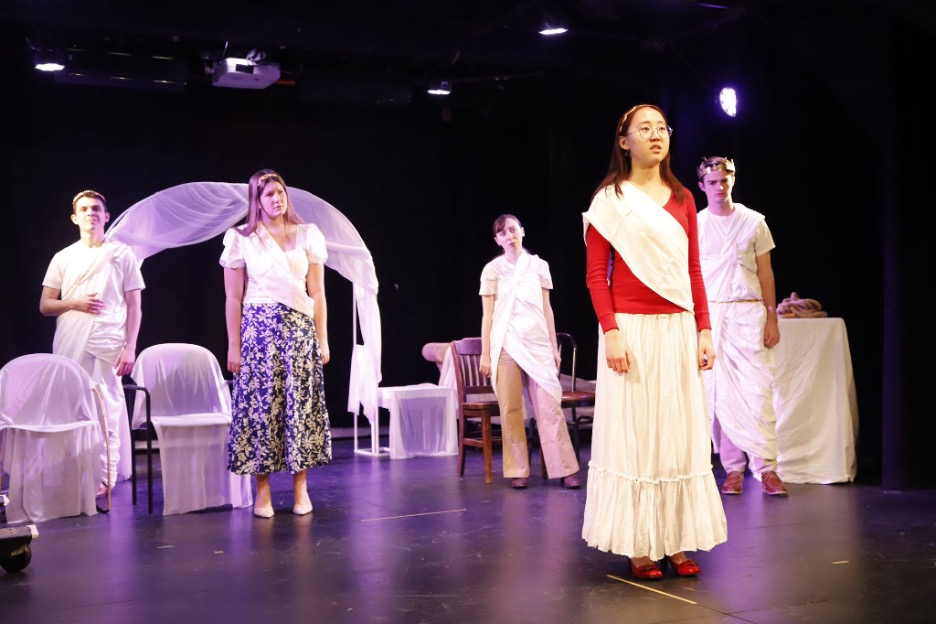
The set and costumes for this show were minimal, setting the action in a specific time and place without drawing attention to it. This allowed the audience to focus on the acting and writing, which were the strongest parts and central focus of this showcase, especially as a student-written production. Additionally, the actors remained seated onstage for most of their “off” time, giving them the opportunity to act in the background and become a living part of the set.
The only ineffective design choice was to set the show in the seating and archway of a wedding venue (differing from the original play, set in the front of the palace), overemphasizing the idea of marriage. While Haemon and Antigone are engaged, they could just as well be lovers in some other capacity without significantly altering the story, which isn’t really about marriage. As such, this choice of set was more distracting than conducive to the presentation of the show.
The second play of the showcase, El Cepillo de Dientes, is one of the earlier and more popular plays of Jorge Díaz, an absurdist Latin American playwright. It follows a couple referred to only as He (Greg Bound) and She (Genevieve Robinson) as they navigate the challenges of contemporary married life, morphing into different characterizations of themselves throughout the show.
Shultz’s direction created visual distinctions throughout the play, a difficult feat with a mostly static set and only minor time jumps. These choices codify the themes around the relationship of the two characters. When the play begins, the marital discontentment is clear: the two sit close together at the small kitchen table, yet stare into their own reading materials and speak dismissively to each other, showing their emotional distance. By contrast, when they act out correspondence published in a newspaper’s personal ad section—a moment in which they are much closer emotionally—they stand much farther apart. Finally, the act ends with the two of them in the closest proximity, but only because He is strangling She to death with a radio cord. Taken together, this blocking shows that the two are put off by their very closeness; sharing a toothbrush is what most repulses He.

By contrast, in the second act, she is dressed as Antona, the housekeeper that He is in love with. She dances with him to the music his wife hates, and the two of them actually look at each other. To reflect this shift, Shultz’s direction is inverted. Now, the characters act as expected: close in space when close emotionally, and distant when tensions rise. This new love is completely different from the deep connections of marriage—it is taboo and exciting. At the same time, the overt intimacy blocked between the actors in this scene creates an uneasy sensation to watch. He comes across as deeply unnatural, acting so unbothered by his recent murder to suggest sociopathy. We see the apparent closeness of lust but through these disquieting choices understand that the reluctant sharing of toothbrushes is the more morally correct alternative.
In the final sequence, the stage is emptied of all its furniture, and the two—no longer masquerading as a housekeeper or pen pal—scramble for each other in the dark, finally united. Their embrace brings closure to the blocking of the previous two acts, reuniting the original couple without the facade through which they have been living throughout the play. This final directorial decision concludes the play on a positive note, leaving the audience with the sense that, despite all the turbulence of marriage, it is also the thing which lasts until the end.
While Shultz’s direction effectively used the positioning of He and She to visualize how their closeness changes throughout the show, it was flawed during She’s first entrance and He’s moment of passion with Antona, which were blocked such that the actors lay on the floor. In the FXK, a theater with minimal raking and a stage already near the audience’s eye level, this action was impossible to see sitting behind the first two rows when the house was as full as it was.
Bound’s performance was witty and charming, lending an invigorating boyishness to a character who is often rather unpleasant. He walked with a bounce in his step and spoke in a manner which was both robotic and aware of its own monotony, highlighting the humor in that contrast. Robinson was vulnerable and intense, allowing the audience into the heart and mind of her character. She delivered her lines with urgency and directness, expressing every sentence zealously, as though she were just a bit aware of the audience, and sounding exactly the opposite of Bound’s deliveries. Together, they create a dynamic relationship between two very complex and hard-to-embody characters, executing the humorous notes exactly as needed while lending a compelling weight to the more sober and dramatic sequences. The serious observations of married life alongside the absurdist humor made the world of the show completely believable.
Jack Zirin-Hyman’s sound design was another welcome element to the absurd landscape of this play. The lives of He and She are interspersed with cuts to old-fashioned TV advertisements, the audio played on top of the actors speaking those same ads. Such interjections give welcome pause to the rapidly changing scene of the couple’s life, while reinforcing their dynamic and maintaining the absurd tone of the show. When He first brings up the toothbrush, the two jump into a Colgate ad, and their concluding argument begins with a disagreement over Dersa versus Ajax detergent. These moments, near the beginning and end of the show respectively, bookend the performance with sudden nods to idealized domestic realities portrayed on TV. Such nods create a stark contrast against the messy dynamic between He and She, serving as a reminder that their imperfections are their authenticity.
Together, these two shows highlighted the strengths of many different roles in the production process. The Burden of Burial was a vibrant presentation of an entirely student-written production, with rich lyricism and skillful acting giving new life to a well-known story. It established the short play showcase as a venue where original student creativity can shine. El Cepillo de Dientes then contrasted a well-known plot with a novel storyline, shifting the focus from the writer’s interpretation of a classic story to the actors’ and director’s interpretation of modern characters. These differing foci of the productions allowed them, in unison, to showcase effective blocking, characterization, writing, and design work, illuminating the impressive creative efforts of the students who brought them to life.