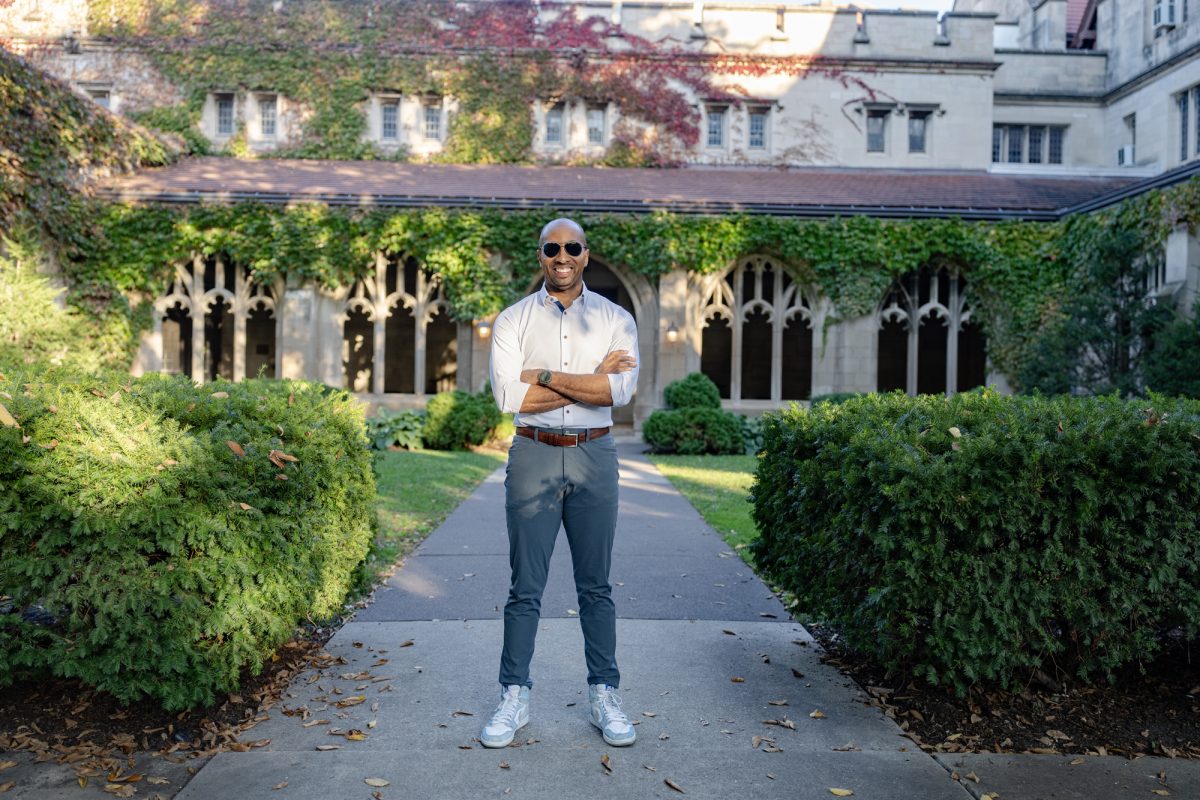
The Hyde Park Jazz Festival quickly became a beloved tradition for South Siders after it launched two decades ago. Festival artistic director Kate Dumbleton speaks to the Maroon about the critically acclaimed musicians returning home to celebrate its 20th anniversary later this month. Also, she discusses the history of Black music on the South Side and the relationship between jazz and democracy, which, she says, is often turned into easy comparisons.
This interview has been edited for clarity and brevity.
The first Hyde Park Jazz Festival was held in September 2007. You came on as the professional director in 2012—the first year the role existed—and you’ve been directing the festival ever since. How did you get the gig, and what excited you about it?
When I first moved to Chicago in 2006, one of the first things I did was go to the Velvet Lounge, I went to the New Apartment Lounge, I went to the Green Mill. I really wanted to immerse myself in the Chicago scene. I was really interested, in particular, in the Association for the Advancement of Creative Musicians (AACM) [a nonprofit organization started in 1965 by pianist Muhal Abrams and other Chicago musicians interested in musical experimentation and innovation] and the history of those artists, so that’s how I moved into knowing what was going on in Chicago. Then I was the executive director of the Chicago Jazz Ensemble, which was a big band that was resident at Columbia College. Columbia eventually defunded that organization as a part of some of their budget cuts at that time.
Right around that time, the Hyde Park Jazz Festival was encountering their first growing pains, if you will. They were so popular right away. They were a really volunteer-run organization, starting to feel like they needed somebody to help shape the organization and guide it into the future. And it just so happened that one of the people on my board at the Chicago Jazz Ensemble is one of the founders of the Hyde Park Jazz Festival. So, when the Columbia organization was being wound down, she said, “This is a perfect opportunity. Can I ask you? Would you be interested in joining the Hyde Park Jazz Festival?” And so that’s how I got the gig, so to speak.
You have this line in your bio that says you’re interested in the “interplay between composition (or structure) and then improvisation (emergence)” and in “why ideas, people, and systems organize.” Can you talk about how that thinking informs the festival?
I think the AACM is the root of how I started to think about this more expansively as it relates to jazz. I’m not a musician, though I’m certainly very, very interested in the music of the AACM. I’m super interested in [its] organizing principles and the idea of self-organization and mutual aid, that is, to create a combination of creative resilience and creative resistance at the same time. The AACM was resisting the kind of box of what Black musicians were supposed to be at that time [in the ’60s], in terms of jazz as a sort of marketing concept. As artists, they wanted to have access to any kind of form and any structure and not be placed in a sort of creative box or be expected to perform a certain way because they were Black artists.
And so, the entire structure of the organization, if you dig into that history, is really built on creating a sort of new structure for organizing around music that was a combination of supporting the individual pursuit of musicians’ own creative ideas within a collective identity.
People think improvisation is winging it, or what you do in a disaster, or when something doesn’t work. Yes, but it’s also actually a very formal process that involves individual practice so that you can listen to other people in real time and move something forward. It’s extremely creative, right?
I’m also wondering how the audience fits in. How, if at all, do you think the energy around the festival stays with people after? Do people carry it into other social organizations, into their work or their friendships, maybe, after the festival?
I think that improvisation is a worldview. It’s a value system. It’s a value proposition, because it’s about agreeing to bring your best self—and by that I mean your practiced self, your intentional self, your technical skills—to a group environment and being open to listening to the different perspectives on the stage. Now that doesn’t mean everyone gets along all the time. The best improvisers are provoking one another all the time if they start falling into a pattern, for example, or if they want to take it a different direction. Many of the most interesting jazz musicians are contrarians, right? They want to mess with something that’s flowing, but that’s because they want to take it in a different direction or add some new ideas.
I think that worldview is also kind of present in the music, because for many older generations, the music is—not to generalize—but it’s coming from a historical experience that has created an extraordinary creative art form that is an amalgamation of different types of music, but also the lived experience of the ancestors that have come before them. Inside of [the music] is an ethos and a set of values that I think is present in the audience’s worldview, the community’s worldview. That’s why I think Hyde Park Jazz Festival is particularly special, because people are showing up for the community part as much as the music part, and I think you can’t really separate them.
I was at a jam session and the host musician said, “This is not a democracy.” There was this respect for elders, more seasoned players, and also a kind of playful, tough love. That is also perhaps democratic—acknowledging people’s differences and creating a space where you aren’t thinking about yourself but your role in a larger group. What do you think of the comparison between jazz and democracy?
I get why people use that metaphor, and I think it could be helpful, but I think democracy is incredibly challenging as we’re experiencing now, and so is being on the bandstand with a bunch of other humans. [John Litweiler] proposes that the jazz and freedom or jazz and democracy concept really was, and is, about the right to argue and to have a voice. So that the space is really about the debate, if you will, and in particular for the pioneers of the music, a space where Black artists could participate in a debate or a conversation that was about who has the right to step in here and there, and whose voice is strongest. And all that kind of stuff was additionally a really political space, right? So, I like the idea of democracy being like a conversation about whose voice is dominant and making space for others, and the idea of the collective individual.
You have to make [the comparison] more complex than “it’s about us all trying to get along.”
I want to go back to the festival and ask about the diversity of artists. You have big names like Emmet Cohen and Joshua Redman, and you have emerging artists like Skyler Tang. How do you gauge what people will be excited about? And when you select an artist and you give them a space to play, you’re contributing, I think, to the cultural conversation around jazz and around who’s worth listening to. How did, this year, those things factor into the final lineup?
When I hear something or I think about something, I try to keep it super grounded in the history, also because, especially for Hyde Park, the South Side context is so incredibly important.
There are tons of artists I would pick for a different festival that I wouldn’t have in Hyde Park because I do try to keep everything pretty tethered in some way to Chicago and specifically Hyde Park. By that, I mean some kind of thread—historical thread, or conceptual thread, or narrative thread. The South Side and Chicago have an extremely diverse history of trajectories of this music, and so there’s a lot to choose from, right? It’s very broad, from super experimental to straight ahead to all the Afro-diasporic Latin music and these different extensions of how jazz has played out in Chicago. So, if you look at the programs over time, you can see those connections, I hope.
For this year, I wanted to really think about the festival’s impact. We wanted to highlight some of the musicians in particular who were playing when they were pretty much little kids in 2007 or 2009 or whatever, who’ve gone on to be super internationally renowned musicians. So, the 20th anniversary band is some of those folks. When I first started, Makaya [McCraven] and Marquis [Hill] and Junius [Paul] had been to the festival a bunch of times. Tomeka Reid, when I first started, she was so shy. Now she’s this superstar. Same with Nicole Mitchell and Corey Wilkes. There’s just a lot of folks that have come through the festival, and we wanted to kind of lift them up and sort of point out what the South Side has done and what Chicago’s done to contribute to the music.
And, of course, Joshua Redman. I heard him play solo in a cathedral—must have been 30 years ago, 25 years ago—in San Francisco, and it stuck with me forever because it was really, really beautiful. He’s a hard artist to get. I didn’t know if he would say yes to it because he doesn’t do solo so often, but I was like, “Let’s just try and see what happens.” And he said yes.
You’ve mentioned the importance of the South Side, and there’s a lot of history that’s buried here, the Sunset Cafe where Louis Armstrong played in Bronzeville, all these places that no longer exist. It seems to me that this idea of returning home for these Chicago artists is a way to document history and make sure that you don’t have this cultural layer that gets covered up. Do you think about the legacy that the festival will leave, or about how to give the chance to artists who go on to larger sorts of acclaim a chance to show people how they care about this place?
The Hyde Park Jazz Society started because the clubs were all closing and they wanted to create some kind of platform, and they were the ones that really started this festival as an extension of that to caretake for the music.
You’ve already said this, but we’re not only preserving a legacy, we’re also, I hope, catapulting it forward too, because the music is there; it’s living. And these artists that we’re bringing home are a perfect example of what that looks like. And it looks like a lot of different types of practice. What Tomeka does is so different from what Marquis does or what Makaya does, you know, but they play together sometimes in different projects. They’re linked up by their investment in this larger community. Preserving the platform is so important [for] the legacy of where we’ve come over the last 20 years, but also for the future of the music.
The whole idea of this year is to celebrate this, as you said, coming home, which is a lovely way to put it, and also to celebrate what these artists have done. And to point us in the future for the next 20 years. I would say I think jazz is having a moment. I do. There’s just so many directions that the musicians are taking it, and I think your generation is listening in new ways to it. Some of the people I see coming up and coming out—there’s a lot of young people that are interested in it for a lot of different reasons.
Regarding funding, I know you guys weathered the COVID storm. UChicago also slashed funding for the festival by 90 percent from 2022 to 2024. More recently, the National Endowment for the Arts (NEA) cut funding. There was triumphant reporting last year about how the festival came through, and there was a larger-than-ever turnout. Could you reflect a little bit on what lessons you learned from that?
I think one lesson was just that the community loves the festival. I mean, I already knew that, obviously, but it was so overwhelming how many people turned out. You know, when we lost the NEA grant, we did a matching [fundraiser]. We sent a newsletter saying we have a match, and we’re trying to [fundraise] the other half. And in no time flat, we had met the match, and it was people donating everything from $5 to $500 to $1,000—it was like everyone doing whatever they could, and so that was just so beautiful to see.
We’ve worked really hard to build a savings account and be financially resilient as much as possible. And we have a really highly adaptive organization—in part because many of the people that work there are musicians, so they are improvisers.
Let’s talk about the “listening sessions” in this year’s program. Are they new, and what was the impetus behind them?
The listening sessions are new as a concept, though we often have programs in the screening room that are lectures of some sort or a panel. So that part we’ve been doing for a long time. I wanted to do listening sessions this year, just as the idea of having space for people to get a historical context for something and then to be able to hear the evolution of that or talk about the music in a way that is grounded and facilitated, if you will, rather than only [attend] concerts.
In particular, there were some cool things that were historically relevant right away, like the 100th birthday of Oscar Brown.
And in my own personal research these days, as I’ve spent a good amount of time in New Orleans in the last couple of years, I’m very interested in the musical roots. Donald Harrison, he’s a Big Chief, and his family is extremely important in New Orleans in the cultural history of Black Masking Indians. [When Black New Orleanians were shut out of white Mardi Gras parades in the 1800s, Black Masking Indians began their own celebrations with traditions passed down from African, Afro-Caribbean, and Indigenous communities.] His father was an extremely important Big Chief…and he has a film about his family called “Guardians of the Flame.” Then he’s going to talk about the tradition, and put on some of the musical concepts.
I used to think in the beginning, “I don’t know if people are going to go to a talk when there’s so much music,” but they’re always full. So I’m expecting them to be well attended this year too.
Anything else that you want to add?
All of us involved in the festival are so grateful to the musicians and to the community for showing up for 20 years, and we just want to put on a great festival to say thank you, and to honor the music and to support the musicians. And especially in this really complicated political time and a very hard time for the arts, just to be like, “We’re still here, and we’re doing great stuff.” Be joyous, be in community, and enjoy one another. It’s so urgent for us to do that for the future, to be in community and to enjoy one another and celebrate this insane creativity that these artists put on stage.
The Hyde Park Jazz Festival will take place on September 26 and 27 at locations across Hyde Park. Attendance is free, but a donation of $10 is suggested.