Saturday, October 10. 10 a.m. 25 hours until selection.
Olin:
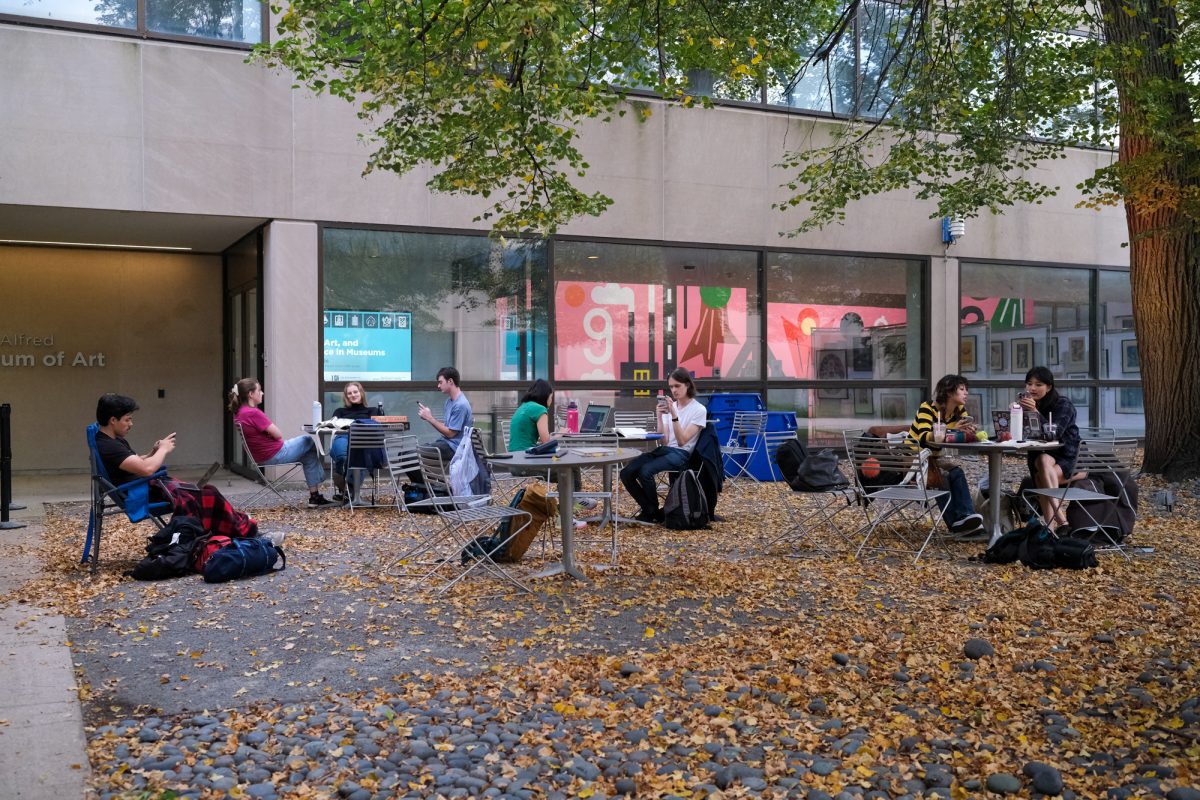
I arrived at the Smart Museum of Art early Saturday morning, armed with a laptop, two notebooks, my camera, and a copy of Thomas Hobbes’s Leviathan, aiming to catch up on the 40 pages of reading my professor had assigned for Monday. Given my (admittedly academically unproductive) experience at last year’s Art to Live With, my confidence in my own reading abilities during the night was perhaps a bit misplaced. On the other hand, I had little reason to believe that anyone else would show up until at least late afternoon, so I didn’t expect too many distractions.
The rules of engagement in Art to Live With are somewhat abstract, as the act of spending the night is technically not allowed—at least, anything that might resemble a political encampment to touring passersby. Instead, groups of students independently choose to study at the tables outside the museum, and, by complete happenstance, end up spending so much time socializing there that they remain in place until a reasonable hour at which they can assume their places in line before the doors of the Smart open.
It’s for this reason that a covenant must be formed between the earliest of arrivals. Unable to take our physical places in line, we are forced to trust that we won’t cut each other’s rightful place in the queue when the time comes.
Hobbes doubts the effectiveness of covenants without a strong leader to keep those that make them in check. I doubt his faith in his fellow man.

Saturday, October 10. 4:38 p.m. 19 hours until selection.
The number of my comrades who also chose to study outside the Smart has jumped from three to 10 in the span of an hour. Violet—Number Eight—is the only face I recognize from last year. She writes down the names of new arrivals in order, marking their place in line, along with their chosen piece, to give newcomers an idea of their options. I proudly tell her that, as the second student to arrive, I’ll be taking home one of the two Picassos that are on display. I tell her I have always been a fan of Picasso’s interwar period. I spend the next few hours reading up on Picasso’s early career.
Hobbes sits at the bottom of my backpack, untouched.

Saturday, October 10. 8 p.m. 15 hours until selection.
A group of first-year students has colonized the small hillside opposite the entrance to the museum, their sleeping bags and blankets sitting idly by as they chat about which book of the Iliad they’re avoiding.
Boris:
My pursuit is not for a work of art. I haven’t even looked at the available pieces yet. My ambitions are for something far greater: a sticker with the phrase “Group 1” printed on it, a title reserved only for the first 15 students to arrive. If such a thing exists, this is the in-group of the evening.
I had the honor of being in Group 1 last year. I was Number Seven, even. When I got back to my dorm, I stuck that sticker on my wall before even trying to hang my Chagall.
This year was different. “You’re 18th,” Number Eight told me when I arrived. How could this be? I arrived an hour earlier than I did last year, but had still fallen into the dreaded Group 2, cementing myself as an Art to Live With “normie.” I had already known I was not as ambitious as my Picasso-pursuing co-writer, but now I wasn’t even of the same class.

Saturday, October 10. 11:46 p.m. 12 hours until selection.
Olin:
A steadily expanding circle of second- and third-year chemistry students has been working its way through problem sets assigned over the weekend. Two members of the group hold phone flashlights to illuminate the papers of their companions.
On the front wall of the museum, Boris and co. have managed to prop a projector on top of a few stacked recycling bins and are scrolling through Instagram Reels on the museum wall, to the amusement of the 10 or so members of their audience.
Boris:
I may not have gotten the sticker I wanted, but at this moment we are still free to hang out wherever we’d like in the area, our spots protected by a list and an agreement not to cut in front of each other. In this moment, we are all equal, giving me the freedom to interact with the members of Group 1 that I so strongly yearn to be a part of.
I gather with Numbers Two, Three, Four, Eight, 19, 23, 25, and 26 to watch Chain Reaction, a film in which Keanu Reeves discovers an infinite energy source by playing the right note on a keyboard (set in UChicago, of course). Afterward, we watch Instagram reels from Four’s account. There’s real bravery in sharing your Reels feed—what one might consider a gateway to the most inner part of your soul—for the entertainment of others. Numbers Five and Six are studying together, trying not to be distracted by 9–13 and 25’s game of Secret Hitler. 14, 21, and 29 nap on the grassy hill behind us while Number One paces in circles around the courtyard in deep thought.
Sunday, October 11. 1:30 a.m. 10 hours until selection.
The social contract, organized through a simple list of arrival times, that once felt so strong must soon begin to fray. Thirty-five students have now arrived, and people begin to worry if Number 36 will respect the rules that have been set in place. If not 36, then surely Number 37 will be the one to rush to the doors and attempt to claim victory by proximity. “You weren’t technically in line, so I deserve the Picasso,” he will say. Soon we will need to protect our place in line, not by agreement, but by force.
I settle in and begin my reading for the night, On Religion: Speeches to its Cultured Despisers by Friedrich Schleiermacher.

Olin:
I remember laughing only hours before at Number 13 when I saw him arrive with his cardboard boxes, flattening them out to make an improvised futon. I laugh no longer; my back aches from the hard, cold concrete, only separated from it by a blanket covered with Josh Hutcherson’s face. I try, in vain, to sleep.
Sunday, October 11. 2:45 a.m. 9 hours until selection.
Boris:
The three-headed Leviathan of One, Two, and Eight assumes its rightful place and attempts to organize us into a line. “We can’t keep track of this list for you anymore,” they say. I begin to settle into my place in line, but many from Groups 2 and 3 resist. “We’re agreed on the list, nobody’s going to take our spot.”
One rests on what looks remarkably similar to a sleeping bag. “Hey, they’re not supposed to be camping,” 42 and 43 say. Even if One was awake, their voices are too far away for him to hear their objections. This is the divine right of Group 1; to show up only an hour ago and question someone who’s been here for 20 would be absurd.
Sunday, October 11. 3:45 a.m. 8 hours until selection.
I’ve begun to appreciate the lowly Group 2. Maybe we aren’t the most committed, most honorable students ordained to get Picassos and Murakamis, but Group 1 is by now fast asleep. We, on the other hand, draw, laugh, and socialize in our metal chairs while the three-headed Leviathan appears to sleep in its cotton throne.
Sixteen checks us in, two at a time, into Max P to use the restroom. The 10s and 20s are very kind; I wonder how many unique people and interactions I missed last year because I didn’t make the time to walk down the line to Group 2. I wonder how many interactions I will miss this year because I’m too busy with Group 2 to talk to Groups 3, 4, and 5.
I look at the art available for the first time. I reckon I like The Blue Cat by Max Kahn.

Sunday, October 11. 4:50 a.m. 7 hours until selection.
Olin:
When I awake, the air has shifted. No longer are there amassed groups of individuals, melting and reforming into new social circles as they so choose. The once-mighty chemistry study group has dwindled to just two, with only one still awake and working. The first-years on the hill have taken to their sleeping bags, curled around one another like worker bees huddling around their queen. A few stragglers have realized that the list is nothing but words without a sword to defend them, and they sneak ahead of those scattered around the courtyard without consequence.
It is no matter to me. My spot in line will not be challenged.
I join Number Eight and the card players in their game of rummy. “This music is too calm,” Number Eight says matter-of-factly. “We need hype music to stay awake.”
I suggest Bad Bunny.
Sunday, October 11. 5:30 a.m. 6 hours until selection.
Boris:
I am awoken by “BAILE INoLVIDABLE.” I was asleep for approximately 45 minutes, but I’m strangely not tired. An air of excitement or perhaps psychosis begins to build among the 10–15 students that are awake.
It is at this moment that we enter a state of communitas, a liminoid space where we cease to be students at the University of Chicago with Goldman Sachs internships and GPAs and p-sets due. In this moment, we are simply people, joined together by sleep deprivation and leftover Jet’s Pizza.
Sunday, October 11. 6:57 a.m. 5 hours until selection.
Sunrise. I don’t need to look around the corner to watch it. Each number—no, each person—in this line encapsulates the universe in a way as beautiful and complex as any sunrise. The sun rises every morning, but we will only be together today.
“Space and mass do not make up the world… to seek the infinite in them is a childish way of thinking,” Schleiermacher wrote. “Is not the most limited body just as infinite in this respect as all those worlds?”
Olin:
It was at this point a year ago that the previous Number One, Will, confessed to Boris and I that he was close to breaking. The air is cold. The ground is colder. Sleep-deprived and irritable, I do my best to shut out the sounds of reggaeton beating across the yard and focus on how Hobbes tells me that, unlike bees and ants, we will never be able to peacefully coexist with our fellow citizens. Humans, he says, with our boundless lust for honor and power, will always choose personal interest over what is better for the group.
The first-years remain on the hill, unafraid of the prowling upperclassmen who filter through the gates, snatching up empty spots in line. They trust the covenant, the promise we made when we arrived, that we lay down our liberty to steal another’s spot in exchange for the guarantee of a spot of our own.
I find myself wondering if Hobbes might have underestimated the true nature of man. Are we really as inevitably self-serving as he claims?
Sunday, October 11. 9 a.m. 2 hours until selection.
Boris:
We begin to line up not out of fear, but excitement. “What number were you?” 62 asks. “Ok, so I must be back there.” Sixty-one and 63 wave their hands upon hearing the conversation, signaling 62 to his place. Through a mostly cordial process, students find their place, choosing to uphold the social contract set by a simple sign-up sheet from hours earlier, rather than push and shove for a Picasso or Chagall.
Event organizers appear. They are kind, and they can’t help but ask why we decided to stay here on the concrete “not camping” all night. I think about explaining that if any of us weren’t here—from Group 1 to Group 5—that the micro-society we have formed would lose a crucial part of itself. Without Number 43, who would play cards with 36? Without 17, who would 53 and 55 spend the night getting to know?
“We just really want the art,” I reply.
At this moment, I wear my sticker that reads Group 2 with pride. At this moment, I understand that every sticker—every group, 1 through 10—is deeply important. I realize now that I loved the Group 1 sticker that was displayed proudly on my wall all last year not because it represented a great accomplishment, but because it reminded me of the people with whom I spent that lovely night.
“[E]verything human is intertwined and made dependent on one another, I see that, according to their inner essence, all individuals are necessary supplements to the perfect intuition of humanity,” Schleiermacher wrote.
Olin:
“How long have you been here?” the photographer asks Number One.
“Eight,” One says, exaggerating his arrival time by a couple of hours.
“That’s not too bad.”
“8 a.m.,” I clarify, not feeling quite gracious enough to discount the hours I spent on the cold cement.
“Oh.”
It is now that I come to the realization that, in wasting so many hours sleeping, so many hours complaining about the cold and my reading of Hobbes, I forgot the real reason I returned to Art to Live With. In the eight months I spent last year with L’Étoile Matinale, I probably could have counted the times I looked at it—really looked at it—on one hand. I am no true seasoned connoisseur of art, I must admit.
I should say that I don’t regret the choice I ultimately made. I admire Picasso’s body of work greatly, and the lithograph I now have hanging above my desk is nothing short of incredible. When I return to my dorm room every afternoon, I look upon Man and Woman with a sense of pride. It reminds me of the disparate, small, and impassioned group of individuals who were willing to forgo sleep for a night just for an original piece of artwork.
But I would have been just as happy with any other artwork. The night is the experience. The art is little more than a treat for our troubles.

Sunday, October 11. 12 p.m. 1 hour after selection.
Boris:
I opted for Crak! I don’t know much about Roy Lichtenstein, but Olin said it was a really cool piece.