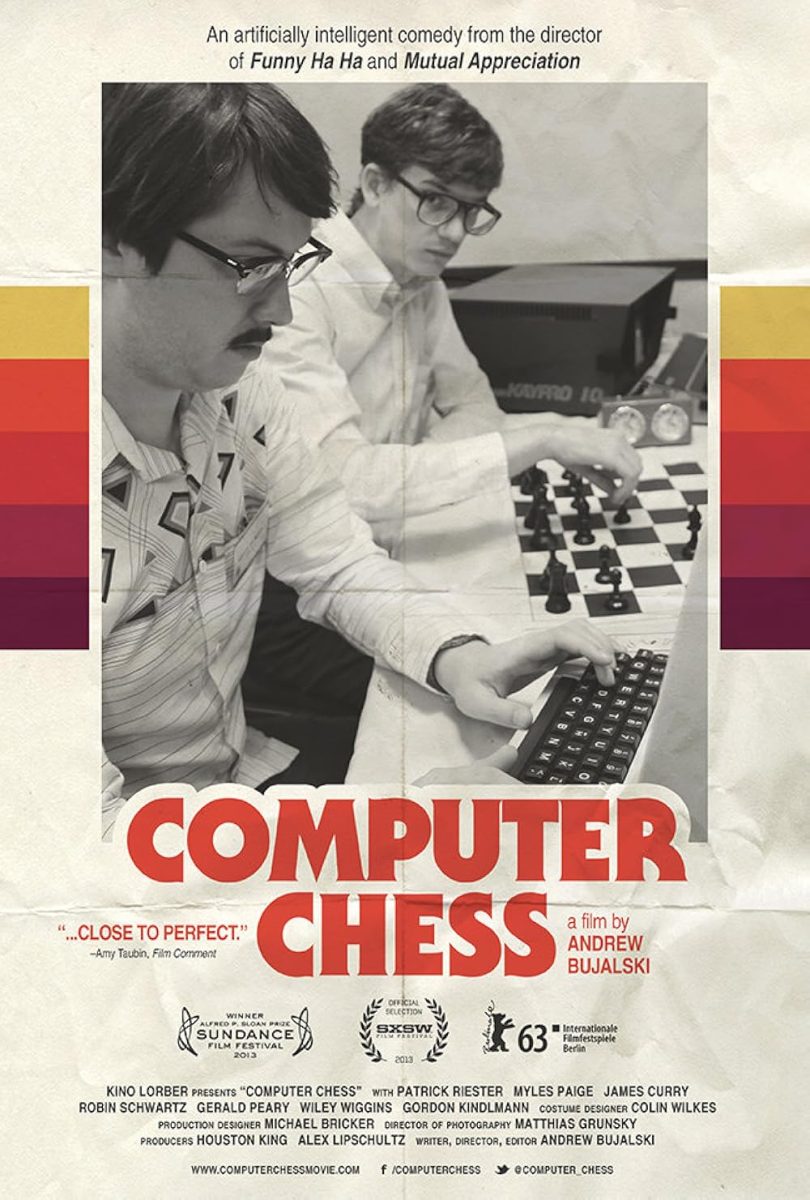
A few minutes into Computer Chess, I realized I might be the worst person to review this film. I was watching a bunch of ’80s tech nerds talk about when a computer might beat a grandmaster in chess (so far, so good). Then it cut to an analysis of a program failing to identify an obvious forced queen-takes-queen. In my excitement to watch the film, I’d forgotten that I don’t know a thing about chess.
But that ignorance would prove to be no hurdle in understanding a film with humanity in its sights. Written and directed by Andrew Bujalski, Computer Chess is a 2013 experimental film that follows an annual computer chess competition at a remote hotel, which also happened to be hosting a spiritual couples therapy retreat. After Doc Films’s screening on February 5, Bujalski held a Q&A with cast and crew member Gordon Kindlmann, an associate professor in computer science at the University of Chicago.
Doc Films, screening in collaboration with the Year of Games committee, pitches this movie as “uncannily prescient” in today’s landscape of rapidly advancing AI and the resulting maelstrom of humanist discussion. But more than that, Computer Chess uses the serendipity of a hotel conference to spotlight the love and care that are sidelined when our egos and our technology collide head-on. The heart of Computer Chess lies in the connections not only between the competitors and their computers but also among the lovers. Humor, awkwardness, and scenes of bread-fondling aside, the couples are more than a cheap punchline as we watch tender moments of connection unfold between them and between their nerdy counterparts.
At the beginning of the film, we see a videographer chastised for trying to film the sun, lest it burn the cathode ray tubes—this is one of the cameras used for the actual footage. The film’s self-awareness is the key factor that transmutes it from another insufferable watch about men and their shiny new tech into a warm, thought-provoking, funny homage to the love of the game: playing chess, programming, and living for the sheer joy of it.
The philosophy behind the making of Computer Chess aligns with its messaging. In the Q&A moderated by Year of Games committee member Patrick Jagoda, Bujalski described the film as “an impossible project,” no thanks to its highly experimental process. Computer Chess had less of a script and more of a jazz-style lead sheet. This choice, in combination with casting a real computer scientist (Kindlmann), built an environment that allowed improvisation to add texture to the scenes, rather than detract from the audience’s immersion. The bits of awkwardness, rambling, and offhand comments become a welcomed dissonance for the two subcultures—computer nerds and hippies, alike in their unintelligibility to outsiders.
Shot on three temperamental Sony AVC-3260s, there was no guarantee that any footage from the cameras would be workable. But the risk was worth it. Filmed in black and white (save for a small blip of color in the one scene away from the hotel), high-contrast with a touch of cathode-ray fuzz, Computer Chess feels like a too-real fever dream; a too-bright, cloudless afternoon; or waking up from a too-long nap. Hints of the cameras making their mark create double vision, like staring at something until your eyes blur. Doc Films screened the only existing 35mm print of this film and scratches in the print dance with the rest of the glitches. Some of these artifacts may have been an inevitability of the medium, but their appearance feels neither accidental nor gimmicky.
Near the start of the film, a mockumentary-style interview presents us with the familiar sentiment that this new technology portends the end of the world. Later on, a conversation between the competitors touches on the military-industrial complex and the militaristic nature of chess itself, prompting one of them to say, “War is death, hell is pain, chess is victory.” In the face of doom, he grounds himself in the enjoyment of chess. There, watching a vignette of this no-name hotel, emboldened by the surreal quality of the film, I too dared to shift my focus away from that ubiquitous anxiety and toward the various pursuits of passion that brought computer programmers and free-spirited couples to the same place.
The programmers in Computer Chess ask, “Can a computer beat a human at chess by 1984?” The couples also seek something beyond themselves: to activate their full human potential, whatever that may be. Computer Chess refuses to answer these questions directly. Choosing not to set a benchmark or tell a success story, it instead turns its three capricious cameras toward happenstance.
What happens when something doesn’t turn out as planned or desired? What do we do when the computer seems to sabotage itself during a chess game—do we blame the machine or a human error during coding? And what happens when the computer-chess nerds and the bohemian couples end up sharing one conference room? How should you respond when a swinger couple invites you into their hotel room?
The realm of happenstance—or kismet, as the swinger couple might put it—is rife with egos colliding and negotiating, wrestling to assert themselves, or shrinking to make room. Maybe we deny that the computer could have developed a preference for human opponents, while at the same time insisting that we’ve programmed it intelligently enough that it could learn from all its past experiences. Maybe we visit the couple’s hotel room, just for a little, just to say, “Hi,” because it would be rude to refuse such an offer.
The one character I can’t square with the rest is chess programmer Michael “Mike” Papageorge, played by Myles Paige. Bearing the brunt of most misfortunes and singled out from the start as an idiosyncratic figure, Mike is primed to become a subject worth exploring, especially given his poetic philosophy of programming. He is certainly competent enough, and his computer performs well in the competition, but possessing the most mediocre (read: slimy) of personalities, his character feels static. Everyone else seems involved, open to challenges, and ready to give back as much as they take. His extractive behavior in the face of one mishap after another reads as if his only trick is calculating how much he can get out of any situation, and this one-note character stands out harshly against the fuzzy complexity where Computer Chess works best.
The promised chess match between human and computer is entirely derailed, or perhaps rerouted, by the two events as they jostle to coexist with one another in one room. The human flips the board in frustration before any decisive move has been made. Perhaps emotions are the weak link, the fragile human ego no match for machines. Or perhaps the machine is easily rendered useless, stuck in an incomplete game that provides its sole purpose. Regardless, Computer Chess denies us the resolution of knowing who would have or could have won and instead turns our gaze toward life unfolding in its fortune and folly.
In the final scene, the videographer films the sun anyway; we can catch a glimpse of the damage, an eye floater of a glitch. In lingering on process and passion, Computer Chess comes closer to answering that age-old question of what it means to be human than defining us by our irrationality, or any similarly effable reply, ever could.