


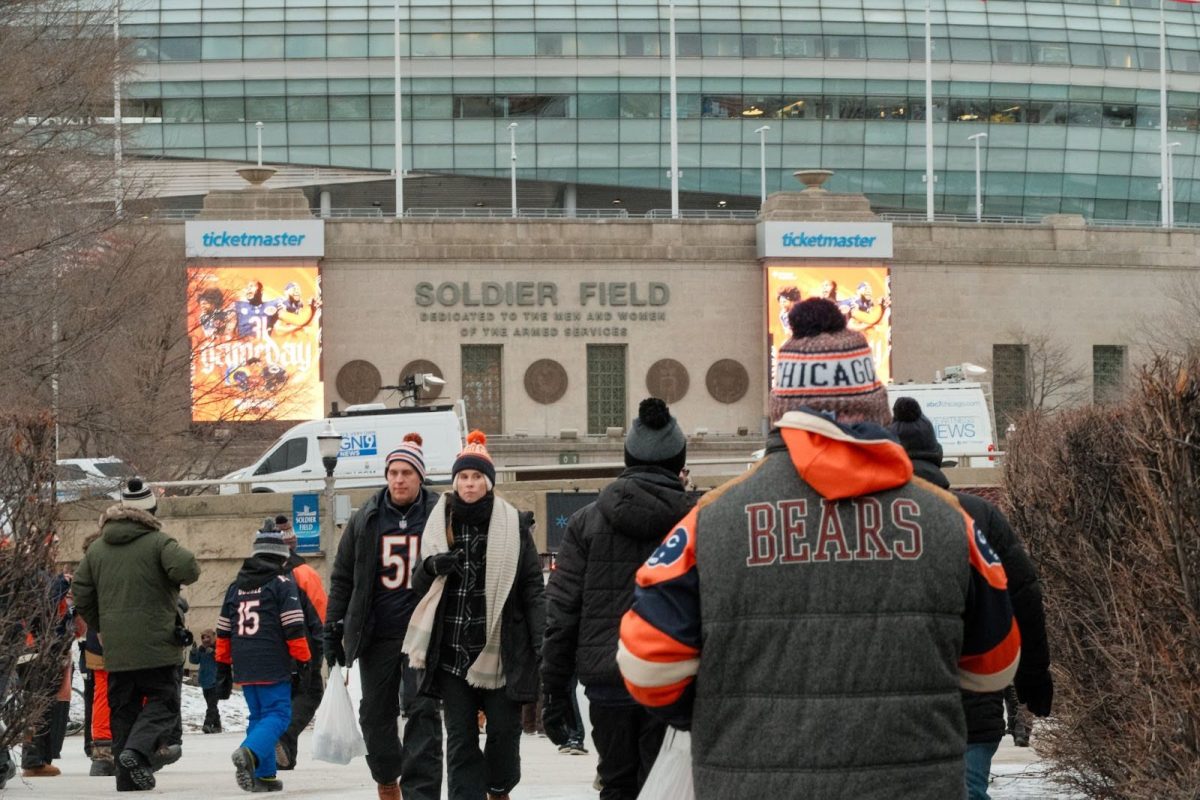
For Chicago Bears fans, Soldier Field is a monument of grit and tenacity that could only belong to a fanbase that hasn’t seen a Super Bowl win in 40 years. The neoclassical stadium, which became the team’s home in September of 1971, is a Lake Michigan landmark, and has since hosted legendary teams like the 1985 Bears.
Despite its storied past, however, this iconic part of Chicago sports will most likely no longer be the Bears’ home. The Chicago Bears organization has been making a push for a new stadium since Team President and CEO Kevin Warren wrote an open letter to fans, stating that “in addition to Arlington Park, we need to expand our search and critically evaluate opportunities throughout the wider Chicagoland region, including Northwest Indiana.”
The open letter materialized following reports that the Bears were seeking $885 million in public funding to support the construction of a new stadium after Illinois lawmakers had previously refused this request from the Bears organization. At the time, the mention of expanding the search to Northwest Indiana was something Bears fans balked at. However, on February 19, Indiana governor Mike Braun wrote on X, “Indiana is open for business, and our pro-growth environment continues to attract major opportunities like this partnership with the Chicago Bears.”
The statement by Braun came after Indiana lawmakers unanimously passed Senate Bill 27, which sets up the framework for the Chicago Bears to build a stadium in Hammond, Indiana. The proposed site near the Wolf Lake area is roughly 27 miles from the Bears’ current home. While the physical distance is not overwhelming, the difference in region and cultural identity is stark, as the proposed site is far from even the most southern parts of Chicago.
Despite this news, many Bears fans have still been clinging to the hope of staying in Chicago, as Soldier Field is a core part of the identity of the Bears fanbase. Yet, when Illinois governor J. B. Pritzker said in a press conference that he was “very disappointed” after the Bears released a statement endorsing the work done in the Indiana legislature, alarms began to sound that a Bears relocation was imminent. No Chicago sports fan wants to hear the Illinois governor acknowledging uncertainty about where the team will end up.
However, the Illinois legislature made a renewed effort to keep the Bears in the state. On February 26, the Illinois House Revenue and Finance Committee advanced a “megaprojects” bill. This bill outlines the ability for the National Football League (NFL) team to negotiate tax breaks in order to break ground on a new stadium in Arlington Heights. Chicago fans shouldn’t get too hopeful, however, as the Illinois House adjourned until April 1 without any further action on the bill.
So, what does this mean for Bears fans? Besides the relentless back-and-forth between two state governments and one stubborn NFL team, these relocation plans signal the end of an era for the Chicago Bears.
As the oldest stadium in the NFL, Soldier Field has seen many eras of a storied Chicago franchise, both good and bad. Though it opened in 1924, predating the high-flying “Monsters of the Midway” of the ’40s, Soldier Field got its first taste of the Chicago Bears in the ’70s, an era marked by rebuilding and general mediocrity. It did, however, accommodate the “Super Bowl Shuffle” team of 1985, with franchise legends like William “The Refrigerator” Perry, Mike Singletary, and “Sweetness” Walter Payton.
Since then, the stadium has mainly seen decades similar to that of its inaugural seasons in the ’70s: constant “rebuilding” against the backdrop of poor performance. Only recently has life been injected into this struggling franchise, brought forward by a quarterback who chooses a pre-game drink of matcha, not protein smoothie: Caleb Williams.
This reinvigoration has led to more excitement, but the newly invested fans have now been struck in the face by relocation plans. For newer Bears fans, of which there seems to be a notable increase due to the popularity of players like Williams and Colston Loveland, the move may seem like an unnecessary stadium goose chase.
However, the reasons behind a possible stadium change are something that Chicago locals know all too well, as Soldier Field is often ranked as one of the worst stadiums in the NFL. With its age and limited seat capacity, the stadium change may be unwelcome in Bears fans’ hearts, but not in their minds.
The Chicago Bears have not made commitments to Arlington Heights or Indiana, but it is abundantly clear that a new era of Bears football is coming.

GarbageMan / May 8, 2026 at 6:35 pm
Didn’t UofC students Leopold and Loeb dump the body of their victim in the Wolf Lake area? The site between Hammond and Gary next to the Borman expressway provides better access for Bears fans.
Alum / Apr 7, 2026 at 6:47 am
Bravo! This is sports journalism at its finest, and this is by far the best article I have read in the Maroon…perhaps ever. I attended the University between 1988-1992, so I was there during the reign of Ditka ((I actually read the Armand Kateyin biography of Ditka in the coffee shop in the basement of Cobb, much to the bemusement of many), so I feel how much the Bears mean to Chicago. It would indeed be a shame to no longer have Soldier Field as the home of The Bears, but the author does a magnificent job of explaining why that sad possibility may come to fruition. Keep up the great work, and I look forward to reading your future stories, which hopefully will include articles on Major League Baseball.