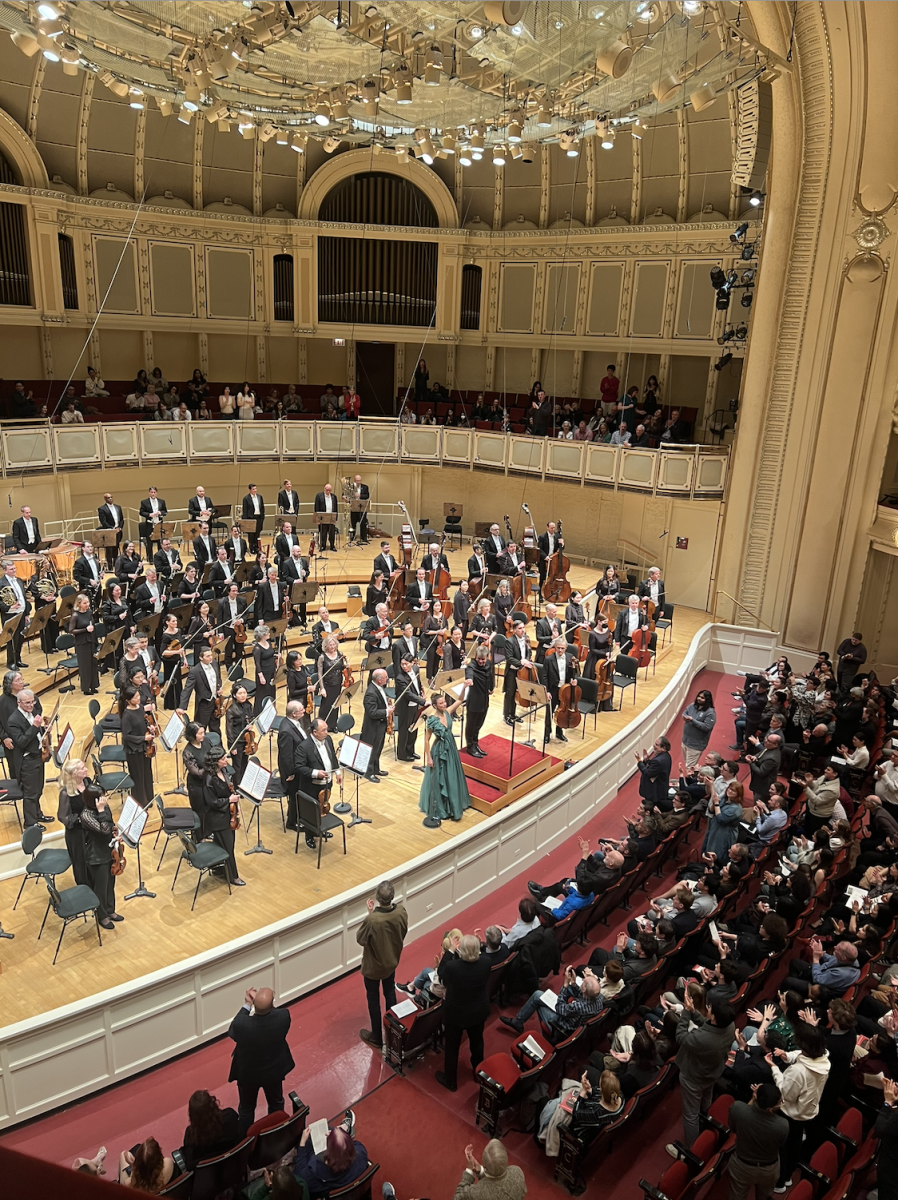
On April 11, guest conductor Jakub Hrůša led the Chicago Symphony Orchestra (CSO) in a powerful program centered around themes of mortality and existentialism. He was joined by up-and-coming soprano Corrine Winters in her CSO debut.
Hrůša, who has recently become one of the CSO’s most popular guest conductors, showed himself to be a masterful program curator. This concert, titled “Songs of Love and Farewell,” brought together music from a wide variety of musical styles, including opera, programmatic music, and lieder.
The evening began with the overture to Czech composer Leoš Janáček’s opera From the House of the Dead, based on Dostoevsky’s novel, The House of the Dead, which portrays life in a Siberian prison. Hrůša, a Czech native, is one of the world’s most in-demand conductors of Slavic repertoire, which he performs at major orchestras around the world. This was immediately made clear by his commanding presence on the podium; he seemed to have complete control over the large ensemble, navigating the complexities of Janáček’s score with precision while making a less familiar piece sound engaging and intriguing.
The rhythmic tugging of the violins that opened the overture was fiery and emphatic, evoking a sense of urgency and desperation. Concertmaster Robert Chen delivered a precise rendition of the frantic violin solos, driving through each phrase with striking intensity. In only six minutes, Hrůša and the CSO captured the drama of the opera, bringing its darkness and emotional extremity to life.
Next came Sergei Rachmaninoff’s symphonic poem Isle of the Dead, inspired by a black-and-white reproduction of Swiss artist Arnold Böcklin’s iconic painting of the same name. A quintessential example of programmatic music, which is intended to convey a particular narrative or symbolic atmosphere, Rachmaninoff’s underrated masterpiece is a haunting depiction of the journey of dead souls to the afterlife.
Isle of the Dead is made challenging to perform by its unusual 5/8 time, which represents the gentle rippling of the water as the oarsman navigates the boat towards the island. Hrůša and the CSO exceeded expectations, with the former displaying a deep understanding of the score and the images it represents. One could hear soft splashes of water in the piece’s drawn-out melodic lines and harmonic progressions and discern the footsteps of the dead approaching their fate with each repetition of the rhythmic bass line in the low strings.
Most impressive was Hrůša’s sense of balance. The orchestral forces were in perfect sync as the piece built towards its thunderous climax. Only at certain points did Hrůša let the ensemble—especially the brass section—unleash its full volume. The climaxes were neither too soft nor too exaggerated; each fortissimo struck with just the right amount of force.
Towards the end of the piece, Rachmaninoff quotes the “Dies Irae” plainchant, a motif made common by Hector Berlioz, who famously used it in his Symphonie fantastique. Hrůša brought out this detail in the score with just the right amount of clarity, adding a creepy and eerie atmosphere to the end of the piece.
The second half of the concert, in contrast to the darker first half, offered a brighter meditation on mortality. Richard Strauss’s Four Last Songs, written just before the composer’s death, are about as calm and accepting a farewell to life as you could imagine, viewing death not as a condemnation but as a transfiguration.
Corrine Winters, a frequent collaborator of Hrůša’s, sang with a clear and crisp tone, especially in the middle and upper registers of her voice. In the first song, “Frühlung” (Spring), however, her low notes were at times overpowered by the orchestra, an issue likely exacerbated by Orchestra Hall’s infamously unforgiving acoustics for voices.
The second song, “September,” was the highlight of the evening. Winters’s voice floated effortlessly above the orchestra while remaining fully integrated into the texture of the music. Her pianissimo on “Müdgewordnen Augen zu” faded smoothly into the melodic horn solo that ended the piece.
In “Beim Schlafengehen” (Going to Sleep), Winters seemed to be a part of the orchestra, her voice working in perfect harmony with the orchestra’s rich tapestry of sound. The famous violin solo, played beautifully by Chen, sounded like a continuation of her melodic line rather than an interruption.
“Im Abendrot” (At Sunset), Winters’s phrasing and dynamics were captivating. Hrůša and the CSO provided accompaniment that supported Winters while taking over where necessary. The song ends with a quotation of Strauss’s symphonic poem, Death and Transfiguration, written 50 years prior, which describes the death of an artist. (Strauss would later say on his deathbed, “Dying is just the way I composed it in Death and Transfiguration.”) Hrůša highlighted this subtle melody, creating an atmosphere of nostalgia and reflection, while Winters’s soft utterance of the line “ist dies etwa der Tod?” (is this perhaps death?) were hushed and tender.
The concert concluded with the Prelude and Liebestod of Wagner’s Tristan und Isolde, a work whose harmonic innovation reshaped the course of Western music. Its famous “Tristan chord,” a dissonant motif representing the couple’s suffering and longing for each other, establishes from the beginning a sense of discomfort that only resolves at the end of the opera.
The prelude opened with restraint, with Hrůša maintaining tension by taking time between each of the first few phrases. When the first surge of energy arrived, the strings played a fierce, almost percussive pizzicato before carrying out the main melody at a brisker tempo. The remainder of the piece maintained a constant sense of forward motion as it built toward an emphatic climax.
The Liebestod, or “love-death,” is the opera’s finale, in which Isolde hallucinates while standing over Tristan’s dead body. While often interpreted as a death or a mad scene, the libretto remains ambiguous in regards to whether Isolde dies, leaving open the possibility that what we witness is not physical death but some kind of transfiguration.
This performance featured an orchestral version of the Liebestod. Yet even without a singer, Hrůša and the CSO delivered an interpretation of sweeping intensity and pathos, stretching Wagner’s harmonic instability as long as possible before ultimately resolving it in the closing bars. The piece culminated in an exuberant burst of energy, a perfect conclusion to the evening’s drama.
This was the CSO’s most thoughtfully assembled and well-performed program this season, beautifully capturing the transformative journey of grappling with one’s own mortality, from the gripping angst of Janáček and Rachmaninoff to the peaceful resolution of Strauss and Wagner. Under Hrůša, the CSO played with passion and boldness, each piece offering a different perspective on death.
The concert was preceded by the CSO’s College Night, a semiannual event featuring food, trivia, and a Q&A with a CSO musician, a perfect prelude to the evening for both lovers and novices of classical music.