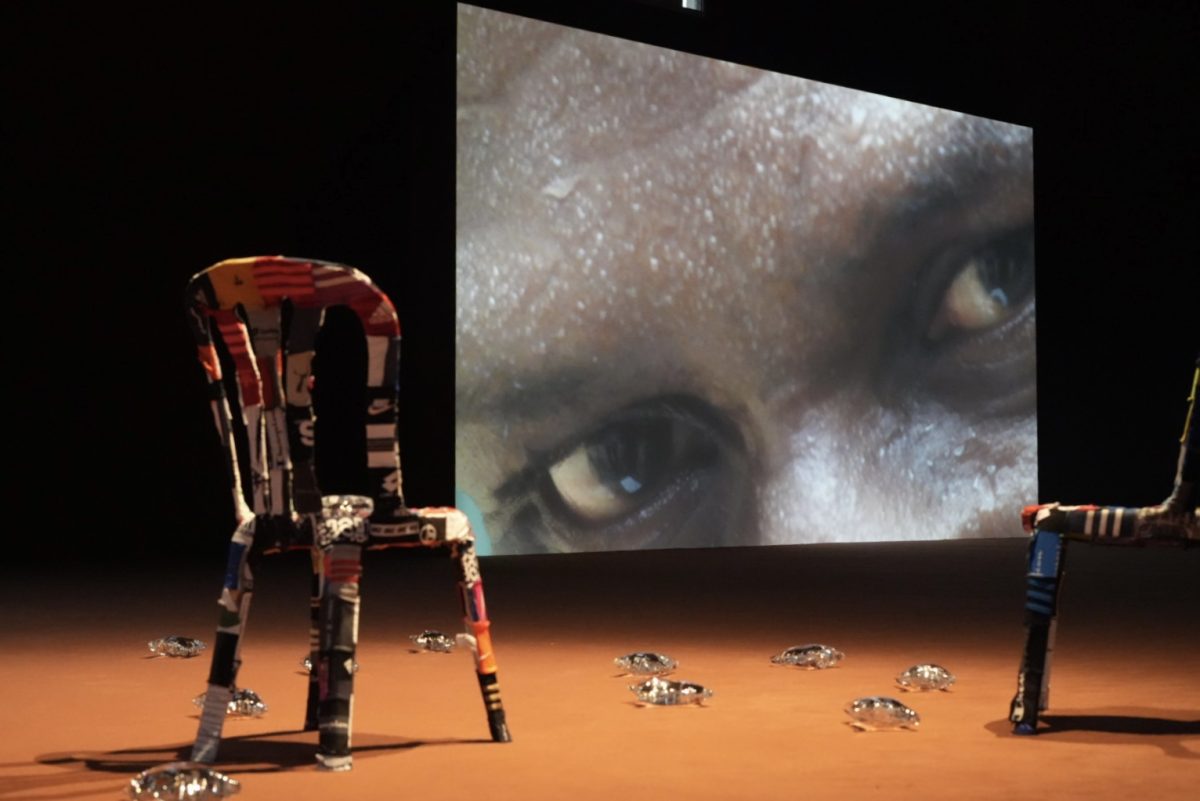
Deep red walls trap the heavy breathing and conversations of a group of Nigerian bodybuilders whose figures illuminate a large screen in the center of the room. In a corner, two banal monobloc chairs covered in sports logos face one another, as if the men in the film will soon walk off the screen and sit down in the chairs to drink from the glass sculptures labeled “pure water” that surround them.
Tendered, displayed from September 12 to November 1, marks the U.S. debut of MUSCLE, Karimah Ashadu’s installation that combines film and sculpture to examine which bodies are deemed disciplined and distinct in the contemporary labor system in Nigeria and among the African diaspora.
Ashadu’s work investigates labor, patriarchy, and the socioeconomic and sociocultural contexts of Nigeria and its surrounding areas. She currently has an exhibit at the Art Institute of Chicago titled Machine Boys, which investigates the informal economy of motorcycle taxis in Lagos’s slums
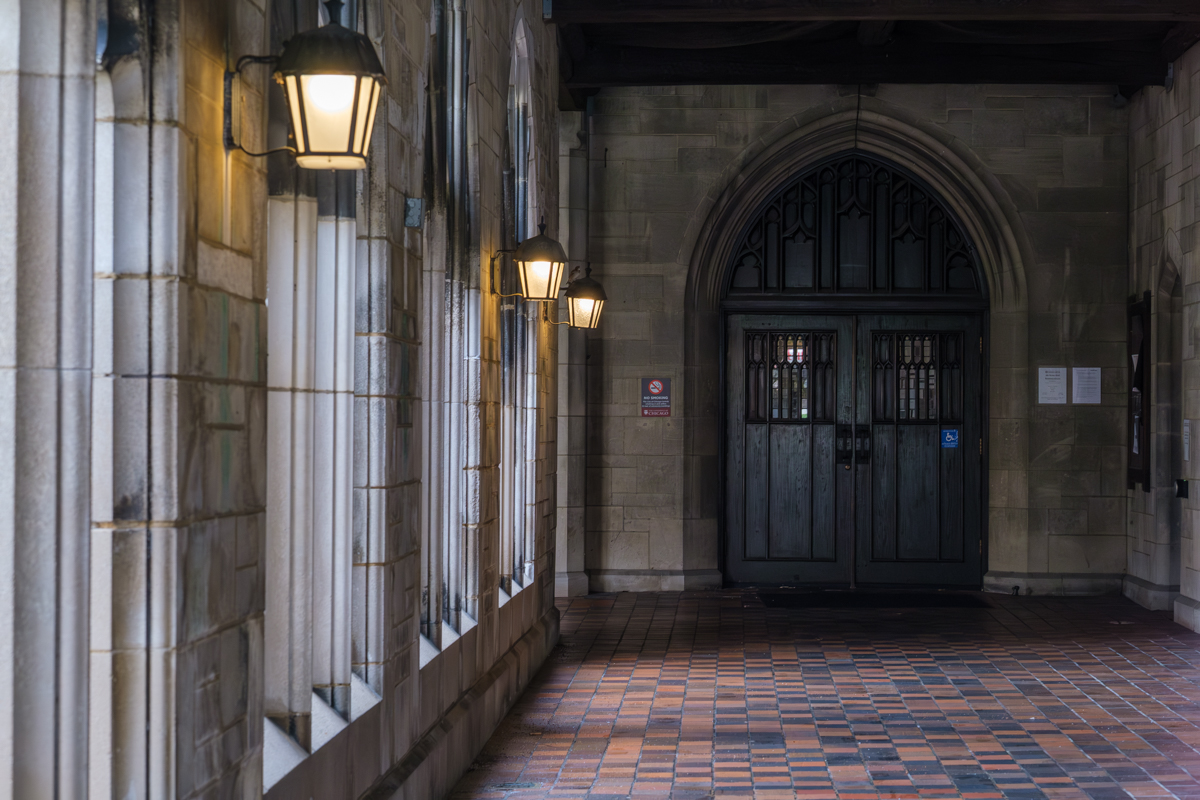
The looming red walls belong to the Renaissance Society, an institution founded by a group of UChicago faculty in 1915. It has been a significant facilitator of bringing European and avant-garde practices to Chicago and continues to do so with the exhibition of Tendered.
Ashadu grew up between Nigeria and the United Kingdom, though she is currently living between Hamburg and Lagos. Her experience growing up between two incredibly different cultures prevails in her work, through the juxtapositions that intertwine European capitalism with Nigerian street culture. To create a backbone for the exhibit, Ashadu worked closely with people in these areas whose lives are dictated by an informal economy and whose aspirations are dimmed by material constraints.
The film gives the viewer a glimpse into the lives these men live, forcing one to analyze their every move, to dissect the expression of a man whose blank stare fills the projection for minutes, and to wonder what he’s thinking. Their actions and their words, booming as voice-overs throughout the space, suggest that where these men falter economically and socially, they make up for with exaggerated physicality. For 22 minutes, we are placed in the slums of Lagos, engrossed in sweat, short grunts of conversation between men, and a determination to lift heavier and push further as they slam their barbells to the ground with loud clanks.
What are the origins of the motivation, determination, and anger showcased by the bodybuilders? This was answered by a subject whose voice echoed through the room. He explains that men in Lagos work out in order to protect themselves. They want to appear intimidating and strong to those who could hurt them. Ashadu resists this oversimplified representation of male strength, however, by highlighting hints of fragility and pride as the camera zooms in not only on their bodies but on their faces and their expressions as they perceive one another.
As one man exercises, the camera pans to the line formed behind him—each man staring intently, just as the audience does. They fidget with their clothes and their towels, waiting for their chance to demonstrate strength and ability.
In their free moments—instants between workouts—men drink from sachets of “pure water,” which are replicated by the artist in glass and placed in the corner of the room. The sculptures are important for contextualizing the physically focused film, highlighting an issue that expands beyond the patriarchy and into Nigeria’s sociocultural and socioeconomic issues.
Pure water sachets became widespread in West Africa in the 1990s, especially among low- and middle-income communities, due to the lack of public water infrastructure and the low price of the sachets. Though they remain relatively inexpensive, the rise in price of these sachets reflects the challenging economic circumstances in the country. Such water businesses face a lack of regulation and can be created by anyone with just a tap and a refrigerator. The reality is that most of the water in the sachets is not, in fact, pure.
The men’s dependence on the pure water sachets in order to fuel their workout mirrors the communal effort in trying to defy Nigeria’s extractive economy and support themselves through businesses independent of foreign investment. The artist states on her webpage, “I wanted to highlight how even water is embedded in capitalist structures and becomes a symbol of democratized access to economic independence.”
The pure water sachets surround garden chairs covered in patchwork of recycled sports clothes titled Cotch I and II. The chairs themselves are ubiquitous to the streets of Lagos, used for events ranging from weddings to funerals. However, the patchwork of American and other foreign brands hints at the imposition of imperialist forces on Nigeria, suffocating it even though it gained independence 66 years ago. The men in the film exercise in a makeshift gym with clothes that lack branding or logos like those plastered over the chairs. Covering a staple of Nigerian culture with foreign brands hints at the pressure these men feel to conform to a standard set in place by the colonial system that predates them yet persists to this day.
Though visitors will wander to the corner of the room to investigate these artifacts, the film and its intensity demand one’s attention. As I sat on the bench in front of the screen, at least three minutes went by with no conversation, no voice-over. My attention was captured by the intense grunting of the men lifting heavy weights.
It was clear that the men were struggling, and their discomfort prompted mine. Gazing at another person’s struggle for an extended period made me squirm. But as the voice-over came back into play, I realized this discomfort was exactly Ashadu’s objective. Feeling one of the many emotions these men experience puts us on the road to fully empathizing with the struggle of the Lagosians. The montage lacked a plot or character arcs, instead inspiring the viewer to wonder about the broader context of the work.
As the exhibit shows the nuances of such intense masculinity, the bodybuilders are made tender. The film and its audio give us emotional insight, while the sculptures provide context to understand why the film’s subjects carry themselves as they do. To be tender is to be gentle, soft, and forgiving, adjectives that seem to stand in tension the intense strength and grit seen in the film.
This tension is never resolved, rather further explored by Ashadu. The bodybuilders strive for strength to prove themselves as the capitalist and extractive economy stifles their culture. As gardens are strangled by capitalist logos and water sachets left scattered on the ground, the bodybuilders ascribe importance to what they can control.