You haven’t seen me or any of my fellow graduating fourth-year copy chiefs on any bylines in the Chicago Maroon (unless you count my first- and second-year foray into crossword constructing), but, as a team, we have edited virtually every piece of Maroon content you may have encountered over the past four years.
As copy editors, we are not responsible for what the newspaper covers or for how our reporters cover it. Instead, our job is to make sure that every article we publish is grammatically correct, stylistically consistent, and, most importantly, factually accurate. Our responsibilities range from checking comma placement to deciding how the Maroon will include the typo-ridden quotes from documents in the Epstein files that mention UChicago trustees. I’ve trawled through financial reports to confirm figures, asked our reporters for countless screenshots of University emails, and spent several hours during one finals week editing all faculty signatures in an open letter to be uniformly formatted.
Given that I mention copyediting constantly in my day-to-day life, in tones alternately excited and regretful depending on how long it’s been since a late-night production shift, I’ve had various people ask me why I think it’s worth it—why I do it, or why the Maroon needs a copyediting team at all.
There are a lot of answers I could give. I love fact-checking (99 percent of the time; there are moments when I’m 20 pages deep comparing charts in fiscal year reports and wondering why I signed up for this). I love making sure that our crossword clues make sense and that we use words and terms correctly. I love how, for the vast majority of grammatical questions, there is an answer if I just dig deep enough into the Chicago Manual of Style. I love the wide range of articles I get to read; I love how aware of the rest of the paper I get to be in this role; and I love the copy team.
More than any of that, though, I believe the work we do is important.
Yiwen Lu, who was managing editor during my first quarters at the Maroon, wrote a lovely senior column about the value of student journalism, and all her points still stand. She writes about how student journalism is valuable for promoting community engagement and holding power (read: the University) accountable, even amid the relative lack of protections afforded to student journalists. She argues that student journalism is valuable for making information accessible and for covering hard topics from a variety of perspectives.
If I were to treat Yiwen’s argument as the singular reason for journalism, it would still be clear why copyediting is a valuable support system, one that ensures that everything the Maroon puts out is clear and accurate, thus maintaining our credibility as a resource to those around us.
However, I would posit student journalism serves another purpose, just as significant as the more obvious ones, that isn’t often discussed when arguing for its value: it not only provides information to the community in the present but preserves it for those who will inherit this community for generations to come.
The smaller and more specific a community, the lower a chance there is that its history will be preserved in the long term, which is part of what makes local and student journalism so vital. The Maroon is fortunate to have an archival structure in place that will ensure the preservation of our work. The majority of our 20th-century issues have been digitized and now are available online through the UChicago Library (while you can find most of our 21st-century articles on our website). If you have a moment, I suggest you go browse through the digitized issues, where you can find articles on topics ranging from the University’s Victory in Europe Day events to a 1986 Ida Noyes renovation. Some coverage, such as library book purchasing cuts in response to budget issues or 1929 changes to English 101, will be familiar topics even to students today, while other articles, like that covering a Burton-Judson snack bar, might seem completely different from the campus we now know.
Unlike these official policies and events, however, old Maroon articles quite often are the only lasting records of non-scholarly life, something that becomes starkly visible when our Grey City reporters investigate topics ranging from the history of disciplinary proceedings and protests on campus to the University’s past stances on lobbying. These long-form articles have become a larger part of our reporting in recent years, spearheaded in large part by then Grey City editors Elena Eisenstadt and Evgenia Anastasakos (now former deputy editor-in-chief and former managing editor, respectively). I truly think it is some of the most significant work we have done.
In Leah Tabakh’s 2025 article investigating the fight for housing desegregation at the University, we can see that the Maroon was the publication that broke the news in 1962 that UChicago publicly acknowledged dormitory segregation, and that, 60 years later, Maroon articles comprise the surviving record of the ensuing protests. Maroon op-eds have helped our reporters uncover community voices from debates ranging from early construction on the Obama Presidential Center (also covered in a range of the South Side’s other newspapers) to the 1939 discontinuation of varsity football at UChicago, helping us to understand the issues of today through the issues of the past.
Perhaps most significant to my own experience at the Maroon since joining in fall 2022, however, is our extensive historical coverage of protest movements at the University. Even two years later, spring 2024 is the most memorable aspect of my time at the Maroon, where copyediting live updates on the pro-Palestine encampment and counterprotests dominated my life for over a week during midterms. While national newspapers also covered the UChicago protests, they did so in much less detail than the Maroon did (or than the Columbia Spectator, the Daily Bruin, or a host of other student newspapers did for their own encampments and protests).
The significance of this became perhaps most obvious to me during our Investigations Team’s three-part series on the history of the University’s disciplinary system in spring 2025. This series was able to reconstruct, largely through past Maroon reporting, the way the University’s disciplinary procedures were handled in response to 1960s Vietnam War protests and 2010s demonstrations over UChicago Medicine’s lack of a Level 1 trauma center. In drawing out these pieces of the University’s past, the reporters were able to provide a historical context for more recent University responses to major protest movements that would simply not be possible without the efforts of past student journalists.
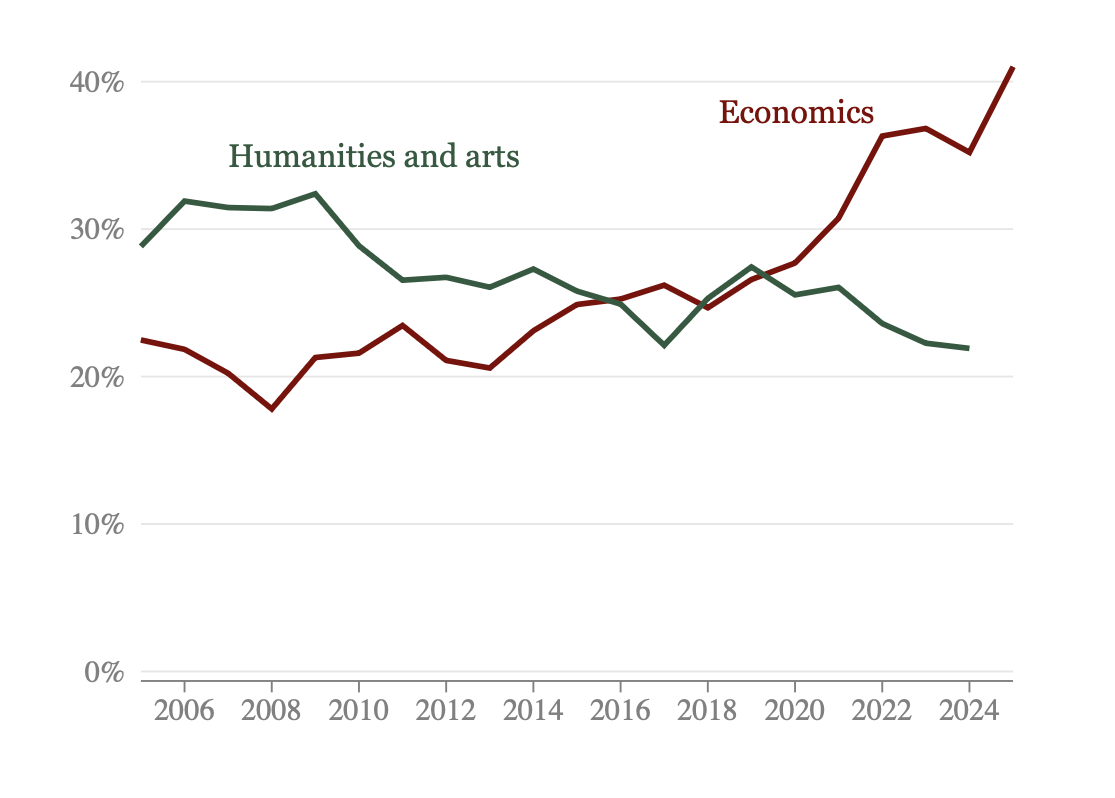
The past four years have been eventful ones for student journalism at this university (as well as many others), characterized by, to list a few, one of the largest waves of student protests in the past half century, extreme cuts in federal funding, and growing threats to freedom of speech, particularly for international students. In UChicago-specific events, we have seen a unified Division of the Arts & Humanities (along with an uncertain future for many of its departments), repeated mentions of trustees in the Epstein files, and a student government impeachment. Some of these—the Epstein files and Department of Justice inquiries—will be well-documented in the historical record even without us, and our reporting is certainly not their most important coverage. Others—the Division of the Arts & Humanities restructuring and the budget deficit—are significant because they are happening at the University of Chicago, a school that has long promoted itself as a bastion of free inquiry across disciplines, making our unique position as a UChicago-specific paper all the more important.
The old cliché is that “journalists write the first draft of history.” This idea has been interpreted various ways—emphasizing the necessity of striving to remove bias from reporting or of maintaining awareness of one’s own limitations—but the maxim underscores the significance of journalism in recording the events of the present day such that they might eventually be used to understand the past. I would argue that this role is particularly important in the smaller, community-based histories that are likely to be lost forever if they are not intentionally recorded in the present day. When future generations of the UChicago community attempt to understand the history of student protests here or to reckon with the decisions that led to whatever shape the Division of the Arts & Humanities will have taken by that point, they will be able to turn to the Maroon to comprehend the history of their institution.
None of that, however, can be the case if newspapers are not trusted by their communities to be credible sources of information. In an age of rampant misinformation, increasing reliance on artificial intelligence, sweeping cuts to vital areas of journalism even in the country’s most prominent papers, and an overall deterioration in trust in the media, copyediting and thorough fact-checking remain a bulwark of trustworthy journalism. This remains true even as the journalism industry’s difficulties in the past decades have disproportionately affected copy editors, meaning that many of the professional local papers upon which the Maroon might model itself have had to sacrifice the work of copy editors—that of maintaining institutional credibility—to make ends meet. Newspapers are vital sources for the preservation of local histories, but that cannot be the case if they are not trusted to report reliably.
Our copyediting team is not faultless, nor is the Maroon as a whole. However, as I leave this paper and University in June, I am proud to have been part of an organization that is constantly striving to be the best possible and most reliable source of information for the UChicago community. I hope that our work over these four years will be, if not sufficient, at least significant in preserving these tumultuous years for the future.
Mazie Witter is a fourth-year in the College and copy chief of the Maroon.