


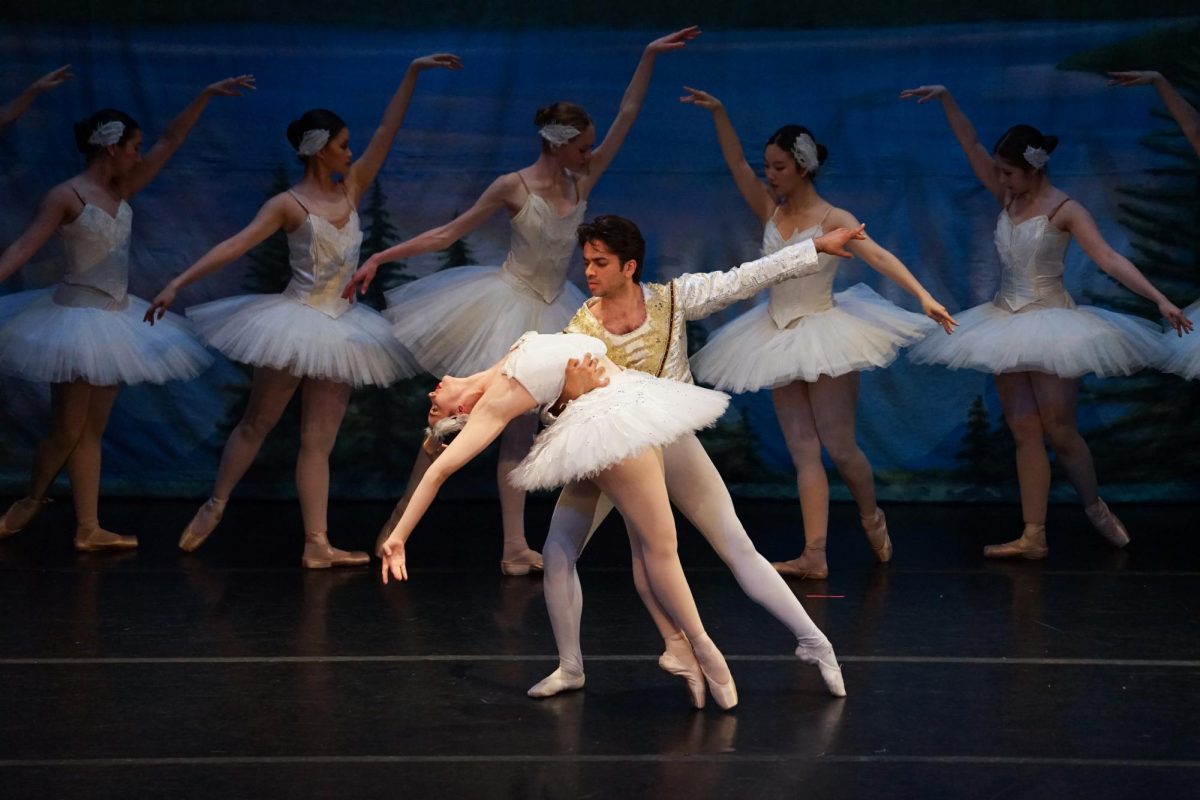
On the night of May 2, the campus buzzed with anticipation of University Ballet’s (UBallet) rendition of Pyotr Ilyich Tchaikovsky’s late 19th century Russian ballet, Swan Lake. Having previously performed Swan Lake in 2017, UBallet staged a production of this timeless piece to celebrate their 25th season. The performance of this classic ballet is typically regarded as the pinnacle of a company’s rigorous training. Although there were some asymmetries in the final performance, the remarkable talent and tireless effort poured into this show was undeniable. The dancers’ impressive feats of flexibility and emotion created a mesmerizing performance across all four acts.
As the only dedicated classical ballet student group on campus, UBallet caters to a wide range of abilities. In the program notes, Executive Director Talya Borisy (’26) and Artistic Director Sarina Zhao (’27) noted that the production “features dancers of all backgrounds, ranging from those who danced professionally to those who [have] never before taken a ballet class.” The organization fulfills an impressive dual role: catering to seasoned and novice dancers alike. Every week, UBallet offers beginner to advanced dance classes led by professional dancers. While leading roles are filled by classically trained dancers from the undergraduate and graduate student bodies and alumni, UBallet stands by its commitment to inclusivity, embracing a no-cut policy. The organization strives to make ballet—an activity traditionally accused of being elitist—welcoming to any willing person.
In the opening remarks before the show, UBallet’s directors extended their welcome invitation to the spectators. Borisy and Zhao explained that although the dancers are silent, ballet has its own language articulated through pantomime—the theatrical form replaces speech with gestures and expression. Before the show, dancers Crystal Wang (’28) and Ben Nieles (’27), performed an example of pantomime using abbreviated moments from Swan Lake. After the lesson on the language of ballet, the audience was in for a spell-binding presentation that applied an emotive charge to the seminal classic.
Swan Lake unfolds in a medieval German kingdom enveloped in a forest. During a solitary walk, Princess Odette is tricked by a malevolent sorcerer, Baron Von Rothbart, who curses her to live as a swan by day and human by night. Meanwhile, in the royal palace, Prince Siegfried faces pressure from his mother to choose a bride. Craving an escape, the prince goes hunting, where he encounters Princess Odette—now the Queen of the Swans—in human form. The pair fall in love, drawn together by an attractive force despite the impossibility of them being together. Tchaikovsky’s music brilliantly underscores this intense romantic passion curtailed by insurmountable obstacles. Seamlessly weaving ensemble, duets, and solo numbers, Swan Lake reveals the tapestry of tension underlying courtly life.

In lieu of an orchestra, a recording of the music was transmitted through speakers. As the overture built into a crescendo, the audience sensed an impending confrontation that set off the show. Princess Odette, performed by Bridget Curtis (J.D. ’26), sanctified the stage; Curtis brilliantly captured the sensitive vulnerability the leading role demands. Lurking in the background, the sorcerer, played by Tate Pan (A.M. ’25), slinked on stage. Wearing a surreptitious smile and a dark cape, he fit naturally into the role of the malevolent shapeshifter. Curtis responded emphatically. She executed pirouettes with precision and leapt weightlessly, bringing an imminent urgency that encouraged the audience to empathize with her plight. At the end of their struggle, Curtis fluttered her arms, marking Odette’s transformation into a swan. The ease of her avian transitions exemplified how even the smallest of Curtis’s gestures were laden with meaning.

The party at the palace gardens introduced dancers with diverse skillsets to the audience. Each court player had their own specialty. After a shaky start, the waltz dancers got into the groove of the movement, dancing in pairs. Each of the three dancers in the Pas de Trois were spectacularly engaging. The en pointe steps of Tori Edington (Ph.D. ’28) and Crystal Wang were in sync with Max Jervis’s (’27) strut. He responded with sharp turns to each female dancer’s delicate twirls. In “Dance of the Cygnets,” the small swans flawlessly executed sixteen pas de chat. Springing into a jump, each dancer glided as they elegantly kicked one leg to the side. The seamless steps blended their movement, making it difficult to tell which limbs belonged to which dancer.

Ian Palmer (A.M. ’24) poignantly played the role of Prince Siegfried. He wore a dejected expression during the scene where his mother, played by graduate student Jimena Gómez (S.M. ‘27), insisted that he choose a wife. Palmer’s ability to combine a somber countenance with nimble movement embodied Siegfried’s sensitivity, making it clear that Palmer was invested in his character’s arc. Embarking on a romantic duet signaled by an adagio, Curtis and Palmer each held their weight. Curtis posed in sustained backbends and Palmer elevated her in compassionate lifts. Through heartfelt movements and emotional gestures, they captured and maintained the audience’s attention.

When the curtains reopened after intermission, four princesses paraded in front of the Prince, intent on piquing his interest in marriage. While their moves dazzled the audience, they were not enough for the grief-stricken Prince, still preoccupied by his feelings for Odette. However, he shared the audience’s surprise at the appearance of Odile, Rothbart’s daughter, who impersonates Odette. Odile, under the instruction of her father, tricks the Prince into breaking his unwavering commitment to Odette. Embracing the new role with a black leotard, Curtis’s embodied transformation was incredible. Infusing her interpretation of the Black Swan with seductive and self-confident motions, Curtis gave the persona a subtle seductiveness as she circled the prince. The turns were emblematic of Curtis’s transition—Odette’s precise pirouettes and elongated arms were exchanged for Odile’s 32 erratic fouettés. The metamorphosis into the Black Swan underscored Curtis’s incredible range of articulate movement.

After nearly two hours, the dancers had earned the full emotional investment of their audience, making the tragic final act extraordinarily devastating. When the Prince promises his love to Odile, believing her to be Odette, he mistakenly betrays his lover. The act seals Odette’s fate to forever remain a swan. In the final scene, when Odette leaps into the lake, her suicide feels like a reminder of her human fragility. With a forlorn expression, the Prince leaps into the water after her. As he made long strides towards the edge of the stage, the extreme devotion underlying Prince Siegfried’s suicide felt sincere. Luckily, the audience did not have to sit in their melancholy for long. The couple’s sacrifice ruptured the sorcerer’s curse. Under brilliant lighting, the reunited couple ascended to heaven together. Their prolonged pas de deux showcased their intimate chemistry. As Palmer carried her in an overhead lift, Curtis elongated into an arabesque. Their form gave off the impression of flight, a fitting send-off for the final act.
UBallet’s rendering of Swan Lake showcased the incredible talent of the performance group. The spellbinding performance stood as a testament to UBallet’s enduring excellence.
Editor’s note, June 21, 12:28 p.m.: This article previously misspelled Talya Borisy’s last name.




Brian James / Jun 24, 2026 at 1:00 pm
They’re swan corps not little swans. Little swans are the four in the dance of the cygnets.