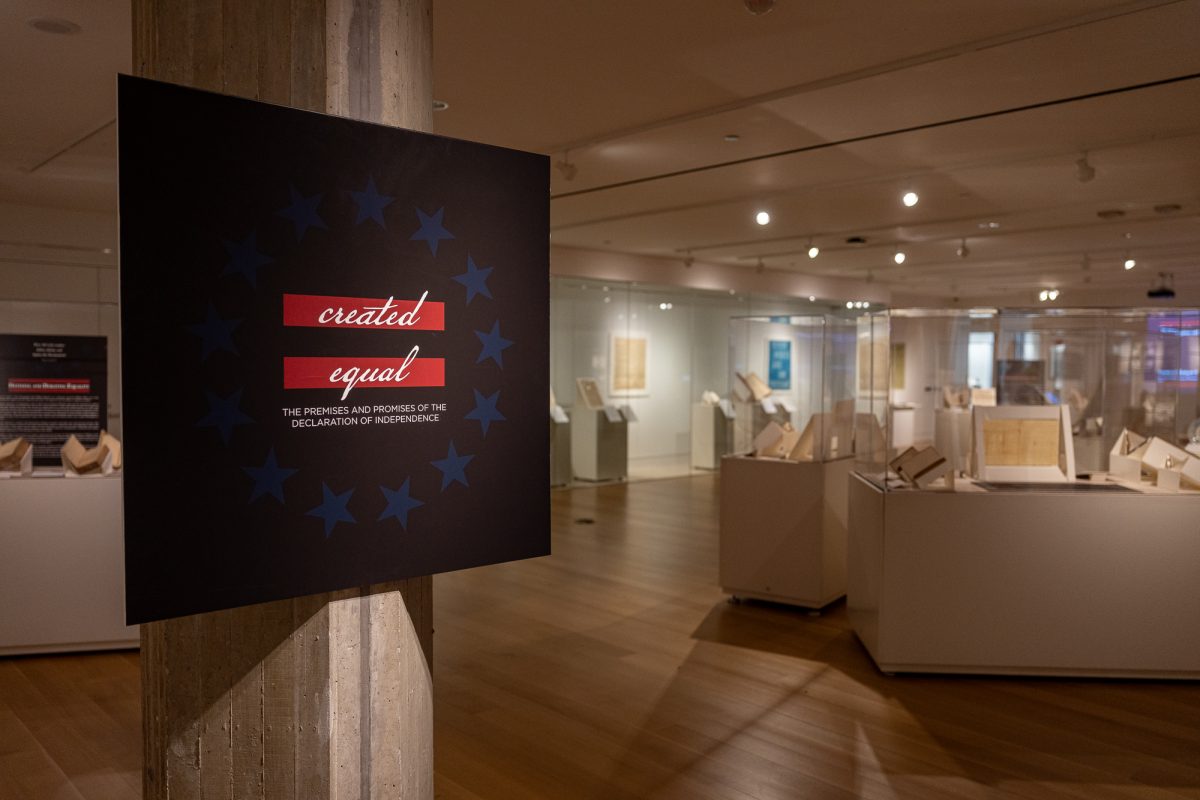
It was an early autumn day in Chicago, and you could feel the air bite with the kind of cold that whips your eyelashes into a snowy blur. As the windchill saturated the night with fallen leaves and red-kissed noses, a kind-eyed man handed me a physical ticket and a brochure printed on newspaper, cast a pitying look at my blue fingertips, and ushered me into the back of the Reva and David Logan Center for the Arts. “Cinema In Real Life,” announced the 62nd Chicago International Film Festival’s banner, as the theater slowly filled with people waiting to see The Watermelon Woman.
Released in 1996 and directed by Cheryl Dunye, The Watermelon Woman is an icon of independent American cinema. The film follows the semi-self-inserted character of Cheryl, a Black lesbian living in Pennsylvania, as she obsessively documents the identity of the elusive Watermelon Woman, a Black Old Hollywood actress from the 1930s. It’s the kind of film that continues to find new audiences 30 years after its release and inducts its fans into a tight-knit community. This screening was particularly packed, as it opened with the presentation of the Career Achievement Award to Dunye, celebrating the festival’s 30th anniversary of Black Perspectives programming.
Inside the theater, the atmosphere was vibrant: the swell of chatter laid the air thick with familiarity, reminiscent of a large group of friends eating on the grass, so that the atmosphere felt orange and warm. The introductions to the film followed in this tone, as Black Perspectives programmer Jada-Amina—accompanied by the Logan Center’s Executive Director Bill Michel and Cinema/Chicago’s Artistic Director Mimi Plauché—spoke about the film in a way that glowed with vulnerability. Jada-Amina talked about her love of Dunye’s work, likening the viewing experience to “discovering… parts of [her]self [she] didn’t know yet.” It’s no surprise then that when Dunye appeared on stage to receive her award, the crowd erupted into a standing ovation. The woman in front of me welled up as Dunye bowed and blew kisses, thanking her longtime colleagues in the audience.
Dunye’s body of work is marked by its originality. Her signature style, known as “Dunyementary,” moves deftly through genres like autofiction, mockumentary, found footage, and fiction to collage a story which blurs the lines between realism and performance. There is no point during a Dunye film when one is fully sure whether what is happening on screen is “real.”
The Watermelon Woman boasts a particularly full repertoire of firsts. The film’s cinematographer, Michelle Crenshaw, is one of the first Black women to hold the role in the country. The themes of the film discuss the ramifications of incomplete histories well before theorist Sadiya Hartman coined the term “critical fabulation”—a term used to describe methods of research and storytelling which aim to address gaps in historical archives—in 2008. Even the physical technology had to be radically changed for the film’s production, as jumps between physical film and digitized video formats were hardly established before its production.
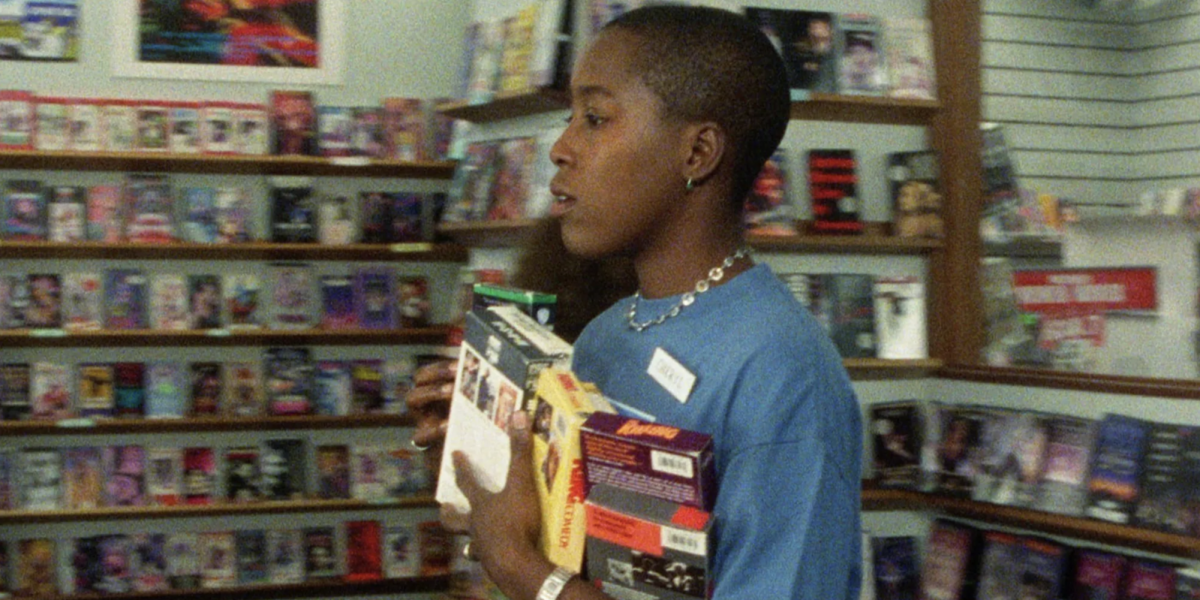
What emerges is an amateurish, but charming and hysterically funny, depiction of young, Black lesbianism in the 1990s. Moreover, The Watermelon Woman is a film concerned with the imperfect preservation of time and the cultivation of a historical sense of community. Two plotlines run parallel, differentiated by format. Shot on film, a young Dunye, playing a fictionalized version of herself, works in a video store and becomes obsessed with uncovering the history of the Watermelon Woman, a Black actress resigned to playing archetypal roles in Old Hollywood films. In this world, she lives among “family,” a queer quasi-utopia where every character is not only supportive but queer themselves. We watch Cheryl slowly fall in love with a white woman named Diana (Guinevere Turner), briefly exploring the power dynamics which arise in interracial relationships, and we follow Cheryl as she traverses a tumultuous friendship with her coworker Tamara (Valarie Walker). Shot on digital, the second plot documents the process of uncovering the identity of the Watermelon Woman, demonstrating in real time the difficulty of reconstructing a history which has been systematically erased.
All the tells of a debut film are visible in this movie. The line delivery can come across as rehearsed, the cuts occasionally feel unfinished, and the plot verges on convenience. However, the “Dunyementary” style captures these imperfections and weaves them into a coherent and grounded narrative about young artistry. “I’m a filmmaker. Well, not yet. I’m trying to be,” Cheryl said, breaking the fourth wall. The film becomes self-aware; it pokes fun at itself without demeaning its subject matter.
The boundaries of realism are left playfully undefined throughout the story. The sections of film feel like Dunye’s—the director’s, not the character’s—own mockumentary, a metanarrative inside a metanarrative. Some of the film’s absurdity is obviously deliberate; for example, the historical lesbian archive that Dunye’s character visits is humorously titled the Center for Lesbian Information and Technology (abbreviated as CLIT). Yet, other instances, such as the interview with Swarthmore professor Camille Paglia, feel absurd and unscripted. The shaky handheld quality of the digital sequences, which lean into the oversaturation of their subjects, contrasts with the smooth and stable blue-and-pink hues of the film sequences. This is a movie unconcerned with perfection; it captures the heart of its subjects with precision, carefully building a vision of community that was only allowed to exist in the fringes.
The room came alive in a way I had never really experienced before. There were entire minutes for which the theater laughed together uncontrollably, as if the room itself heaved and clutched its sides. People lightly heckled, applauded, and whistled, as if they too were working in a Pennsylvanian video rental store 30 years ago. The post-screening conversation echoed this friendliness. Stephen Winter—director of Chocolate Babies, and another darling of the Black new wave independent scene—spoke with Dunye like an old friend, joking and gossiping about parties from the 2000s in between questions. The entire theater felt infected with joy, as though the audience and filmmakers were sharing in an inside joke.
The two spoke about being marginalized as queer Black people in cinema, the lack of representation, and struggles with funding. Yet the conversation never fell into despair. Dunye was adamant about the necessity of action: “Everybody thinks nothing has been done. But you haven’t done it,” she half-admonished the audience. “You are an archive. Your life matters!” she said, urging the audience to actively seek out community, be it in the U.S. or abroad.
However, despite The Watermelon Woman’s success and her long, decorated, career, Dunye still lacks traditional Hollywood backing. She discussed her newest project, a retelling of Sunset Boulevard starring Laverne Cox, revealing it is set to begin pre-production in November despite receiving almost no industry support. The film is entirely self-funded and relied heavily on community donors to move forward.
Inside that theater, however, these storytelling limitations were transformed. A pleasant choral swirl emerged as people took off their coats, reached across the aisle to ask each other about their day, shared smuggled popcorn, returned belongings dropped at inopportune moments, and offered shared complaints about the turn of the season. Community, says The Watermelon Woman, has the potential to make the unseen seen. Or as Dunye’s cited inspiration Audre Lorde put it, “Without community there is no liberation.”