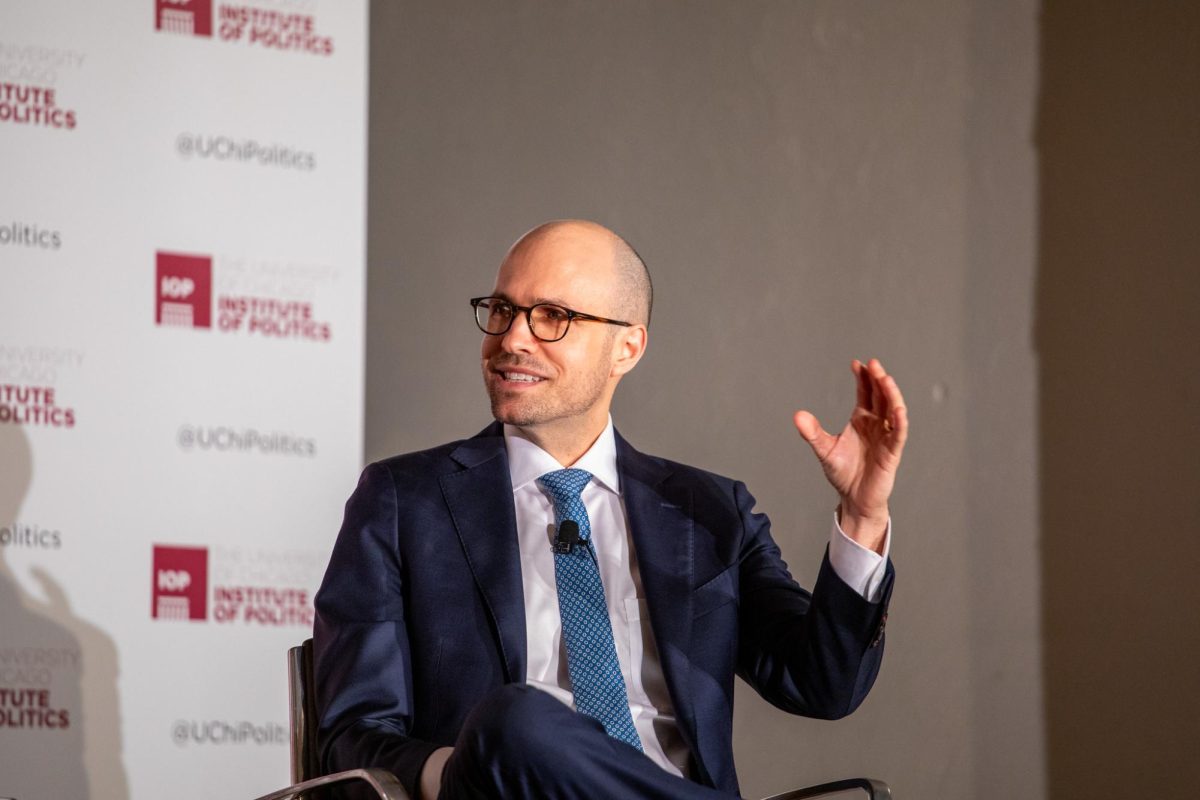
Utah Governor Spencer Cox spoke to Institute of Politics (IOP) Founding Director David Axelrod about his efforts to promote collaboration and debate across party lines at International House on Monday.
This past year, Cox published Off Ramp: How to Be a Peacemaker in an Age of Contempt, a book outlining his blueprint for depolarization in the U.S. as an extension of his comments calling for unity in the wake of the assassination of Charlie Kirk in 2025.
Off Ramp builds on Cox’s previous work in depolarization through Disagree Better, a non-profit promoting bipartisanship through conversations between Democrats and Republicans. The project included a series of videos, including one featuring Cox and Democratic Maryland Governor Wes Moore.
Axelrod began the conversation by asking Cox about the source of political polarization in the modern United States. “We are lonelier than we’ve ever been before,” Cox said, “and we’re desperate. We need connection, and we’re tribal by nature. And if we don’t have healthy tribes, we will find unhealthy tribes.”
Cox went on to discuss how the 24-hour news cycle and the proliferation of “talking head” pundits contribute to polarization. “We all get together and we get outraged about those people who aren’t even on the show right now, and that’s how we get your attention.”
Cox added that social media has further isolated Americans—particularly young people—by making them focus on events beyond their control, “When you’re caring and focusing on issues that you really can’t do anything about, it’s incredibly unhealthy,” he said. “I don’t know who my next door neighbor is, but I’m really worried about what’s happening in Gaza, and I’m focused on that.”
Cox went on to discuss his own experience with deleting social media. “Changed my life,” he said. “We get to choose. We get to decide. We can blame them. We can blame the politicians. We can blame the media. But ultimately, we have to look inside and say, ‘Am I part of the solution, or am I part of the problem?’”
Under his administration, Utah has filed multiple lawsuits since 2023 against prominent social media platforms for harm against the state’s youth caused by their algorithms, including damage to mental health and increasing risks of addiction.
“I always say, look, we focus so much on the x-axis of politics, the you know the left and the right, the you know Republicans, Democrats, conservatives, liberals, MAGA, DSA, whatever you are,” Cox said, “I think builders and destroyers. You can know you can be MAGA and be a builder. They exist, I promise. You can be a moderate and a destroyer.”
Cox turned the conversation to his relationship with Donald Trump. Despite withholding endorsements in 2016 and 2020, he endorsed the president in 2024.
Cox said that he had been able to maintain a working relationship with the president. “We are able to have these conversations and work on very important things together, and that matters to my constituents for sure. I think it matters to Americans.”
When asked about the upcoming midterm elections, Cox acknowledged that Republicans were likely to sustain losses but emphasized the importance of bipartisanship, saying, “The only way to get stuff done in this country is to build coalitions. You have to work with the other side.”
When asked by Axelrod about the issue of gun violence in the United States, Cox said, “I believe the Second Amendment says what it says, and I believe if enough Americans want to change that, there are ways to change the Constitution.” He added that providing increased education and economic opportunities could also decrease the incidence of violent crimes.
Axelrod also pushed Cox on the appeal of a redistricting lawsuit against the state. The original lawsuit, brought by the League of Women Voters of Utah in 2022, alleged the Utah state government diluted non-Republican voters’ power by splitting Salt Lake City County into four districts and unconstitutionally gerrymandering the districts in favor of Republicans.
The ongoing appeal, filed in February, alleges that the Utah legislature’s passing the case from the state’s supreme court to its constitutional court, created earlier that month, was itself unconstitutional.
Cox pushed back, saying that the expansions of Utah’s judicial system were unrelated to the case and would not influence its outcome. “If I’m court-packing and I’m picking judges for the constitutional court, I am the worst person ever at doing it,” he said. “But that’s the narrative.”
Audience members asked questions about LGBTQ+ rights in Utah, the free market’s effect on political discourse, criticism of the “both sides” approach to polarization in Off Ramp, podcast culture, and Cox’s approach to supporting emerging party leadership.
In between taking audience questions, Axelrod asked Cox about the future direction of the Republican Party. “I think the pendulum is going to start to swing back because I think people are tired of the vitriol,” he said, “and that’s what this is all about.”
“Politics doesn’t have to be the way we’re told that it should be right now,” Cox said, “I think that’s a worthy fight to try and champion a better kind of politics, where we can compete vigorously over a set of ideas without hating each other.”