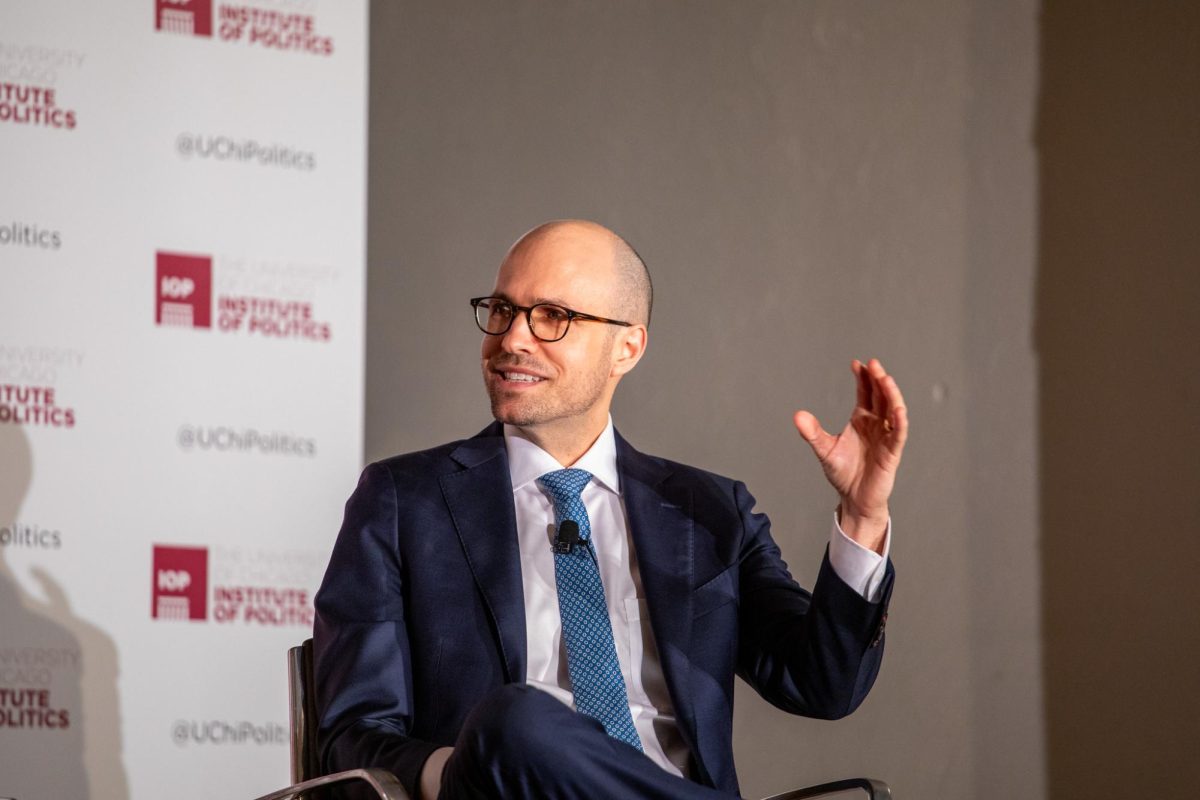
Senator Elissa Slotkin (D-Mich.) joined Astead Herndon, editorial director at Vox, for a live recording of Vox’s America, Actually podcast hosted by the Institute of Politics (IOP) at International House on October 13. Slotkin discussed the Democratic Party’s economic agenda and ongoing response to the current Trump administration, as well as its losses in the 2024 election and possible presidential nominees for the 2028 election.
Slotkin said Democrats had failed to focus on voters’ concerns about the cost of living during the 2024 elections, including whether families could afford housing and achieve financial stability.
“The Democratic Party should be the lobbyist for the middle class,” Slotkin said. She described economic insecurity as a threat to the country’s stability, stating, “The existential threat to America is not from abroad. It is that threat to the middle class and the American dream.”
Slotkin said Democrats should focus their messaging into a set of concrete proposals because voters want practical solutions rather than political labels.
Slotkin said she supports “declaring a housing emergency” to accelerate construction and address barriers that prevent new homes from being built. She suggested withholding some federal infrastructure funding from communities that refuse to accommodate housing growth.
Discussing health care, Slotkin said she would like “some kind of public insurance option for anyone at any age,” which would provide a government alternative to employer-sponsored plans. She said Democrats need proposals that address the financial pressures facing American families. “If we don’t speak to those things, we’re not going to get it in ’28,” she said.
The conversation also addressed artificial intelligence and data center development. Slotkin said she supports strong regulation of AI and that the country has spent too little time debating the technology’s limits and the legal responsibilities of technology companies. “I personally believe if you create something, you can be held liable for the things that that creation does,” she said.
Slotkin also called for a “radical reform and ethics package” to rebuild public trust in elected officials and judges. Her proposals included “ban[ning] corporate PACs,” establishing term and age limits for Supreme Court justices, and restricting stock trading by members of Congress and their spouses. She said Democrats should pursue investigations into alleged government misconduct and introduce safeguards against future abuses of power.
“We have to Trump-proof the government going forward, so that no president of any party can ever abuse the system the way he did,” Slotkin said.
Slotkin argued that the divide between moderate and progressive Democrats mattered less than whether lawmakers were willing to use their political power to challenge the Trump administration. “I don’t think the divide is moderate versus progressive,” she said, “I think it is fight versus flight.”
Slotkin pointed to her work with Michigan Senate candidate Abdul El-Sayed, a progressive Democrat whose primary campaign she did not endorse but whom she campaigned with after he won the nomination. She said the two disagreed on some issues, particularly foreign policy, but shared priorities on democracy and economic security. “We may come from different so-called wings of the party,” Slotkin said, “but we can work together as a team on the things that we both believe in.”
During the audience Q&A, one student asked whether former Vice President and Democratic Presidential nominee Kamala Harris’s potential 2028 presidential candidacy would conflict with the Democratic Party’s need for new leadership. Slotkin said she expected a competitive primary, saying that voters wanted “new faces and big and bold ideas.” She said Democrats should expect a contested nomination process rather than assume a familiar candidate will prevail.
Looking toward the 2028 presidential election, Slotkin said she is considering a possible presidential run but does not view herself as the only candidate capable of leading the party.
“It does not need to be me,” Slotkin said. “I just need someone who understands the mission.”