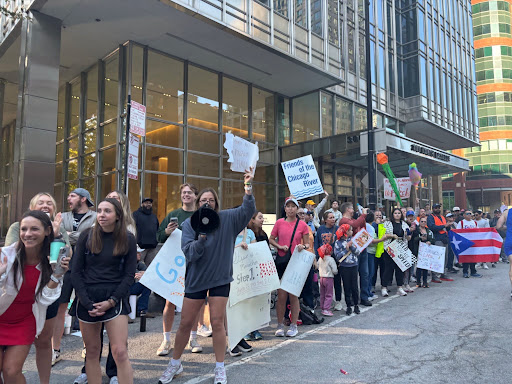
There were many University of Chicago students among the estimated 55,000 people who ran the Bank of America Chicago Marathon on October 11, a day slightly warmer than ideal for racing. Some students earned their spot through the lottery; others joined charity teams and fundraised for causes of their choice.
Two of those runners were Liz Villegas and Sebastian Galindo, graduate students at the Harris School of Public Policy. Both trained for about a year to take on the 26.2-mile course.
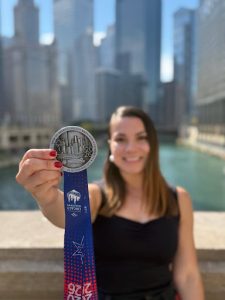
Villegas signed up to prove to herself that she could accomplish whatever she set out to do and that she had no limits. She trained with a coach and ran weekly, learning to adapt to Chicago’s changing summer weather while balancing her studies. On race day, she reached her goal: crossing the finish line of her first marathon.
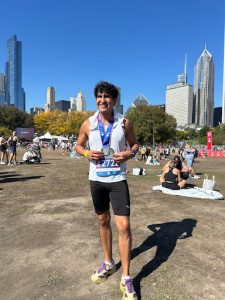
For Galindo, the race was his fourth marathon, but his first Abbott World Marathon Major—a series of seven of the world’s largest marathon races, which includes the Chicago Marathon. Last year, he had volunteered at the Chicago Marathon; this time, he returned as a runner, hoping to set a personal best while fundraising for St. Jude Children’s Research Hospital.
Galindo’s training became a lifestyle. He ran nearly every day for about a year through graduate school exams, work, and other commitments, and said the hardest part was fitting in three-hour long runs.
Cheered on by friends throughout the course, Galindo said his favorite moment was running through Pilsen, a neighborhood known for its large Latino community and a stretch he had looked forward to throughout the race. “The crowd did not disappoint,” he said, adding that the strangers’ support made runners feel like celebrities. He finished in 3 hours and 15 minutes, averaging his goal pace of 7 minutes and 26 seconds per mile.
Endurance running, Galindo said, has taught him two lessons: “You can achieve great things if you work for them, and you have to accept what is outside your control.”
“Even after months of disciplined training,” he said, “runners still have to overcome the fear of possibly getting sick right before race day.”
The 48th edition of the race started and finished in Grant Park, following a flat, fast loop through 29 Chicago neighborhoods. Kenya’s Amos Kipruto won the men’s race in 2:01:09, and Ethiopia’s Hawi Feysa Gejia won the women’s race in 2:13:33. More than 200 local, national and international charities partner with the marathon each year, with runners raising money for their causes.
Students across the city also ran with support from programs such as Students Run Chicago, which, for more than a decade, has offered a 26-week training and mentorship program for Chicago high school students, covering costs that might otherwise keep them from racing. This year, about 80 of the program’s students took part in the marathon, and 50 finished.
For students hoping to run the 2027 race, Galindo’s advice is to be persistent and patient, because results don’t happen overnight. Villegas recommends sticking to a disciplined training plan, since being unprepared for the physical demands of running 26.2 miles can lead to injury.
UChicago students interested in distance running can connect with the UChicago Road Runners, a club whose members train together for races across Chicago.