“This is the oldest story ever told—two boys and a girl.”
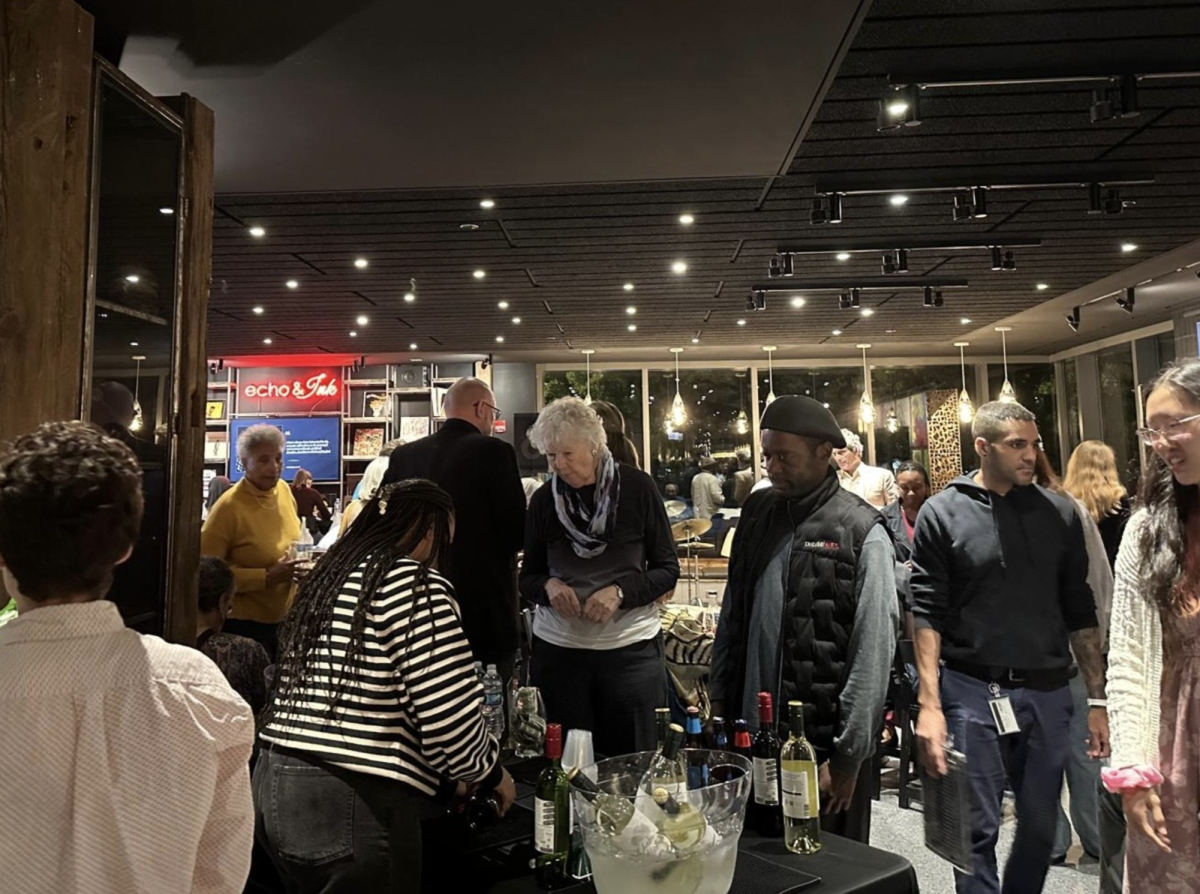
So read the opening intertitle of John M. Stahl’s 1926 silent film Memory Lane, which the Film Studies Center screened last week at the Logan Center for the Arts on 35mm film. Live accompaniment was provided by the internationally renowned pianist David Drazin.
The American filmmaker is today best known for Magnificent Obsession (1935), later remade by Douglas Sirk (1954), and the Technicolor noir Leave Her to Heaven (1945). Until recently, most of his 22 silent works were presumed lost. In fact, more than half survive, many of which were preserved in the Library of Congress archives. The Library of Congress and the Film Foundation collaborated to restore the film shortly before its 100th anniversary, and it is only available for special theatrical screenings, such as the Logan Center’s.
Memory Lane’s significance is evident from the first sequence, when Mary (Eleanor Boardman) slips out on the eve of her wedding to the chivalrous Jimmy (Conrad Nagel) for a final escapade with Joe (William Haines), her old flame. The following day, Joe inadvertently intrudes on the newlyweds’ honeymoon, casting a shadow of uncertainty over the outwardly idyllic marriage.
At a tight 78 minutes of run time (which was typical for the era), the film’s structure is easy to follow. Upon release, it was both praised and criticized for the simplicity of the plot, yet its concision is not for lack of emotional dimension. By the final scene, Memory Lane reveals itself as a mostly comedic telling with a bittersweet bent. In moments of more superficial humor, the Logan Center’s audience laughed: a doubtlessly laudanum-doped one-year-old fell asleep eating his own birthday cake, salacious small-town gossip darted through back doors and across telephone lines, and all manner of ludicrously pitiable circumstances plundered the protagonists’ pride.
Simultaneously, the predicament of a young woman at the crossroads of passion and finding economic provision feels painfully serious. Memory Lane displays a certain empathy toward the female experience, and Mary’s inner conflict is honored in the acting and dialogue. “Tomorrow I’ll be his wife—tonight belongs to me,” Mary writes to her mother before slipping out of the house, asserting the little independence she has. On a lighter note, the humorous portrayal of socialites and servants makes it a film dominated by female community. This commitment to exploring the women’s world extends throughout Stahl’s works.
“Stahl represents an adept threading of a needle between, on one hand, an honesty about real situations that, more often than not, are so-called women’s issues, while existing within the constraints of Hollywood studio filmmaking,” Hunter Koch, Ph.D. candidate in the Department of Cinema and Media Studies, said before the screening.
Both men are equally sensitive characters, desperate to secure Mary’s happiness, possibly even at the cost of their own. Melodramatic pyrotechnics would have marred the tender, melancholic effect that Stahl instead achieved through a more subtle approach. The audience becomes helpless onlookers alongside Joe, as a camera shot framed by a window mirrors his perspective into the wedding ceremony. Another detached shot through the back windshield of their getaway car follows, capturing the gaze of a lonely outsider upon domestic bliss. As Koch noted in the introduction at the Logan Center, “every shot… feel[s] necessary.… The film progresses more like a composition of moments and expressions.”
Fundamentally, however, the film communicates the pain of choice. Love, Stahl seems to posit, is the repeated choosing of an individual—particularly in the face of more exhilarating or nostalgic options. Mary’s decision suggests we may release the past without forgetting it, as the boys on the village green mournfully sing: “I am with you, wandering through memory lane. / Living the years, laughter and tears, over again. / I am dreaming yet, of the night we met, when life was a lovely refrain. / You were so shy, saying goodbye, there in the dawn. / Only a glance, full of romance, and you were gone. / Though my dreams are in vain, my love will remain. / Strolling again, memory lane with you.”
The sense of desolation was bolstered by the lack of audible dialogue and Drazin’s remarkable playing. With over 40 years of experience accompanying silent films in Chicago, he played nonstop throughout the film. The piano not only provided a score but also animated the sounds of everyday life. A tinkling motif, for example, expertly aligned with the ringing of a doorbell. The proximity of live music enhanced the experience, making onscreen emotions feel more immediate without disrupting visual immersion.
Overall, the audience appeared to enjoy the film. It was part of an event series hosted by the Film Studies Center, which in the upcoming weeks will include a screening of The Ladies Man (1961) directed by Jerry Lewis; Step Into the Light, a collection of short films made by the 2026 16mm production class; and Were You Scared?, a night “devoted to the fears, anxieties, dangers and everyday disasters of growing up.”