Summer festival season in Chicago is just beginning. Throughout the city, street music festivals transform neighborhoods into giant block parties, while iconic events like Lollapalooza and Riot Fest prepare for their annual return. But with Chicago’s Latino population comprising nearly 30% of residents, it is no surprise that the city is the perfect setting for the largest Latin music gathering in the Midwest.
Sueños is a festival by Latinos and for Latino crowds. In a culture built on celebrations, many of the songs, dances, hype phrases, and traditions that are familiar across Latino households are usually reserved for family and community gatherings. But at Sueños, everyone from the organizers and vendors to the artists and the crowd members shares those cultural references. As attendees explored the grounds, that sense of familiarity extended well beyond the music.
Founded in 2022 by Aaron Ampudia and Chris Den Uijl in partnership with C3 Presents, the same production agency behind Lollapalooza, Sueños has grown rapidly, currently attracting an estimated 100,000 attendees over Memorial Day weekend. Speaking to WTTW News, Ampudia emphasized the need for a festival for the Latino market that would both represent and celebrate Latino culture in Chicago.
Part of this success can be attributed to the brand’s ability to attract some of the biggest names in Latin music across a variety of genres. Having previously hosted artists like Shakira, Maluma, and Ozuna, this year, the headliners included reggaeton and Latin urbano star J Balvin on Saturday and regional Mexican band Fuerza Regida on Sunday. The lineup also featured Yandel, Kali Uchis, Danny Ocean, Tito El Bambino, Ryan Castro, Manuel Turizo, and Los Tucanes de Tijuana.

Stepping into the festival grounds, flags from across Latin America line the walkway, leading the crowd toward a towering sculpture with the names of the countries and territories stacked in oversized 3D lettering. People exclaimed with joy as they located the places connected to their families and heritage, and eagerly lined up to take a picture in front of the installation. Near the food and bar areas, a sign reading “Munchies y Miches,” a playful nod to the popular spicy Mexican beer cocktail, signaled the bars and concession stands.
Beyond the festival’s main stage, a central corridor led to two smaller stages named “La Fuente,” located near the Clarence F. Buckingham Memorial Fountain, and “La Plaza,” located near the food vendor plaza. While smaller and more intimate than the main stage, these spaces highlighted dozens of artists from a variety of genres that have shaped the Latin music landscape over the years in a more intimate setting—from Banda to Tejano, EDM, Latin Pop, and Salsa bands. At the north end of the grounds, a “Mercadito” shop carried merchandise from small local Latino businesses, and DJ sets, exclusive listening parties, and student performances from local schools ran daily at the Toyota Den.

While the festival’s design played an important role in shaping the experience, what truly defines Sueños is the pride displayed by its attendees. Throughout the weekend, flags brought by the fans draped across the barricades and regularly popped up as the performers called out, “Suban sus banderas” (“Raise your flags”). Near the main entrance, spontaneous attendee-led dance circles formed and randomly broke out into conga lines and popular Latino line dances led by Mexican folk jarocha dancers waving a huge Mexican flag.
In many ways, every corner of the festival became its own celebration. At the main festival area, Mexican American DJ Fredy Fresco kept the crowd dancing between sets. The audience roared every time a classic reggaeton song or a Bad Bunny track played, turning the gaps between performances from tiresome lulls into immersive mini parties. Adding to the festival’s playful spirit, full-sized Dr. Simi mascots, a beloved white-mustachioed character representing Mexico’s largest generic pharmacy chain and a popular cultural icon, began popping up at random, dancing their way through the crowds.

This lighthearted, fan-fueled atmosphere created a space that made everyone feel right at home. Artists routinely addressed the crowd with the same jokes, phrases, and crowd interactions often heard at Latino gatherings and celebrations. “¿Dónde están las mujeres solteras?” (“Where are the single ladies?”) several acts playfully teased from the stage; Tito El Bambino jokingly added, “Las mujeres solteras se van a Puerto Rico conmigo” (“The single ladies are coming back to Puerto Rico with me”).
Artists like Ryan Castro and J Balvin expressed their national pride through stage props and graphics on the jumbo screens. Perhaps most strikingly, Latin pop and reggaeton artist Manuel Turizo opened his set with imagery of a Colombian neighborhood projected across the stage, as couples dressed in Caribbean Colombian–inspired outfits performed a dance.

Puerto Rican singer Llandel Veguilla Malavé, better known by his stage name Yandel, brought one of the weekend’s most unexpected performances. Formerly part of the reggaeton duo Wisin y Yandel, the artists officially ended their partnership in 2023, and Malavé, advertised in the bill as “Yandel Sinfónico (Yandel: Symphonic),” now performs with a full philharmonic orchestra accompanying him onstage. While violins and wind and brass instruments are not unheard of in reggaeton, “orchestra” is not typically the first word associated with the old-school Latin hits. Yet in a genre known for dramatic sound effects and explosive energy, the combination worked remarkably well, as the orchestra added a new layer of depth to the music without sacrificing the qualities that make the songs catchy in the first place. Despite the grounds being muddy from rain earlier that day, the crowd buzzed with excitement as people pushed in closer to the stage to get a better view and dance to the hits. The success of this arrangement has also been echoed at larger scales and earned Malavé a Grammy nomination for Best Música Urbana Album for his live album “Sinfónico” (“Symphonic”), which featured the ensemble.

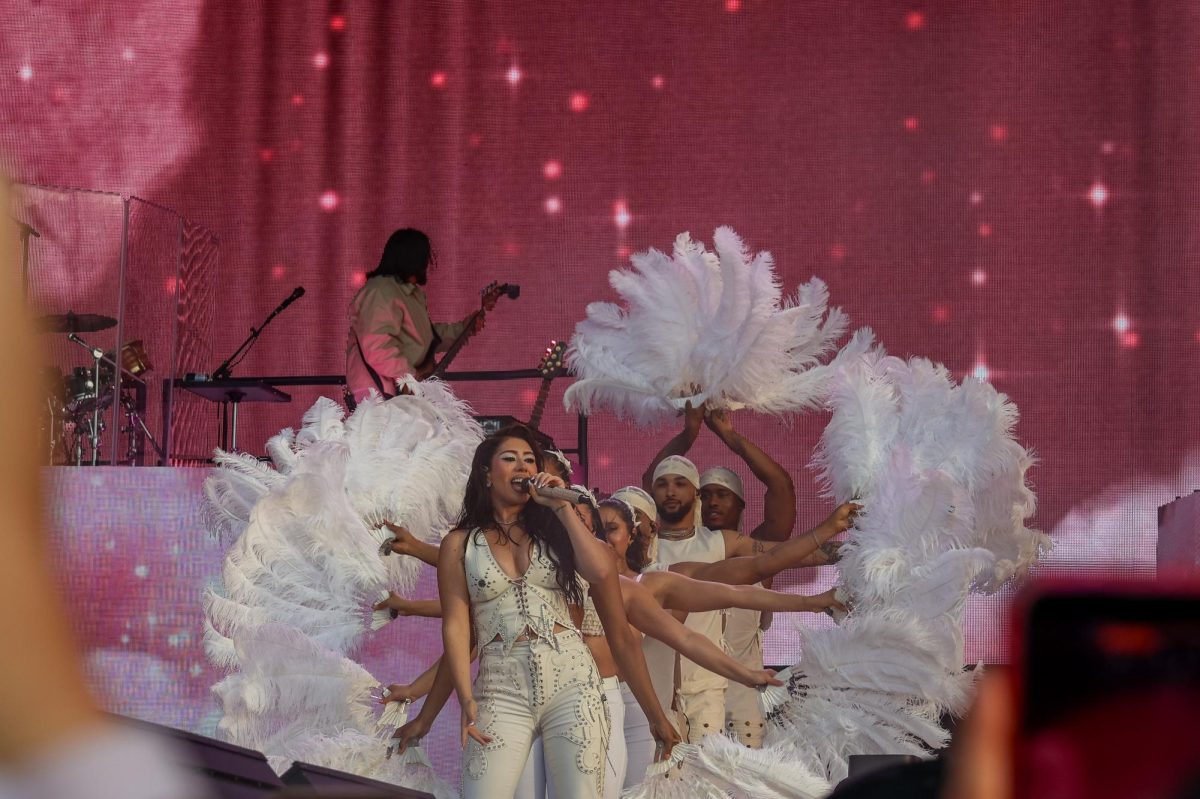
Other performance highlights included American Colombian singer-songwriter Kali Uchis, who is well known for her bilingual songs like the hit track “telepatía,” which went viral on TikTok in early 2021. She arrived at the stage area in a white carriage accompanied by a group of dancers holding giant white feathers that extended her silhouette into a skirt-like shape. The feathers then closed around her like a cocoon before she reemerged to perform “Moonlight.” For his headlining set, J Balvin performed 22 songs and delivered a heartfelt speech encouraging fans to appreciate the moment before playing “La Canción,” a track from the collaborative album “Oasis,” which he released with Bad Bunny in 2019. “Approvechen a abrazar la persona que tienen al lado, porque los tiempos como estos no vuelven a pasar” (“Take advantage of holding those next to you, because moments like these won’t happen again”).
As the final sets closed each night, celebratory fireworks were launched from behind the main stage. The crowds slowly filtered out of Grant Park, and certain images lingered: couples holding hands while clutching the flower bouquets sold by roaming vendors, attendees that tied their flags around their necks and wore them like capes, the sequins and glitter shimmering from various outfits against muddy legs and cowboy boots. But most importantly, the joyful energy of the day was still palpable.
Perhaps that energy stemmed from the festival’s ability to offer attendees a unique chance to see the artists that represent different generations, styles, and eras of Latin music all in one place—many of whom have helped shape the soundtrack to their lives. Whether it was Yandel reimagining classic reggaeton hits, Los Tucanes de Tijuana performing their popular party anthems, or J Balvin’s fresh mix of traditional Latin music with hip-hop, EDM, and R&B, those performances carried memories with them. For some, these songs transported them back to their sister’s quinceañera, their high school graduation, or their uncle’s wedding. For others, Sueños became the setting for moments they will revisit years from now.