

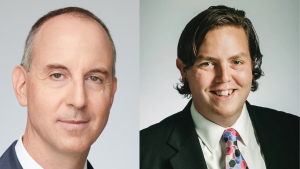
Three UChicago Law School professors were named among Social Science Research Network’s (SSRN) 50 most downloaded authors for legal scholarship in 2025. SSRN is one of the largest online research databases, allowing users free access to over 1.5 million papers.
The Maroon spoke with two of the named professors—William Baude (ranked 41st) and Eric Posner (25th) —to learn more about their research.
William Baude: Constitutional Law
Baude, the Harry Kalven, Jr. Professor of Law, taught at the University of California, San Diego and Stanford University before coming to the Law School in 2014. His scholarship has primarily focused on constitutional law and federal courts, particularly the differences between the powers of the Supreme Court and lower courts, as well as the limits on those powers.
He is currently working on a series of articles explaining the originalist theory of constitutional interpretation. “The debate over originalism is about the extent to which we should use the Constitution’s original meaning to understand what it meant, or the extent of which we should instead let judges update its meaning based on what they think is necessary,” Baude said. “I’m an originalist, so I think part of what makes our constitutional system work is that judges don’t have the power to change it.”
Though originalism is more frequently employed by conservative scholars and judges, Baude is a frequent critic of President Donald Trump.
He collaborated with Michael Stokes Paulsen, a professor at the University of St. Thomas School of Law, to write “The Sweep and Force of Section 3″ published by the University of Pennsylvania Law Review. It argued that, according to Section Three of the 14th Amendment, Trump was constitutionally ineligible to run in the 2024 election because of his role in the January 6 insurrection.
“The Sweep and Force of Section 3” is the most downloaded article on SSRN in the U.S. Constitutional Law: Interpretation & Judicial Review eJournal category, with over 100,000 downloads. The second most downloaded has 11,000.
Baude is also currently researching the effects of partisan mistrust in American democracy, which he notes as a current issue in constitutional discussions. “Both sides of our constitutional disputes don’t trust the other side to obey any rules or to obey any norms,” Baude said. “Each side wants to find ways to retaliate against the other based on what they think the other one is going to do. It’s almost a problem of game theory.”
Baude also emphasized that scholars on constitutional law should try to avoid focusing on current events too much and instead tackle long-lasting questions about the nation’s founding political document.
“Of course, the courts have to apply constitutional law every day, so every year the Supreme Court has new cases about ‘Can you prosecute a current president? Can the president forgive student loans? What about tariffs?’ But the thing scholars have to contribute is not so much specific arguments about these policies. It’s more about, ‘How much discretion should the president have? What should the role of Congress be?’” Baude said.
Baude was appointed by Joe Biden to the Presidential Commission on the Supreme Court of the United States in 2021, which sought to investigate potential reforms to the Supreme Court. “I was what you might call a token conservative, who was there to voice the position that maybe the Supreme Court shouldn’t be packed or reformed or dramatically changed,” Baude said.
In the future, Baude said he wants to spend more time researching the importance of “unwritten law,” such as the tradition of a two-term presidency, which was not legally enforced until the 22nd Amendment. Before Franklin Delano Roosevelt was elected four times, the term limit had simply been a norm established by George Washington. “Legal systems also have a certain amount of common law practices, things that are not written down, that are also very foundational. How to integrate those into constitutional law, written law, is one of my big projects for the future,” he said.
Eric Posner: Antitrust Law and Artificial Intelligence
Posner, the Kirkland & Ellis Distinguished Service Professor of Law, published works on international, contract, and constitutional law early during his academic career before moving toward antitrust law in the past decade, particularly focusing on its application in labor markets.
Posner studied philosophy as an undergraduate and said that he had always had interests in academia. “When I was in law school, I was a bit dismayed about what you’re taught, because it’s not very intellectual, it’s more like, ‘This is how you make a legal argument,’ which is interesting but not philosophically interesting,” he said.
He worked on his academic writing and engaged in independent studies to satisfy his intellectual curiosity, planting the seeds for an eventual career in legal academia. “Because I wrote these papers, I attracted the attention of some of the professors there who are always looking for people who might be good academics.”
Posner served as a law clerk for a circuit judge in D.C. before serving in the Office of Legal Counsel, part of the Department of Justice, from 1992–93. He entered academia shortly afterwards as an assistant professor at the University of Pennsylvania Law School. “Once I went out in the world and actually found out what legal practice was like, I realized it was not how I wanted to pursue my career,” Posner said.
In 2005, Posner wrote his most cited work, The Limits of International Law, which has almost 3,000 citations. Written in collaboration with Jack Goldsmith, who taught at the Law School until 2002, the book argued that international law is not strong enough to constrain state actions.
Posner began researching antitrust law in 2010, working with economists specializing in antitrust and labor law. Antitrust law often seeks to prevent corporations or firms from price-fixing, the practice of rival firms agreeing to sell goods or services at a fixed price, or at least not below a certain threshold. “There’s much less emphasis on the possibility that firms could get together and agree to suppress the wages of workers or agree not to compete for workers,” Posner said, noting that this aspect of antitrust law was the most recent focus of his research.
More recently, Posner has been researching the potential use cases for artificial intelligence in legal practices. He believes there is an opportunity for large language models to serve as judges, or at least assist judges in resolving disputes, making courts quicker and more efficient.
“Experiments have been done where real professional judges are given legal materials and asked to decide hypothetical cases, and I’ve been replicating those experiments but using AI in place of the judges to see whether AI decides the cases differently from the way the judges do,” Posner said.
So far, Posner has written three papers, including one on artificial intelligence, and hopes to continue exploring the potential of the technology. “It’s going to have a lot of implications for law and policy,” Posner said.


Matthew G. Andersson, '96, Booth MBA / Apr 2, 2026 at 8:46 pm
The professors, along with over eighty percent of their law academy peers, are political progressives; bourgeois Marxist is perhaps not inaccurate. Mr. Baude is not a textualist or originalist in the caste of former Chicago Law and judge Antonin Scalia, or Law’s Robert Bork, for example. Baude’s horn book on constitutional law is well done, to the extent it sticks to facts and history. But few works compare to the intellectual integrity and aesthetic elegance of Chicago Law emeritus Richard Epstein’s “The Classical Liberal Constitution.” Former Chicago Law professor Randy Barnett’s programmed instruction work in constitutional law is objectively grounded in facts, and efficient. The SSRN paper otherwise referred to—“The Sweep and Force of Section 3”— has little to do with constitutional law, and more a facile argument used for partisan activism. That is the great risk of the modern US law school, especially due to its vulnerability to bias escalation, fueled by progressive academic saturation (see UChicago Knowledge: “Transforming Law Education. Reclaiming Legal Thinking,” 2020). Moreover, SSRN is an inter-academic network where downloads, used often for research citations, are prone to the confirmation bias problem, especially when law and politics are mixed, which can create download sample anomaly (it is rarely normally distributed). The argument Baude otherwise makes rests on a logical error of induction, as the asserted disqualifying election incident, when subject to significance and other testing, does not conform to known standards of durable evidence. His argument is an example of wishful thinking, where the emotional motivation for specific interpretation produces overestimation of probability, while discounting or ignoring contradictory data, and agency. Most modern law professors struggle to cognitively coordinate legal and political system facts with their private ideology. See the National Association of Scholars, “Universities Have a Logic Problem” and “How Stories Replace Facts in Legal Education.” Concerning Mr. Posner, the pursuit of antitrust in law school is not a stable endeavor, as antitrust is an industrial and applied economics problem, explained by former Chicago economist Lester Telser via mathematical core theory. If you don’t know the mathematics of core theory, and cost accounting, you can’t do the law of antitrust. which is not coherent. As Telser often stated, “antitrust is busy work for lawyers.” Otherwise, the law and economics tradition at Chicago has diminished, if not effectively expired, compared to the rigor of Coase, Director, Bork, Stigler, R. Posner, and others. Cf. E. Posner’s unfortunate book on economic Georgism. With some select exceptions, the law academy is anchored culturally in Fabian socialism, and public justice activism, hence their frequent distortion of law into “lawfare.” See “Why Marxism Thrives in Academia,” concerning Chicago Law and others, NAS, 2.4.26