In the past months, advertisements for the new Art Institute of Chicago exhibition Matisse’s Jazz: Rhythms in Color were plastered across the city, threading Henri Matisse’s vibrant shapes into everyday urban life. Jazz tells a story of courageous innovation and defiance of prevailing artistic style, from Matisse’s Fauvist debuts to his bold late-career collages under Nazi-occupied France.
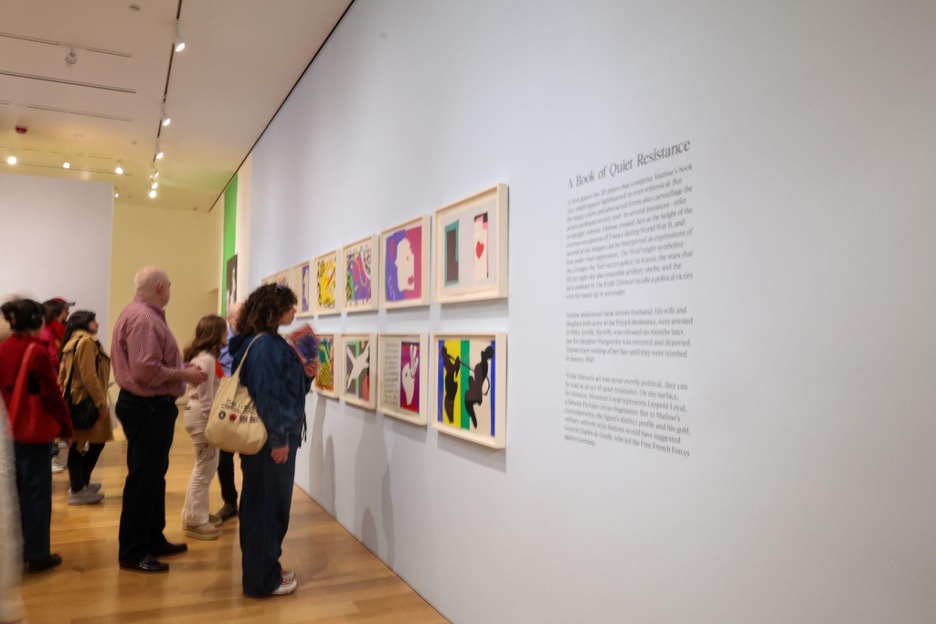
The exhibition takes its name from Matisse’s 1947 book, Jazz. Its twenty pages of colorful prints are sequentially arranged on the walls of the first room, immediately acquainting viewers with the iconoclastic energy running through Matisse’s anthology.
Curatorial notes anchor the imaginative collages in their historical context. They explain that the exuberance of Jazz’s hues is striking given Matisse’s failing health during the time of the work’s creation. Struck by abdominal pain and deteriorating vision, he was unable to stand at the easel or even hold a paintbrush. As traditional painting was inaccessible, Matisse turned to collaging, translating scenes from his imagination into vivacious paper cut–outs.
Matisse described the value in his new approach in Jazz, writing, “To cut right into color makes me think of a sculptor’s carving into stone. This book has been conceived in this spirit.”
Jazz depicts fantastical stories inspired by folktales, mythology, and Matisse’s childhood memories. Through geometric, abstracted shapes, Matisse highlights cherished moments including visits to the circus, parties at Parisian halls, and trips to Tahiti. A recurring theme across the series is ecstatic movement. Le Cirque figures a poised trapeze artist balancing on one foot as they stand above a red carpet. The Sword Swallower depicts a trio of angular blades jutting out from a performer’s open mouth. By enlivening these moments with brilliant color, Matisse accentuates the absurdity of performance.
If the exhibition’s main hall serves as an introduction to Jazz, the following five rooms feel like glimpses into Matisse’s studio. In these rooms, the curators offer a prologue to the groundbreaking direction Matisse took in the 1940s. From wildly vibrant paintings with thick brushstrokes to fluid sketches, each piece demonstrates the artistic exploration with texture that culminated in Jazz.
Upon entering the first gallery, Still Life with Geranium is instantly striking. The work is emblematic of Matisse’s experimentation with color. Simplified forms and bold hues of familiar table objects are initially difficult to identify. On further inspection, the observer may notice root vegetables rendered in vivid red perched beside ceramic pottery framed by a backdrop awash in gradients of turquoise and lilac. This piece captures the simple comfort of light falling upon a domestic setting. By weaving unexpected color into an everyday scene, Matisse invites a moment of appreciation for ordinary pleasures.
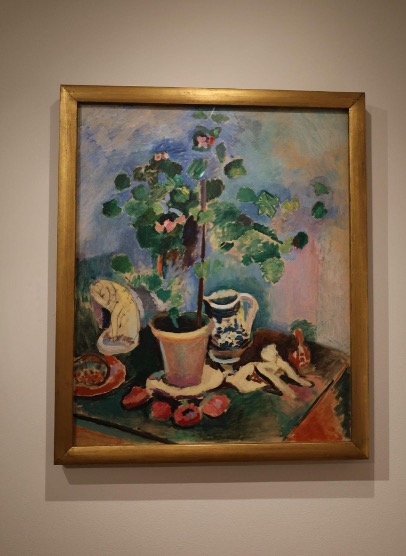
Matisse completed Still Life with Geranium a year after a watershed moment at the 1905 Salon d’Automne exhibition in Paris, where the audience was shocked by the artist’s vigorous brushstrokes and bizarre color, marking a clear divergence from the subdued turn-of-the-century style. After viewing the exhibition, art critic Louis Vauxcelles disparagingly likened Matisse’s frenetic paintings to “les fauves,” translating to wild beasts. In doing so, Vauxcelles unintentionally christened Fauvism, one of the first modern art movements to follow Impressionism. Matisse embraced the label, finding that it captured the spirit of his process. He began with free sketches. Once outlined, he did not examine his palette for a proper color, but rather chose hues impulsively. As a result, Matisse’s paintings pulse with the emotional current of his spontaneous process.
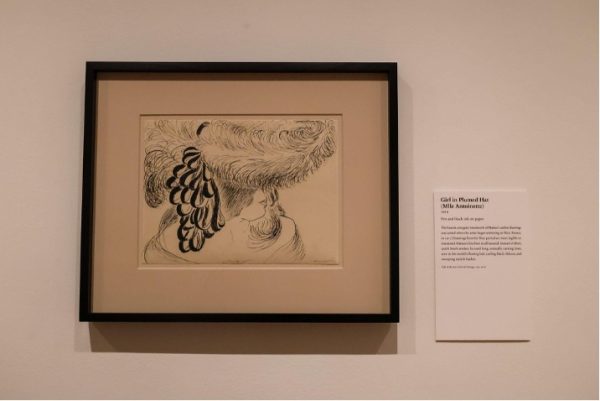
The exhibit also highlights Matisse’s portraits. From depicting fellow artists to studio models, Matisse captured the whimsical personalities of the 1920s. Exhibiting extravagant styles and theatrical postures, each depiction was imbued with the cheerful spirit of the decade. Girl in Plumed Hat renders the model Mademoiselle Antoinette in thick black ink with a flamboyant cap. The hat obscures the top of her face, lending her an air of mystique.
The next room marks a shift towards a lighter and more subtle style. Matisse’s thin lines gently grace the pages of an illustrated 1932 edition of Stéphane Mallarmé’s Poésies. The collection, titled Poésies, presents Mallarmé’s ambiguous prose poems and lyrical sonnets. Matisse drawings harmonize with the poet’s melodic register. His dashed strokes allow the figures to fluidly move through mythic stories across the page. In this phase of his career, Matisse moved away from heavy shading, instead lending the figures a more delicate presence on the lithographs. The book functioned as a lively prelude to Jazz, his looser lines foreshadowing a more extreme simplification into broken shapes.
Years later, during the Nazi occupation of France, Matisse took discreet actions to resist, admitting in 1941 to temporarily sheltering refugees in his studio. His family was more deeply involved in the French resistance, with both his son and his daughter engaging in espionage and insurgent groups. In an interview about his 2025 book Matisse at War: Art and Resistance in Nazi Occupied France, Christopher Gorham remarked that while Matisse’s actions were less rebellious compared to those of his family, “[he] was engaged in a form of resistance that suited his stature, his advanced age and his failing health.” While Nazis condemned modern art as degenerate, Matisse embraced bold color and stylized forms in Jazz. Through defiant compositions, he celebrated the inventiveness of the human spirit in the face of fascist ideology.
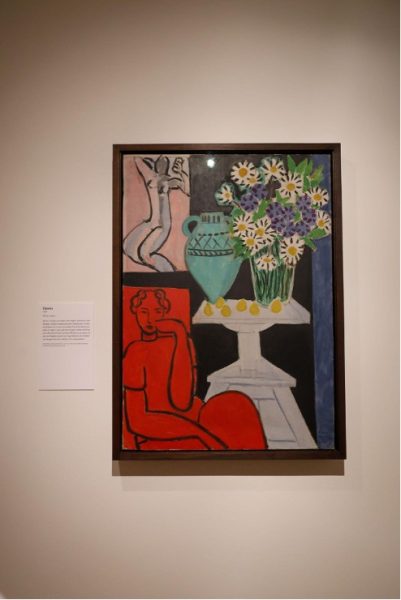
In the final room, Daisies offers a striking example of this artistic philosophy. Matisse’s use of ambiguous forms and composite colors resists the politically sanctioned realistic style imposed by the Nazi regime. Featuring a lopsided woman lounging in a boldly decorated interior, Daisies exemplifies Matisse’s playful affair with abstraction. To the right of the reclining woman is a large disproportionate table littered with artifacts such as a vase brimming with flowers, a turquoise urn, and six small lemons. Matisse named the strong black outlines featured in Daises “ballast”, utilizing the French word for heavy materials. The ballast technique lends the amorphous figures in Daisies a resonant solidity. After Matisse sold Daisies to Jewish art dealer Paul Rosenberg in 1939, the piece was confiscated by the Nazis in 1940. Fortunately, Rosenberg was able to reclaim the piece from Nazi possession for his New York gallery after the war.
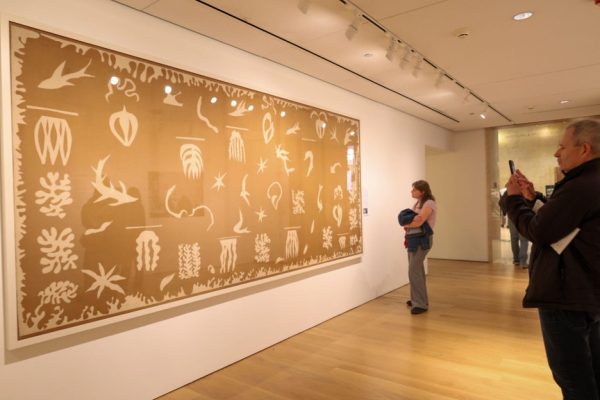
The last room returns to the abstract shapes of Jazz with Oceania, the Sea, a cut-out panel printed onto a shimmering linen. Natural forms of flora and fauna are excised from the textile, demonstrating Matisse’s technique he names in Jazz of “drawing with scissors.” Marine imagery acts as a portal into enduring memories of his vacation to Tahiti in 1930. While creating
this piece, Matisse conversed with friend Louis Aragon, who later recorded his reflections in a biography. Matisse told Aragon that the “enchantments of the sky there [in Tahiti], the sea, the fish, and the coral in the lagoons plunged me into the inaction of total ecstasy.” 16 years later, Matisse revisited the abundant source of inspiration in the creation of Oceania, the Sea.
Amid political upheaval and bodily decline, Matisse transformed color and form into acts of creative freedom. His radical vision ignited subsequent modern art movements and paved the way for the modernist experiments that followed. The Art Institute’s exhibit honors that legacy with care, drawing spectators in with Matisse’s late career triumph, Jazz, then walking them through the decades that made it possible. Nearly 80 years later, Jazz still lands like a revelation.
Matisse’s Jazz: Rhythms in Color was on display from March 7 to June 1.