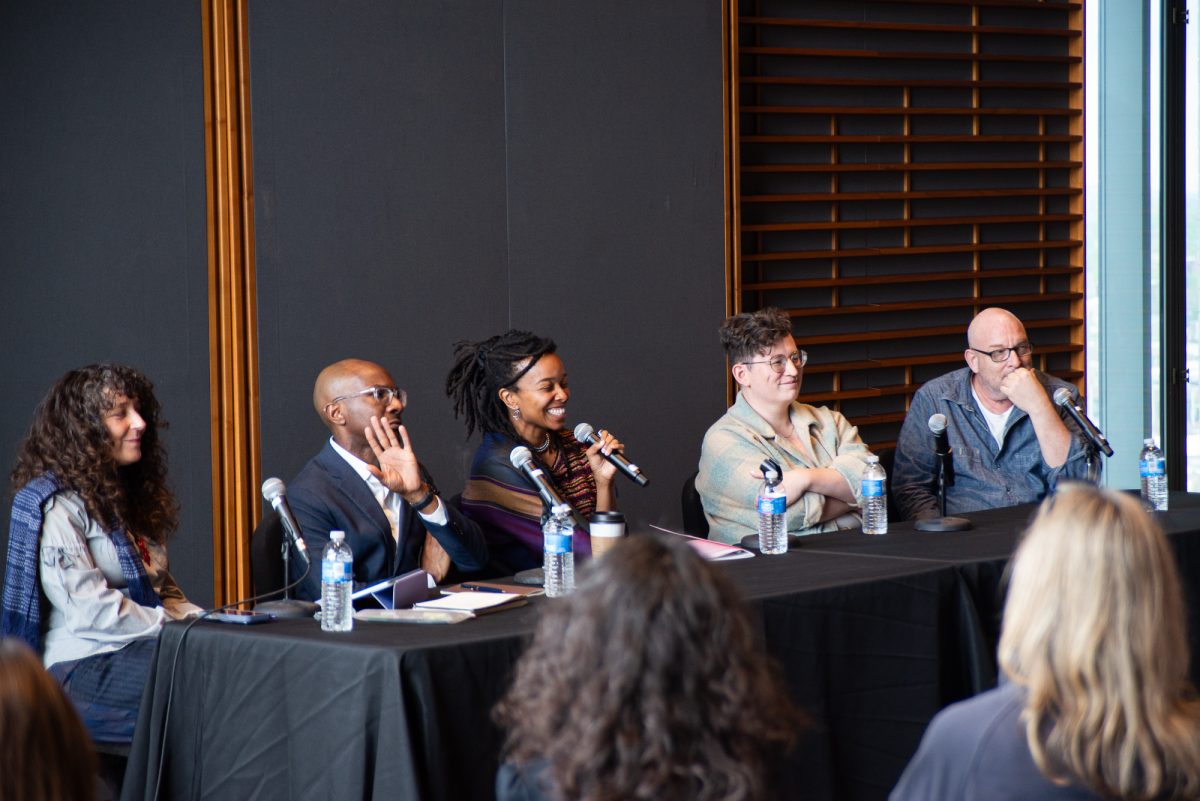
The University’s Program in Creative Writing hosted the 2026 Literary Arts Lab Festival on April 24 and 25, bringing together four distinguished writers to read their work, discuss their processes, and present their perspectives on the writer’s role in society. In the Logan Center Performance Penthouse, students, faculty, and community members gathered against the backdrop of the Chicago skyline to hear from writers Andrea Long Chu, Teju Cole, Jamila Woods, and Richard Siken.
Chu, an essayist and critic at New York magazine, represented the genre of non-fiction. She won the Pulitzer Prize for Criticism in 2023 and was a finalist for the 2019 Lambda Literary Award in Transgender Nonfiction. Sitting opposite Chu, Cole represented fiction and photography. Cole is the Gore Vidal Professor of the Practice of Creative Writing at Harvard University, a position named in honor of the late American writer.
The event also featured poets Woods and Siken. Woods is a poet, songwriter, and performing artist from the South Side of Chicago. She spoke about growing up in a musical household and discovering poetry in high school. She described how these two practices merged: “Eventually writing my own songs showed me that I didn’t have to judge my voice based on how well I could sing a Whitney Houston song; I could write a song for my voice.”
Siken, a poet and painter, won the 2004 Yale Series of Younger Poets prize, a Lambda Literary Award in 2005, and the Thom Gunn Award for Gay Poetry in 2006. During the panel, he commented that poetry is what he creates for an audience, whereas painting is a medium “just for him.”
The event consisted of a writer’s roundtable, a reading, and a Q&A session. In partnership with Pilsen Community Books, works by the featured writers were available at a discount, along with tote bags from the bookstore.
The diversity of styles represented by the panel contributed to a fruitful conversation. They proposed conflicting answers to questions from Scappettone that were often unresolved. Cole remarked at the beginning, “Whoever thought the four of us should be on the same panel is a genius because it’s going to pop off in four different directions.”
The identities of the authors are sewn into their work and therefore shaped their answers as they reflected on their craft. Scappettone, the moderator, asked about the roles of the writer and of literature in society, which resulted in a long-lasting conversation about writing’s potential outside of the hand of its author. The panelists offered four distinct responses, each compelling in its own way.
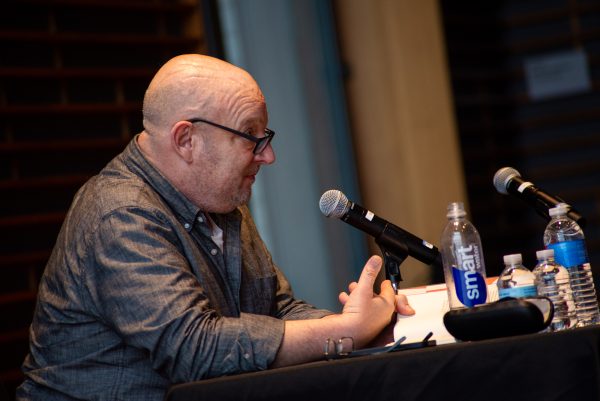
Siken began his response with a short anecdote about a professor he had in graduate school who told him that any creation, whether in art or life, is a political act. Siken recalled wrestling with this idea. He reflected on his doubt and his struggle to determine his beliefs, and thus what to write, offering a beautifully simple conclusion. “I think I like the idea of the fact of me, bearing witness, the fact of me just sharing my experience as an example of something that happens in the world, as a significant way to participate in the discourse,” he said. His experience shapes his words, and he argued that those words, as well as any writer’s, inherently matter to the world.
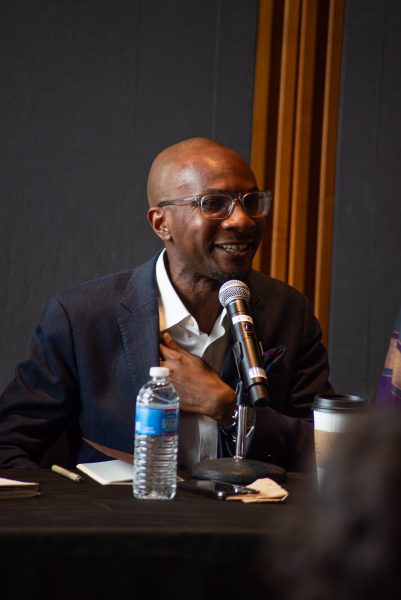
Cole weaved an aspect of the human experience into the conversation. “One way to approach this old difficult question of writing and politics is by acknowledging that we live in difficult circumstances—uniquely difficult,” he said. “Not in the sense that these are the worst circumstances people are living in right now, but because it is a particular amalgam of difficulties, that living in them can feel like they are not difficult at all.” He explained that it is easy to become accustomed to the suffering in the world and ultimately become disconnected from it. Cole refrained from making a connection solely to writing. Instead, he attributed these circumstances to all people rather than writers alone. He underscored that people cannot be passive participants in the world; they must actively confront the hardships they recognize. At another moment in the discussion, Cole claimed that the reason he has had success with his prose is that he has stayed with the format for many years. Because of that, “I’m starting to have a chance to say some of the things I want to say.” Thus, Cole suggested that in the current and uniquely difficult circumstances in the world, truths emerge by addressing them and carefully learning how to articulate them.
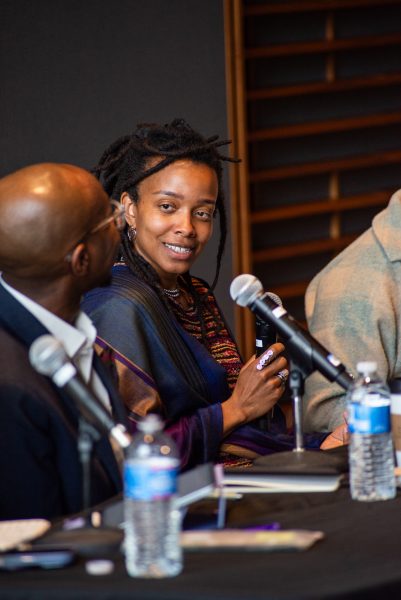
Woods told the audience directly that she preferred to answer from the perspective of a poet. She explained that she thinks of everything she creates as a form of a poem. According to Woods, the value of this lens is “that it has the capacity to connect us to our empathy, our agency, and our ability to make change personally and collectively.” She highlighted her personal focus. “I am motivated by myself wanting to connect to my own capacity to feel.” In this way, Woods is truthful in what she writes and can create art that matters intimately to her. She described writing as a personal process that forces you to look inside yourself, in turn producing truthful writing.
Chu was pragmatic in her answers. She offered a welcome contrast to her panelists, often sparking further conversation and managing to elicit some laughter. Chu remarked that she didn’t think of herself as an artist. She said, “I write for a living and that means that I have to approach it in a practical way.” Chu agreed with Woods that writing is connected to agency while noting that “that agency can be applied in any number of ways.” She warned, “there is nothing about language that is inherently just. I find it very important to remember that you can’t let literature or writing do the work for assembling a coherent set of morals.” Chu suggested that, ultimately, it will be up to the reader to interpret what they consume and construct their belief system.
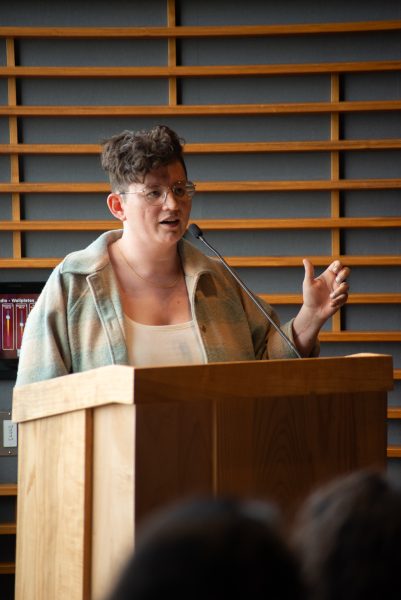
Chu’s comment sparked a long back-and-forth between the panelists on the question of the writer’s role in society. They reflected on their previous answers in the context of her words, discussing whether art is public or private. Woods argued that art inherently begins with the private, leading to a consideration of whether writing can begin privately but become scaled up to a tremendous audience. The question of scaling caused the panelists to examine whether it is truly the role of the writer to understand their work as public and potentially unifying in times of hardship. The act of working through these questions showed that, no matter what art is meant to do, it exerts a force beyond the control of its craftsman.
“When I’m writing it really does feel like a very personal practice of trying to wrestle some question or put language to something that’s on my soul to express. And I have a lot of faith that I’m never the only person who can resonate with whatever that is,” Woods said. Chu was even more optimistic in her belief about writing: “You have to assume that someone is reading on the other end, right?”
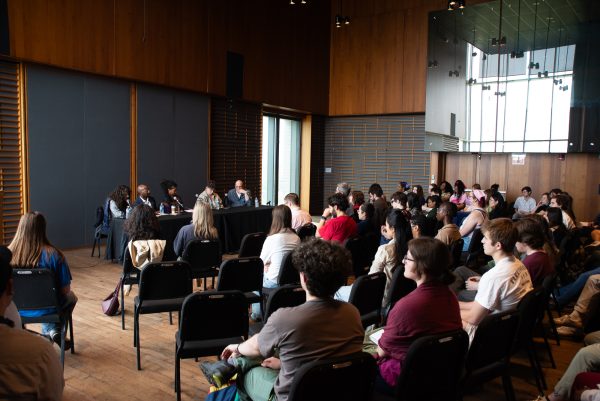
These two statements demonstrated that writing is powerful in its ability to express and to be received. The term “society” can often slip outside of our reach. It can begin to feel abstract, but the panel highlighted that society is fundamentally a composition of people, all of whom have unique stories. By sharing stories with others, personal narratives become impactful on a public scale.
Chu described writing as a descent into the mines, and at the end of the day the writer comes back up to see what they found. Each of the panelists echoed her sentiment. Siken added that in the creative process, sometimes a good day’s work is simply going down into the mines and coming out with nothing but dirty hands. This metaphor suggests that the act of dedicating time and space for writing is enough on its own.
Many answers in the panel circled around literature’s role as a connecting force—a place to deliver a truth, to compel, and to emotionally touch—as well as a method of engagement with the self, others, genre, society, or simply the craft itself. The Literary Arts Lab successfully crafted a diverse panel that argued that writing on its own matters because it is representative of a writer’s time and their experiences. The diverse representation of genre and style allowed for a nuanced discussion of writing’s numerous roles and potentials. The voices of each writer were distinct and thoughtful, leaving the audience inspired by writing’s potential as a personal craft and a public force.