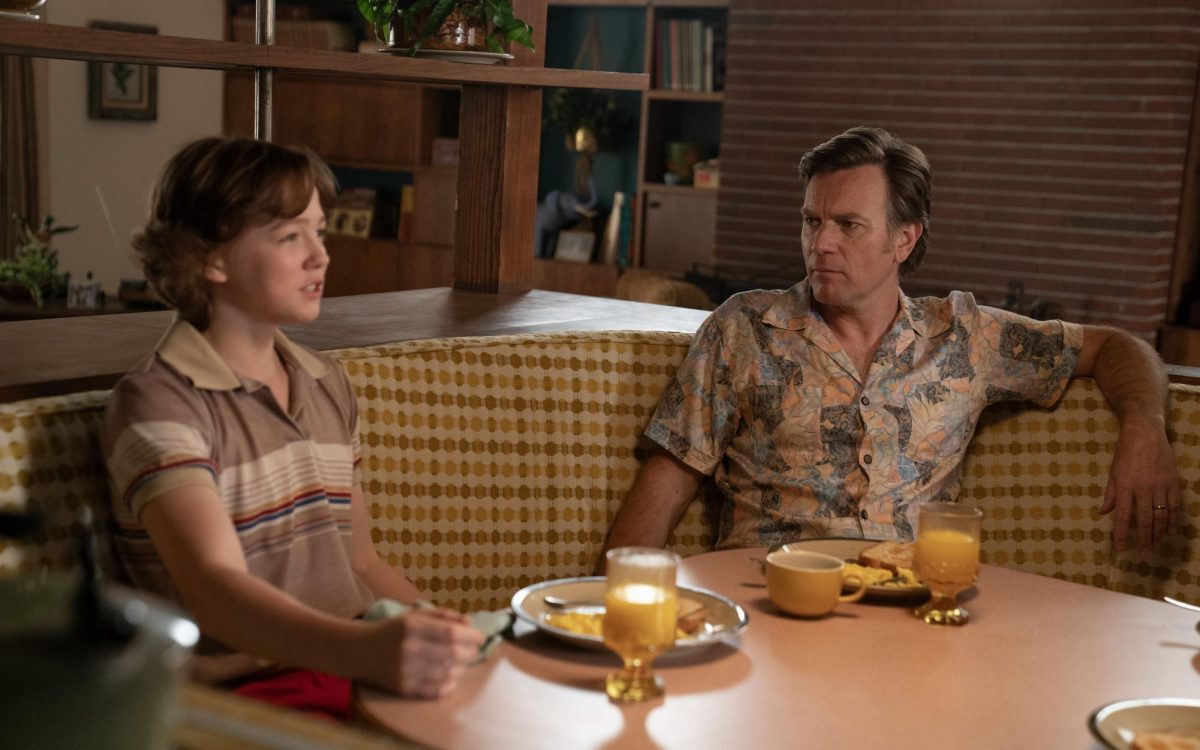
Despite the chaos of T-Rexes, Velociraptors, and Stegosauruses that the trailer promises, The End of Oak Street opens with joyful frames of 1982 suburbia, specifically an incredibly lively block party. Ewan McGregor and Anne Hathaway play Greg and Denise Platt, the loving parents to Brian (Christian Convery) and Audrey Platt (Maisy Stella). The first shot sets up everything that there is to lose for this classic 1982 middle-class suburban family and takes its time before this sense of normalcy is ruptured, replaced with a reality of dinosaurs, death, and devastation.
Writer-director David Robert Mitchell introduces Denise as a complex protagonist from the onset the audience watches her escape the noise of the block party to visit the home of Mrs. Huddleston (Anne Gee Byrd), her elderly neighbor. The two discuss a manuscript she keeps hidden from everyone else in her life. The camera seamlessly moves between wide shots through the outside window to close frames within the living room. The oscillation of shots from outside and inside the house and between the faces of Denise and Mrs. Huddleston reveals Denise’s care for her writing, orienting the audience to a complex character that drives the action of the film.

Instead of leaving the audience to remember Denise’s complexity solely from this one scene, Mitchell solidifies her love and dedication to writing by building in screen time for the family’s routine, including Denise sitting in the basement wearing headphones each night, diligently typing away. This choice facilitates a deeply devastating moment after Oak Street is revealed to have been transported back to the Mesozoic Era. Teenage Audrey lets her mom know that the basement has flooded due to the environmental changes that come with living amongst dinosaurs. Denise lets out a biting “Shit,” realizing that the manuscript she dedicated her nights to is gone. The confusion that flashes across Audrey’s face highlights how Denise keeps pieces of herself hidden. Moments like these demonstrate that Mitchell writes Denise as a full character that functions beyond her central role as a mother. By building the visual rhythm of Denise’s nightly writing it becomes clear that her sense of self is emotionally tied to her writing. Losing this manuscript represents the sacrifice she is forced to make of her old self to lead her family to survival.
The End of Oak Street is a refreshing take on the modern sci-fi film. Modern sci-fi has a recurring problem, often over-relying on special effects and an action-filled plot, while neglecting what made 80s films from the same genre (such as The Goonies and E.T.) beloved: strong writing that centers character dynamics and arcs resulting in an emotional relationship between the audience and film. The film is a character driven narrative, which makes the devastation more intense and visceral.
Opening with a block party and the everyday routines of each of the four characters paints an image of classical suburban life. The characters that drive the film are familiar, which is weaponized against the audience to make each twist of the knife all the more shocking. Editor John Axelrad came together with Mitchell to build incredible suspense. The pair subvert the audience’s expectations through gradual pacing; the action we expect to show up throughout the film does not make an appearance until the latter half. Instead, a foreign plant that hasn’t been seen in 250 million years is found on a neighbor’s lawn. Strobe lights blink in the middle of the night. Instead of hearing the lively chatter of the block party, the screams of neighbors ring in the distance. Each of these small clues gives homage to the pre-CGI lower budget visual effects of 80s sci-fi films. As suburbia slowly fades, suspense quickly builds.
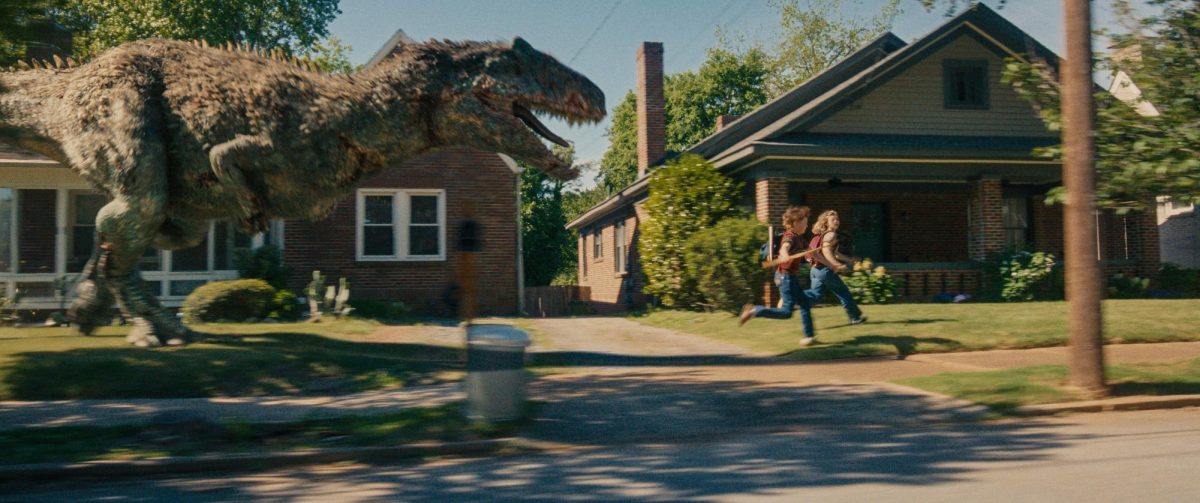
Then the action sets in. Scene after scene, the family barely escapes death. Around each block corner, they encounter morbid visuals that raise the stakes. They watch as their next door neighbor is torn apart limb by limb by Pteranodons, run past dead bodies being fought over by Velociraptors, and are themselves brutalized again and again. The makeup and special effects produce disturbing displays of death, heightening the stakes of the film as the family realizes the only way to survive is to find a way to go forward in time. The visual design of the dinosaurs and their ruthless pursuit of each of the characters felt as inevitable and real as any predator hunting their prey. However, what was terrifying was how the family’s unity built simultaneously as they moved closer and closer to either death or survival. Because the pacing invested time in non-action scenes, each moment of action was consequently filled with more intense dread as well as excitement, ultimately creating an even more gripping cinematic experience.
Although The End of Oak Street is bookended with inaction, during the action the emotional stakes grow even further with displays of normal family dynamics amidst the terror. After catching that the coast is clear, Greg and Denise venture out alone expecting to encounter another near-death experience, but instead they find two mating dinosaurs. The editing facilitates the hilarious transition from them walking on guard through the neighborhood, to their fear spiking as they hear dinosaur grunts, to turning the corner and jump cutting to two dinosaurs mating against a house. The horror of watching people being eaten is broken by such laugh out loud moments and visuals. This dichotomy built incredible suspense and simultaneously made the audience crave the classic family dynamic scenes as a respite and guaranteed laugh after the action.
Critics may argue that The End of Oak Street wraps up too perfectly, making the action and devastation unworthwhile. However, the choice of ending landed as a relief. The catharsis in the final scenes of action made the picture-perfect ending feel earned. It was satisfying to see the characters return to suburban life, with a fresh perspective of how much privilege there is within a loving family. Beyond being set in the 80s, The End of Oak Street embodies a central aspect that makes the 80s sci-fi genre enduring: humor, believable characters, and a plot that seriously tests them with palpable horror and visceral stakes. In the end Denise sits in an office instead of a basement, behind a laptop instead of a typewriter writing her first novel: The End of Oak Street.