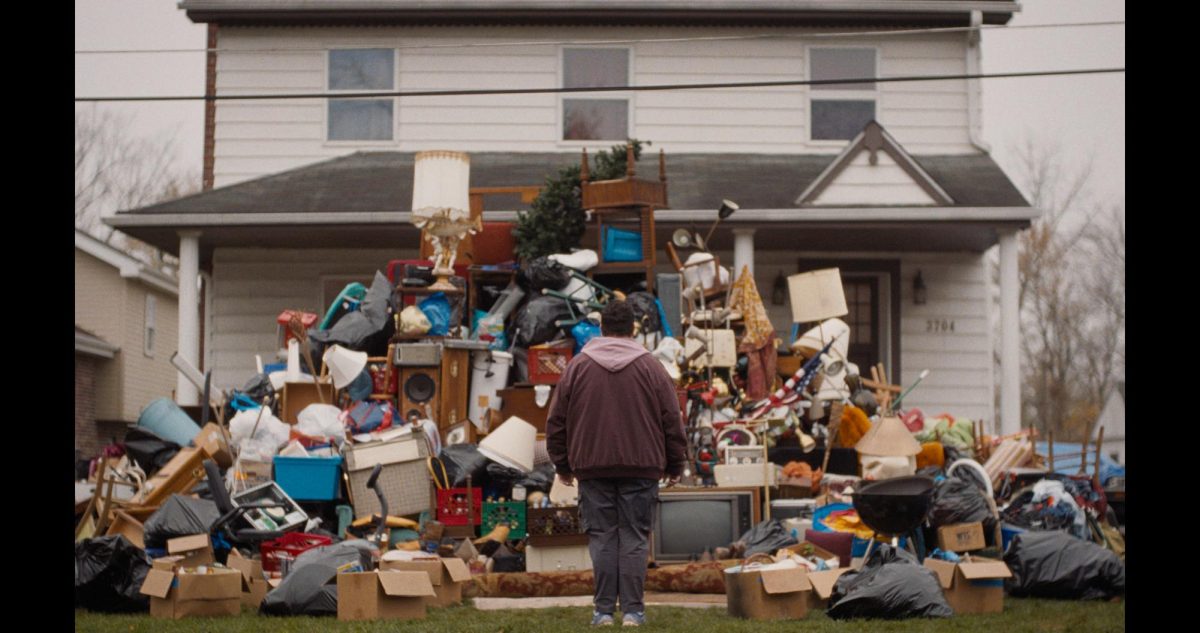
Is it possible to grieve in a place you hate? What about when grieving a person whom you sometimes hated? Trash Mountain explores this conundrum, following Gavin (Caleb Hearon), a gay comedian who lives in Chicago and performs with drag queens. Upon the news of his father’s death, he begrudgingly treks home to rural Missouri. Back in the town he Gavin and his older sister Abbi (Zooey Deschanel) must search for their deceased father’s social security card in his hoarder home, forcing Gavin to remain in the small, conservative town longer than he would prefer.
As Gavin travels home to a land of corn fields and trucks with Donald Trump decal stickers, his reluctance is palpable. Despite his heartwarming reunion with his sister, Gavin aims to swiftly sort through his father’s house so that he can return to the city where he feels that he belongs. In an interview with the Maroon, Hearon, both lead actor and co-writer, details this complex relationship between one’s hometown and their chosen home by relating Gavin’s experience to his own of growing up gay in a rural town: “I am so grateful for it, because I fucking love being from a small town,” he said. “I love that I kind of talk like my aunts when I’m gossiping. I love that I know things about this country that my friends from the coast can never know, because they’re not from where I’m from.” On the other hand, struggles arise, one being that many people from his beloved hometown “don’t think that [he] should be able to marry the person [he] love[s].”
But this dynamic isn’t a dictating factor in Hearon’s life. He believes that being emotionally healthy and well-regulated is “getting over yourself and trying not to think about yourself so much… not allowing yourself to think that you are so unique.” He clarified that almost everyone has a complicated relationship with home, that “there are people that have been displaced from their home by genocide and by climate change and that are from a place they love but can’t go back to.” These complicated feelings toward home are not singular but often expansive, thus making it important to remember that “you are not the only person experiencing anything.”
Being from a small town isn’t the only experience Gavin and Hearon share. Hearon states that there were many facets of the film that felt “powerful” to include, with another being that “Gavin’s character [has] a romantic relationship with a conventionally attractive man, a thin person, and there [are] no self-deprecating jokes, no explaining why this guy would be into a fat person.” Hearon noted that experiences like these aren’t often shown in television and film, making it important for him to use his voice and “say [what he wants] about being alive.”
This film immediately enraptures the viewer and holds their attention throughout. The bittersweet journey Gavin embarks on immediately after receiving word of his father’s death is both relatable and entertaining. A major reason for this is the brilliant writing and performances, which balance both comedy and sadness. One moment, you will cry tears of laughter, giggling at awkward encounters with past high school peers, but soon after you’ll be sobbing from sorrow watching Gavin and Abbi rummage through remnants of childhood memories in their dead father’s home.
Gavin’s tumultuous relationship with his father leads him to cope with humor, cracking dry and witty jokes during intense moments as he sorts through his father’s remains and estate. Hearon argued, “We need more representation in general of grief that feels true and modern.… I don’t see people that talk like me in a lot of movies, or talk like my friends, or talk like my family.” The humor in this film is not overwhelming; instead, it is used to defuse awkward and uncomfortable events, just like a real person would. For instance, when handling the heavy matter of deciding between cremation and burial for their father, Gavin and Abbi giddily mock the pastor’s antics, adding humor to an otherwise uncomfortable moment.
This realness extends to other emotions in the film. As the movie progresses, Gavin’s struggle to cope with his father’s death intensifies, with jokes losing their power as a defense mechanism. Hearon naturally shines in the comedic moments and, remarkably, excels in the emotional scenes as well. As a pair, Hearon and Deschanel deliver a heartbreakingly moving portrayal of siblings mourning a parent.
The choice to focus on Gavin and Abbi’s relationship is vital to the film. Hearon explained that “Abbi provides Gavin with a level of grace and patience that he almost certainly doesn’t deserve at certain parts of the movie,” which leads the audience to have the same feelings toward the grieving son, for “without Abbi, you might not be so willing to excuse Gavin’s behavior and attitude and sarcasm.” All in all, Hearon says that “Abbi represents that feeling to me [that] there are a lot of cool, worthwhile, interesting things and people back home.… And so, I think Abbi represents so many things that Gavin can’t completely communicate to us as a character.”
The film ends on a tender, open-ended scene. While the main plot is resolved, the future of the character is not specified. This decision was collaborative between Hearon, his co-writer Ruby Caster, producers, and the director, Kris Rey. Hearon sees this as the clear choice, saying, “That’s how life is.… I think tying everything up super neatly makes me feel kind of itchy.… It feels more true to me. And I try really hard to tell the truth the best I can.” He then laughed and heartily clarified, “It’s not because I think that we’re going to return for a sequel.”
Hearon’s career wasn’t always pointed toward film, or even comedy. In college, he studied sociopolitical communication, aiming to be a lawyer, but he was “just so fucking bored.” After reevaluating the idea of a life in the courtroom, he shifted to improv and comedy. “This was a way to just kind of make me happy and, like, stop wanting to commit suicide. I hope you can put that in,” he said. Hearon’s humorous coping mechanism is also reflected in Gavin throughout the film, shown in how the aforementioned comical moments brightened the film.
He noted how he found an artistic purpose in these interests and began to venture into stand-up comedy, then sketch comedy, and then back to stand-up. Eventually, he began acting in TV shows while living in Chicago, leading him to his current acting career. Hearon stated that “this is a really lucky version of a career where I’ve kind of woken up every other year and said, I think I’d like to do this thing now. And then I’ve gotten to do it.”
There are two things Hearon seeks out when making art: creating something no one else can and finding a “mix between levity and heartfulness.” He doesn’t want to do just “goofball stuff” or create a piece that is purely “violent or sad.” It is these qualifications that solidified Trash Mountain as a film that fits Hearon’s vision of an artistic piece following the passing of his father.
While the film is based on events from Hearon’s life, it is not an exact documentary of his personal experience. One notable difference between Hearon and his character is Gavin’s harshness with his family. Hearon noted that although he has hard opinions on certain topics, he would never be harsh with his grandmother like Gavin is in the film, such as when he yells at her in a hospital or mocks her religious preferences for his father’s funeral.
This decision to add fictional components to a story based on his own life was difficult for Hearon, who worried that viewers of the film might walk away believing “that’s who he is,” but he says, that’s “not completely who I am, and in many ways, it also is.” They chose to fictionalize some of it because viewers don’t want to see “17 minutes straight of [Hearon] crying in [his] room and then going to the funeral home, and you see the whole car ride and [him] stopping for… coffee. That’s not a film. A film is an artistic expression of an idea or experience.”
As for actually creating the film, Hearon worked with Caster as a co-writer. He believed the script was too close to his own experience and wanted Caster’s input and strengths in order to finish it. The process of co-writing is imperative for Hearon. “Singularness in your work is fine if it happens,” he said, “but being in pursuit of it is so fucking corny and lame. I think it’s more exciting to work with people you respect and bring as many people as you can to the party.”
Being both a star and co-writer for the film, Hearon said that being first on the call sheet was an important responsibility to him: “Even if you’re tired, even if your back hurts, even if you’ve had a really hard day, even if you got [in] a fight with your partner, you really got to show up to work and be the emotional core of the set.” His schedule consisted of early mornings and late-night rewrites, but Hearon embraced the experience: “There’s really nothing like writing such a personal story and showing up to a set. Showing up every day and seeing that number of talented people working to execute this thing that came from your brain is very humbling and exciting.”
Hearon stars alongside Deschanel, an actress known for roles in New Girl (2011–18), (500) Days of Summer (2009), and Elf (2003). Hearon said that he is “such a huge fan of [her],” and he has only grown to “love [her] more and more.” Speaking to this experience and the many other famous actresses he has worked with, Hearon said, “I’ve really worked with such lovely people, and I’ve learned so much from the people I’ve been able to work with. Yeah, I can’t believe my luck, really. It’s been awesome.”
He further remarked, “I feel jealous [of them] in some ways. And also, I don’t know—without a fan-supported system like we have now—if I would have ever even gotten a chance, because I’m a fat gay guy from rural Missouri. There’s give and take. There’s ebb and flow. But primarily, I sit with them, and I’m just astonished by their work ethic and their generosity and their kindness.”
While expressing his respect, Hearon compared the state of the film industry now compared to when these stars were rising. “It’s really hard to get a film like this into theaters,” he said. “It didn’t used to be like that. All the companies are consolidating. These greedy billionaires are buying up everything and downsizing and rightsizing and replacing people with AI.”
As for what he has taught established performers in return, Hearon simply laughed and said, “Oh, God. Probably stuff about Grindr. I’m certain that I haven’t taught them anything.”
Overall, Hearon has one wish for viewers of Trash Mountain: connection. He wants people to see this film with “their best friend or with their family… with strangers in a room… in theaters when they get the chance.… If it could do anything, I hope it inspires people to reach out and reconnect while they still have time. I would do anything for more time with my dad. And I think that would be a beautiful, beautiful thing to come from the movie.”