An audience expects to walk away from a narrative with something. Every question raised by the writer, the director, and the storyteller anticipates an answer. What happens when a narrative unfolds in front of you? What happens when it’s not just a narrative you’re watching, but a person’s reality as they’re living it?
To see convicted fraudster Elizabeth Holmes of Theranos recruit comedian and filmmaker Nathan Fielder as the documentarian for her public relations campaign, one can’t help but be reminded of Fielder’s previous work. The premise feels like something straight out of Nathan for You, his groundbreaking satirical docu-reality comedy television series in which he provided business owners with ridiculous plans for improving their struggling businesses.
The plan? Pair star documentarian Lance Oppenheim with Fielder on a film assignment: to paint a picture of Holmes’s tranquil home life before her impending prison sentence. Together, Oppenheim and Fielder attempt to uncover the nature of how Holmes manipulated scores of powerful men to invest in a product that never fully worked in the first place. Only 10 percent of blood tests performed by Theranos were done using their technology, seemingly unbeknownst to their investors.
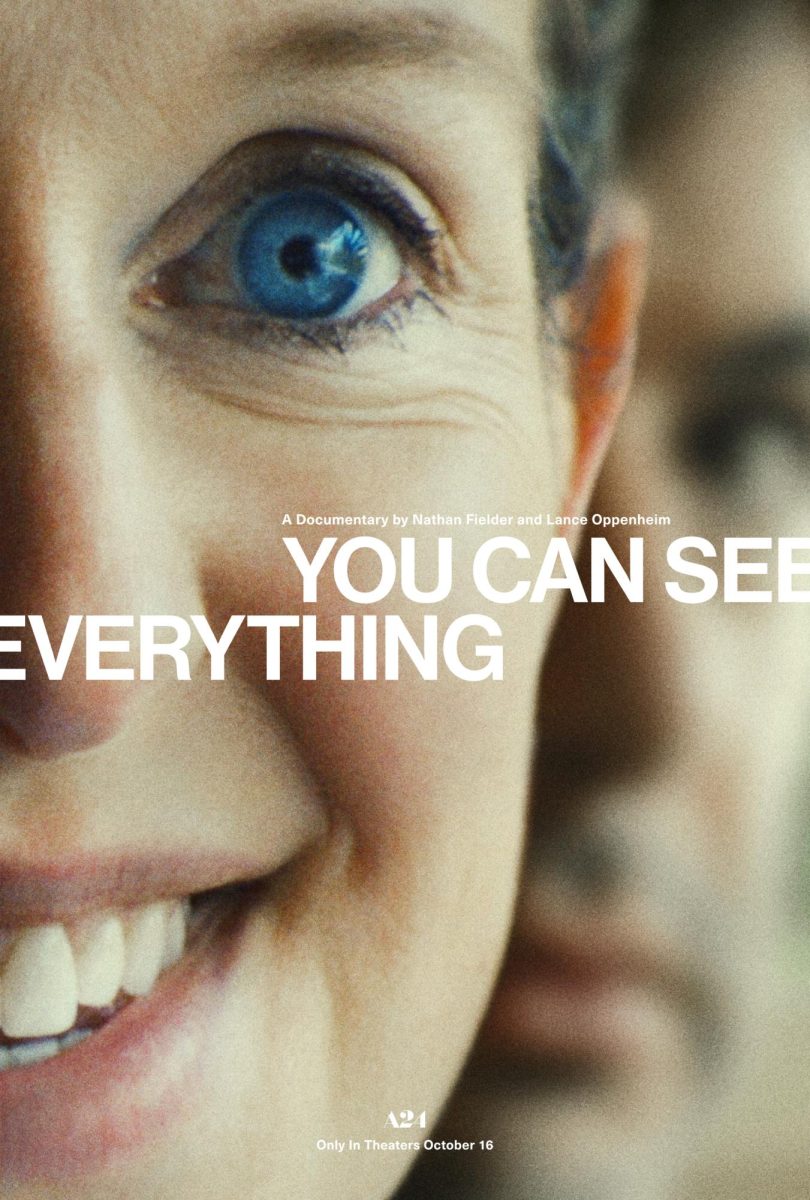
Holmes attempts to create an air of transparency for both the audience and the film’s directors. She reinforces this aim by sending Fielder the text “fyi you can totally see everything…” (from which the film derives its title) during filming. Is she just manipulating Fielder and Oppenheim? Or alternatively: Was she the one manipulated all along? Or are we, as the audience, being manipulated? Or was she manipulating her so-called manipulators?
Fielder and Oppenheim harness this tension: the classical presuppositions of the documentary form and the familiar comfort of separation between actor and script, filmmaker and subject, and reality and narrative are demolished. Dramatic reenactments act as a clever way to get around the inherent limitations of documentary filmmaking while also creating new ones; these insertions blur the line between constructed narrative and reality itself. What we gain in entertainment, we may lose in credulity. Memory is reconstructive and, in parts, so is the documentary. The veneer of the impartial and omniscient director is lost. When we watch Fielder struggle to remember minute details, we are comforted by his desire for precision and disquieted by its potential absence.
One wonders what documentary will look like after the success of You Can See Everything. Following Holmes intermittently over the course of three years, the film struggles to document the inner workings of her mind immediately after the birth of her second child, set against the backdrop of her looming 11-year prison sentence.
Fielder and Oppenheim, as representatives of the audience, get roped into a loopy psychological thriller. As they slowly lose their grip on reality and truth, we do too; what was supposed to be their documentary is quickly hijacked by monumental forces beyond them.
The production was granted unrestricted access to Holmes’s home, with Fielder even moving in, becoming Holmes’s shadow. “What if I see something that makes you look bad?” Fielder asks. For those aware of Holmes’s saga with Theranos, the inevitable question is what he could possibly see that would make her look good.
Even if viewers come in with ironclad preconceived notions of Holmes’s guilt as a fraudster, the film questions the extent to which we must empathize with her circumstances as a subject deprived of her voice and a soon to be ripped from her children.
Fielder launches the project into the stratosphere with his signature off-putting persona and genre-defying destabilization of the documentary form. Along with the rest of the crew, Fielder and Oppenheim are embedded in Holmes and her partner William “Billy” Evans’s home.
Director of Photography David Bolen is a frequent collaborator of Oppenheim’s, but his vision persists in a far more restricted style than his work on Primetime. Instead, likely forced by necessity and discretion, the camera lingers at a safe distance from the actors, while extreme telephoto lenses, usually reserved for documenting wildlife, are pushed in on the faces of our subjects, uncomfortably so. Up close, we can see Holmes’s contact lenses as she maintains unflinching eye contact with Fielder.
There’s an unexpected contrast between the visual compression and the intimate sound of the production. The sound in the film relies largely on lavalier microphones, tucked into the clothing of our subjects. You can see everything, but you can hear everything too—or can you?
The audiovisual tension highlights You Can See Everything’s ingenious move: the destruction of the epistemic certainty that often accompanies documentary films of its kind. The impartiality of the filmmaker is entirely destabilized. The intimately captured audio places us between Fielder and Holmes, while the visuals condemn us to peering in from the next room, warping the sense of reality that the audience typically takes for granted.
Halfway through the runtime, Holmes effectively exits the film. What the audience finds when the film loses its subject is nothing short of revelatory. The lengths both the filmmakers and those in Holmes’s life go to fill her absence, and its moral implications therein, leave jaws on floors.
The directorial duo is counting on the audience’s skepticism of the carpet of the narrative underfoot, so enticingly laid out by both the role of the documentary as a form of truth-telling and the cinema as a cultural institution, as the lights dim and the opening credits play. Yet, despite our preparedness, the rug is immediately pulled away, and we fall on our asses.
We may feel, at moments, that we have found our footing, yet the rug is yanked away again; this time, we hit our heads. Oppenheim and Fielder have lost their grip too. The film they set out to make isn’t theirs anymore. Rather, the film is an inclined treadmill running at 60 miles an hour on which the duo and the audience sprint for its three-hour run time.
You can see everything. Will you?