Late in the night, a group of dazed students marches into a room on the third floor of the Kersten Physics Teaching Center, cans upon cans of Monster Energy clutched tightly against their chests—their shields, protecting them as they head into battle. Armed with brightly colored energy drinks, these students can take down the need for sleep as midterms loom in the distance.
Monster Energy cans are easily accessible to students in the UChicago Space Program (UCSP); a large supply of free Monster sits innocuously on the shelves of their second-floor lab.
UCSP’s relationship with Big Caffeine is hardly unique. All over campus, students share stories of combatting their need for sleep, lost due to stressful RSOs or classes, with an easy fix: free energy drinks.
This University’s relationship with caffeine is legend. Per data released by Grubhub in 2017, UChicago students order 138 percent more caffeinated beverages than the national average, making it the most caffeinated campus in the US. (Notably, that data doesn’t include the amount of caffeine UChicago students buy from cafes on campus or get from club sponsorships). With around 10 coffee shops within a one-mile radius of campus, students and faculty constantly lament the amount of coffee they drink or debate which café is best. Energy drinks, however, are often missing from the conversation.
Even so, they’re everywhere. Energy drink companies sponsor clubs and events. Cans are available for purchase at on-campus stores, cafes, and vending machines. Bringing energy drinks into the conversation raises a different question: is the extensive presence of energy drinks a product or a cause of the University’s caffeine culture?

Sponsored and Saturated
RSO leadership can acquire energy drink sponsorships by reaching out to a student marketeer, or they can reach out directly to companies if they don’t already have representatives on campus, as is the case for Monster Energy. Third-year Seth Knights, president of UCSP, said that his RSO’s vice president simply “reached out” to Monster and the company was happy to sponsor the RSO.
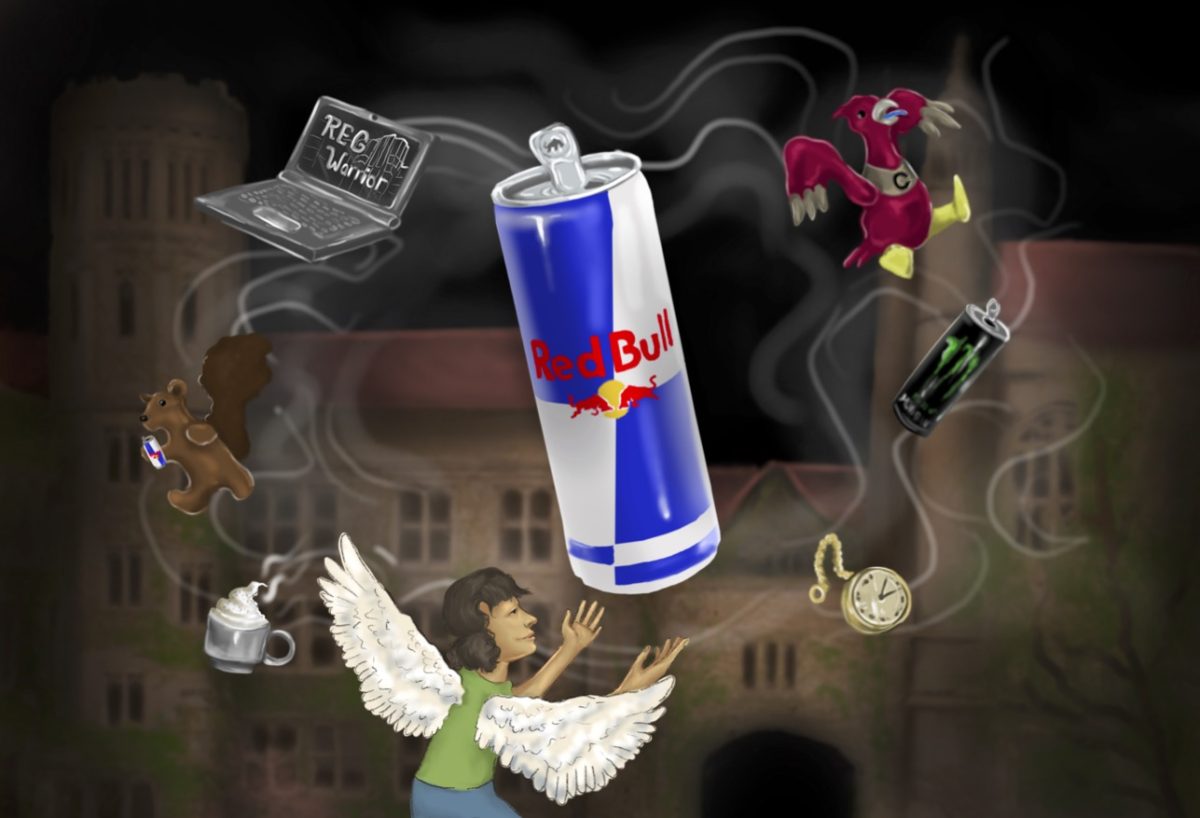
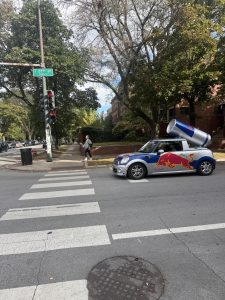
A Red Bull–branded car, complete with a giant can on the roof, periodically sits parked by the curb outside Regenstein Library. Individuals in Red Bull–branded backpacks stand nearby, handing out free cans. The same car can be seen driving around campus and sitting on the quad during the University’s annual music festival, Summer Breeze. Red Bull has also sponsored other events at UChicago, including a collaboration between UChicago Scav and the Delta Kappa Epsilon (DKE) fraternity last month.
Red Bull also supplies drinks to most fraternities on campus including Psi Upsilon Omega, DKE, and Sigma Chi, according to a review of their respective Instagram pages. Monster Energy also sponsors the club volleyball team.
Third-year Samuel Morse, a member of UChicago’s Mock Trial team, explained that RSO sponsorships work through a simple exchange. “Whenever [Mock Trial has] an event or competition, we reach out to Red Bull and they’re happy to give us Red Bull,” he said. “Then we have our members or invitees, holding Red Bulls, take a few photos. We also take a lot of candid shots of people enjoying the product and we send those photos over to Red Bull.”
Knights explained that UCSP’s relationship with Monster functions in much the same way. According to Knights, UCSP club members take photos of themselves holding cans of Monster Energy, send them over to the company, and get shipments of boxes of Monster in return.
“I’m not totally sure what they’re using the photos for, but I would hope they’re of use to them,” Morse said.
Second-year Ian Schmidt, director of outreach and social media manager for the club volleyball team, told the Maroon that the team also posts photos with Monster Energy on the club’s own social media, and that the company is “super flexible about what kind of photos we’re taking and where we’re posting them.”
“We always get a lot of Monster,” he added.
Third-year Jackson Collins, a student marketeer, works part-time for Red Bull promoting the product on campus through RSO and event sponsorships. The co-founder of Red Bull, Dietrich Mateschitz, thought that college students couldn’t be targeted in the same way as “a bunch of 50-year-old, 60-year-old guys in suits in a boardroom in Austria, so [Red Bull] created student marketeers,” Collins said.
“We’re trying to create a Red Bull family that’s always going to be there for you… when you’re at some frat having a good time and when you’re in the Reg and you’re hiding from the security officer because you really need to finish this essay and it’s 12:30 a.m.,” Collins said.
The convenient appearance of energy drinks right before finals or right outside of the biggest library on campus is not coincidental. With student marketeers, companies like Red Bull know when energy drinks will be the most in demand and can then respond to that demand, according to Collins.
Demand runs high during exam weeks and popular social events. “I will say to my boss, ‘You know, listen, we’ve got our first rounds of midterms coming up,’ or ‘Our finals week is coming up, so this is going to be a big time in front of the Reg.’ So they’ll send out two guys in the car in front of the Reg,” Collins said.“Or I tell them it’s Homecoming and I say that there’s going to be a bunch of people here, so send a couple of cars. Summer Breeze is another good example of that,” he said. “We’re trying to push against that 5-hour Energy reputation by sponsoring all sorts of events and clubs.”
At each event, and with every sponsorship, the pattern is the same: free distribution, high visibility, and constant branding. Their reach is vast—and largely hidden in plain sight. But why would energy drink companies even want to sponsor concerts, events, or clubs?
More Than Just Study Fuel
Both Morse and Arav Saksena, former president of Phi Delta Theta’s UChicago chapter, suggest that energy drink companies are present in other, nonacademic spheres in hopes of being viewed as a fun, cool, young, alternative to coffee and other caffeinated beverages.
Red Bull has what Saksena calls a “guerilla marketing” strategy. Besides its famous “Red Bull gives you wings” commercials, Red Bull sponsors Formula 1 drivers and many famous athletes, including freestyle skier Eileen Gu and snowboarder Scotty James.
When asked why Monster Energy would want to sponsor a sports team like club volleyball, Schmidt said, “I think they want to have an image of being associated with athletics, which people associate with good health. Monster is mostly associated with pseudo-sports, like monster trucks and things… so maybe they want to try and get into that niche.”
Moreover, according to Saksena, targeting frats allows energy drink companies to move away from “that 5-hour Energy reputation” that they have and “toward an ‘omnipurposed’ energy drink. You can drink it at a social event, before a big exam, before you work out… that sort of thing.”
Notably, “that 5-hour Energy reputation” is also how Collins, a paid marketeer for Red Bull, described some people’s perceptions of the brand’s image.
Collins explained Red Bull’s approach to college campuses: “I mean there’s a split between what the company wants and what the marketeer decides,” he said. “I just want to make sure everyone is having the best time possible and I think having a multinational conglomerate backing you is an easy way to take events… and give them infrastructure and credibility.”
So are energy drink companies simply responding to student exhaustion, or are they becoming the default fuel of both work and fun—a “drink that people my age love to drink and aren’t necessarily drinking it for the purpose of having a caffeine source,” as Morse describes it?
According to Morse, “more and more people are looking toward more creative caffeinated energy drinks. Not just a boost in the morning but the boost throughout the day.”
“People don’t really go for coffee for that purpose,” he continued. Red Bull is “a more fun way to drink some caffeine. Like with Starbucks, they have their sweet drinks that apply to a younger audience… with an energy drink with all these different flavors, it’s young and fun… I think people are drawn to that… it’s sleek [and] it’s got a lot of flavors.”
Ex Libris, a student-run café in Regenstein Library, serves a drink called the “Great Fire”, combining Red Bull, lemonade, and pomegranate syrup for a sweet and highly caffeinated drink. More recently, they served the ‘Scrink’ from May 4–10, 2026, to celebrate Scav. The ‘Scrink’ is made with Red Bull, cherry syrup, and Mountain Dew. And one of Harper Cafe’s many “community creations,” drinks, dubbed “Surfin’ USA,” is made with Red Bull, orange juice, and mango syrup.
Collins explained why he believes Red Bull, specifically, is easily available at UChicago. “Red Bull is one of the, like, last holdouts of an energy drink that hasn’t been bought out. Most notably, the thing that screws us in every other campus across Chicago is a Coca-Cola exclusivity clause,” Collins said. Most universities in Illinois have signed a contract requiring university-owned dining halls, cafes, and even vending machines to exclusively sell Coca-Cola products (which includes Monster Energy). The fact that UChicago has not signed one of these sweeping exclusivity clauses is the main reason Collins cites for the wide reach of Red Bull on UChicago’s campus.
A Crutch or Just a Drink?
Since the start of Phi Delta Theta’s sponsorship in October 2025, Saksena hasn’t noticed any change to the fraternity culture but did express concern about caffeine consumption on UChicago campus.
Saksena recalled that, while studying for an exam during his freshman year, he had left the Regenstein Library to grab food. He saw “two stretchers outside the entrance with two poor people foaming at the mouth, going into an ambulance,” Saksena said.
While he didn’t know the cause of these emergencies, he speculated that they were caused by an overconsumption of caffeine. “It’s insane that it has ever come to that. That was at like 3 p.m. You had to have been drinking so much for so long for something like that to happen. And so it’s definitely endemic and it needs to be addressed,” he added.
Studies have linked high levels of caffeine intake to increased risks of heart palpitations, anxiety, insomnia, and, in extreme cases, caffeine toxicity, particularly when consumed quickly or combined with alcohol.
The Wall Street Journal reported on younger students having seizures due to their caffeine intake, and a National Institute of Health article cited a specific incident in which a 30-year-old man had a seizure after ingesting 900 mg of caffeine.
The U.S. Food and Drug Administration considers up to 400 milligrams of caffeine per day safe for healthy adults, equivalent to about four cups of coffee. A can of Red Bull, on the lower end, has 80 milligrams of caffeine. A can of Monster contains 140–160 milligrams of caffeine depending on if you drink the lower-sugar or lower-carb options. A can of Celsius contains 200 milligrams of caffeine. So, to pass the safe threshold, you’d have to drink 5 cans of Red Bull, 2.5 cans of Monster, or 2 cans of Celsius.

Morse believes that Redbull’s brand messaging doesn’t promote caffeine overconsumption. “Red Bull isn’t saying you should have 10 cans a day or [that] you should always have a Red Bull in hand when you’re going from class to class. That’s not what they’re trying to push for,” Morse said. “It’s not supposed to be like a crutch or like a supplement to your diet. They’re not at all trying to force themselves into your life as this all-consuming beverage that makes you tick.”
Regardless of company intent, UChicago students are using Red Bull and other energy drinks as a tool to help them study longer, stay up later, and generally to push through their exhaustion. Collins claimed that people can use Red Bull as a “crutch.” They may also be drinking energy drinks for fun, but that doesn’t mean they aren’t creating a dependence, he said.
An RSO like UCSP faces a lot of deadlines that require late nights, whether that be submitting funding requests or completing pieces of its satellite. Students in RSOs that have free access to unlimited amounts of energy drinks “are more likely to drink it because, well, it’s free… it being free decreases the barrier so much,” Knights said. “Since it’s free, you don’t necessarily have to drink all of it and you don’t feel bad about throwing it away… so maybe it leads to people who would otherwise not go buy an energy drink grabbing one.”
Difficult work and tight deadlines, however, are not unique to students in UCSP. “Why would these energy drink companies target UChicago? I mean I definitely didn’t drink energy drinks before coming to UChicago,” Knights said, recounting how he began drinking energy drinks his first year in order to stay awake through Inquiry Based Exploration of Biology, a three-hour-long lecture and laboratory course.
“UChicago is a mass of people who are already getting addicted to caffeine and have abnormal amounts of deadlines that they need to hit,” he added.
Collins emphasized that Red Bull is best consumed in moderation.
“I think it would be naïve of me to say that Red Bull has no idea of UChicago’s reputation. I mean, there’s a photo hanging in the admissions office illustrating said reputation,” he said.
“We can talk about the moral and ethical quandaries that come with exploitations of certain—I don’t want to call it an addiction—but, I guess, reliance. And everyone does it, and that’s not an excuse,” Collins said. “I’m tiptoeing because, well, I do love this job, but I think it’s definitely a problem.”
For Schmidt, athletes aren’t using energy drinks to work out or play in tournaments. Instead, they are taking them from sponsored events or tournaments as study fuel.
According to Saksensa, when one of Phi Delta Theta’s parties or mixers is sponsored by Red Bull, Saksena says they’re sent a box of Red Bull to feature prominently at the event so partygoers can easily grab a can. Being sponsored by Red Bull brings people to their parties, Saksena said. “It brings in older brothers who are sort of checked out of the party culture and encourages them to come to parties just because of UChicago culture, you know, they want a kind of stimulant.”
Saksena also expressed worry about the impacts energy drinks can have on party culture. “When people are drinking alcohol with these stimulants, there’s definitely ‘benefits.’ You stay awake longer, you can have more fun, [and] the effects of alcohol are dulled.”
The so-called “benefits” that Saksena is referring to are not unique to Red Bull. “If Red Bull isn’t there, another drink will be. The issue is endemic and I don’t think… killing one brand, or even removing energy drinks from the conversation more broadly, is going to solve the issue,” Saksena said.
“If Red Bull goes away, then Celsius will fill that gap… or in the party context, espresso martinis will. It’s already baked in the culture,” he continued.
Saksena claimed there’s a difficulty in solving the issue of overconsumption “because at UChicago, I think people really need [energy drinks]. To be honest, I don’t really drink energy drinks but this morning I had to drink some Red Bull because I had a midterm at 8:30 in the morning and I’d been studying since like 3 a.m.”
“It’s an issue that the University needs to fix. To be honest with you, these companies are multinational with just loads of money. And when you’re multinational, focusing on solving a caffeine problem, it’s barely going to hurt your bottom end, and even at one specific school, you can’t expect them to fix it. This is really a problem, [this] culture we’ve cultivated,” Collins said.
Caffeinated Since Construction
Saksena says that in his experience, overconsumption isn’t a new problem. His older sister graduated from the University in 2016. “Even then, people were overdosing on caffeine,” Saksena claimed.
Collins echoed Saksena’s sentiment, claiming that UChicago students have been reliant on caffeine for years. “If you think back to the ’60s, yeah, Red Bull wasn’t on campus, but those guys were downing pots of coffee.”
According to the Maroon archives, UChicago students of years past weren’t just “downing pots of coffee” to get their caffeine fix. In February 1982, the Maroon published a piece describing the ways students used stimulants in order to stay up and study. Over 40 years ago, students may not have relied on energy drinks, but they were drinking coffee, taking caffeine pills, and even calling “non-recreational” drugs like amphetamine (a.k.a. speed), “necessary.”
In the 1960s the Maroon published advertisements for a caffeine pill called “NoDoz” more than 10 times.
A satirical advertisement for a brunch event in which former First Lady Nancy Reagan is pictured “injecting a caffeine supplement” was published in the April 26, 1965 issue of what then was the Grey City Journal.
The longtime presence of caffeine at UChicago is helping shape what Collins describes as “not a culture of ‘over-caffeination,’ but a culture of overwork—one that leads to overconsumption.” UChicago’s culture of overwork may be the root of the problem, but the widespread presence of energy drinks has become part of the system that fuels it.
Today, the Maroon may not be advertising caffeine pills, but if you were to walk into the Maroon office on production night, there would be at least one shiny energy drink can on the table.
Since the 1930s, UChicago students have relied on stimulants, in both legal and illegal forms, to face the uphill battle of neverending midterms, essays, and finals. Today, Celsius might have found a way to shape the same chemical that Monster Energy brands as “Monster Assault” into illusions of tropical beaches, nostalgic reveries of the ’90s, or some commodified version of cosmic nirvana. Red Bull does the same with its “editions” while simultaneously presenting itself as a party drink.
The difference in branding ultimately anaesthetizes the same experience: rejecting sleep in favor of success.
Editor’s note: Arav Saksena is a chief financial officer for the Maroon. He had no involvement in the reporting or editing of this story. At time of publication Phi Delta Theta has been suspended.