Chicago Public Schools (CPS) will be overseen for the first time by a fully elected school board starting in January, the culmination of a five-year legislative change ending decades of mayor-appointed governance.
Residents will vote for president of the school board and for their district’s representatives on November 3. Ahead of Election Day, the Maroon has compiled overviews of each candidate’s platform in the races for school board president and the University’s two surrounding subdistricts, 6B and 10A.
Decreasing enrollment, a growing budget deficit, and the debate over closing less-attended schools are major talking points for all candidates. Enrollment across the CPS system has dropped 20 percent in the last decade, with this past year seeing the largest enrollment drop since the COVID-19 pandemic; 150 of the district’s 626 schools now operate at half capacity.
CPS also maintains a deficit of $732.5 million despite the drop in student registration, and, according to district data, CPS has “73 percent of the revenue that the formula says the District needs to be ‘adequately’ funded,” 8 percentage points fewer than it did two years prior.
The Chicago Teachers Union (CTU), Mayor Brandon Johnson, and other politicians and partisan interest groups have endorsed candidates in the various races. Michael Sacks, CEO of investment firm GCM Grosvenor and a prominent Chicago Democratic donor, has taken a significant financial interest in the elections after originally attempting to lobby against the elected board model. He has since donated to multiple candidates across the city, including school board presidential candidate Jessica Biggs.
Early voting centers are open in the Chicago area from 9 a.m. to 6 p.m. on weekdays, 9 a.m. to 5 p.m. on Saturdays, and 10 a.m. to 4 p.m. on Sundays until November 2. On campus, early voting opened at the Reynolds Club on Wednesday, October 28, and will run through Friday, October 30, from 10 a.m. to 5 p.m.
On Election Day, November 3, voters can only vote from their precinct’s polling place. Polls will be open from 6 a.m. to 7 p.m. Residents can find their polling place by visiting the Illinois State Board of Elections website.
Online voter registration has closed for the 2026 general election but will reopen after Election Day. Illinois offers same-day, in-person voter registration at various county and city offices and at polling places. To register to vote in person, residents must bring two forms of valid identification, with at least one showing proof of residency (such as a driver’s license, bank statement, resident contract, or utility bill). For students living on campus, a housing confirmation document can be found in the MyHousing portal.
To vote in Illinois, individuals must be U.S. citizens, be 18 years old by Election Day, and have lived in their precinct for at least 30 days before the election.
Presidential candidates
The three presidential candidates are Victor Henderson, Jessica Biggs, and Hilario Dominguez. Sendhil Revuluri, the former vice president of the Chicago Board of Education, remains on the ballot despite dropping out of the race in September.
Each remaining candidate has proposed sets of solutions to the most critical issues facing CPS, including funding, school closures, and community involvement. However, each campaign has been fraught with controversies. Opponents have resurfaced decade-old claims criticizing candidates’ respective approaches to corporal punishment, attendance records, and sexual misconduct.
Henderson did not respond to requests for an interview.
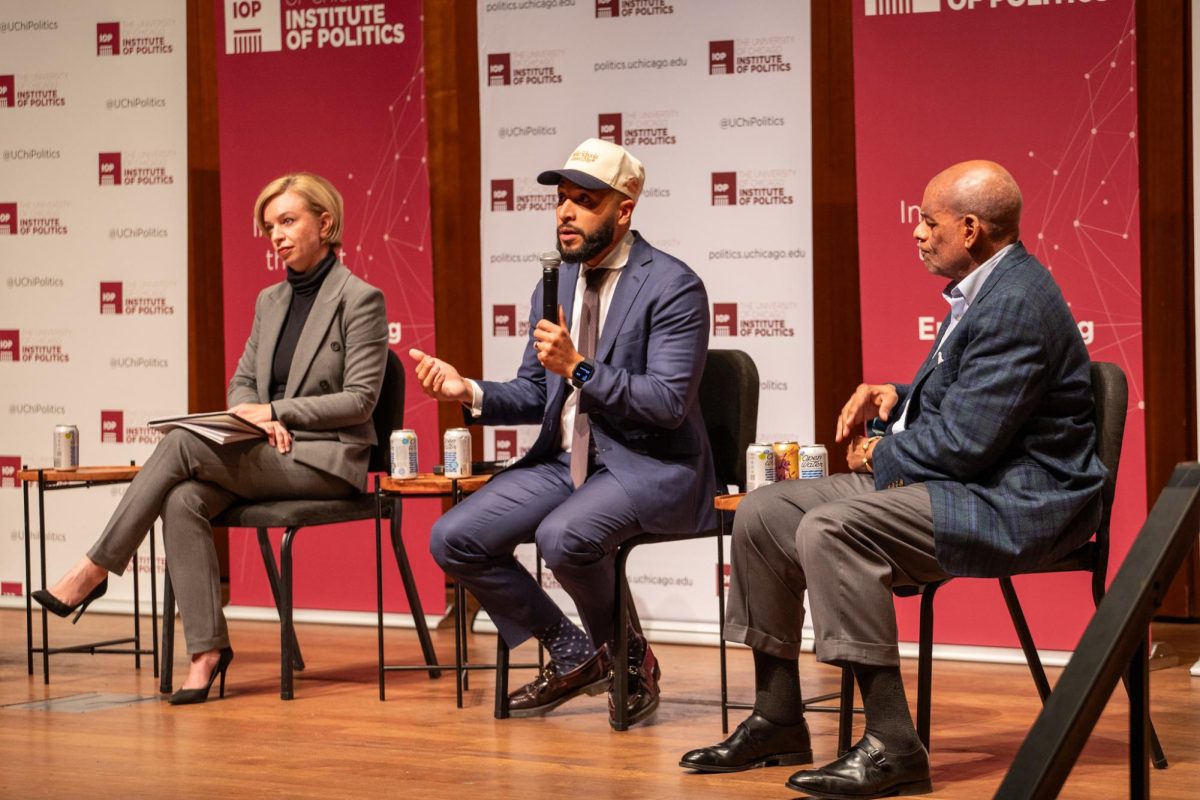
Hilario Dominguez: Dominguez, a former CTU organizer, is CTU’s candidate of choice in the board president’s election and has been outspoken against Sacks’s spending on the race.
“[Sacks] spent over $3 million on just attacking me. He said from the very beginning, he wrote a letter to President Stacy Davis Gates of the Chicago Teachers Union saying that he would do and spend whatever it took to beat me,” Dominguez said in an interview with the Maroon.
Dominguez opposes school closures as a tool for promoting district financial stability, saying they help neither the CPS budget nor students’ education. In the interview, he cited a 2026 Stanford University study which found that school closures did not improve the financial state of school districts in California.
“Here in Chicago, we’ve tried [closing schools] over 180 different times, and not once has it saved us money,” he told the Maroon. Former Mayor Rahm Emmanuel closed 50 schools in 2013 as part of the city’s response to similar enrollment declines and a $1 billion deficit in the district’s budget. The effort was largely unsuccessful and may have contributed to population declines in low-income neighborhoods.
Dominguez also cited a June UChicago study that found that when schools closed, especially on the South and West sides, shootings increased around the schools by 9.9 percent. “What [closing schools] does do—and Chicago tells us this too in their study—is that it increased gun violence around the closed schools. Why do we continue to do something that doesn’t work?” Dominguez said.
Dominguez supports schools forming corporate partnerships to manage debt. “What the model calls for is for the community to come together with the school to decide on everything: programming, curriculum, [and] the whole entire environment [and] ecosystem of the school is decided upon by the community and the school together,” he said.
He also promotes recruiting volunteers from community groups to watch over students on their way to school. These community groups could “provide staff that are quite literally in the streets, in the most populated routes to and from schools… keeping eyes on our students, walking with them back and forth to and from school, so that it deters violence because now they see community members out in the street.”
Dominguez’s campaign has also been marked by controversy. A district watchdog this month dropped a reopened investigation into 2017 allegations of sexual misconduct by Dominguez against a CPS student, who alleged that Dominguez asked her about her dating life and made other inappropriate advances while she was a minor. CPS’s Office of the Inspector General found that there was “insufficient evidence” to meet substantiation requirements.
Dominguez called the claims “unfounded [and] unsubstantiated” during an October 23 presidential candidate forum, even after 16 Chicago aldermen signed a letter asking the Illinois attorney general to independently investigate the claims.
Dominguez told the Maroon that he will now “get back to focusing on the issues.” He said that he is “glad that for the fourth time, CPS has cleared me, and now it’s back to focusing on what’s really important.”
Victor Henderson: Henderson, an attorney, former charter school board member at Urban Prep Academies, and former counsel for the U.S. House Ethics Committee, has received endorsements from former U.S. Senators Moseley Braun and Roland Burris, and U.S. Representative Danny Davis (D-Ill.).
He blames “unnecessary, politically-driven costs and bloat” for the CPS’s budget issues. He says school closings should only be a last resort to combat CPS’s financial stress.
In August, NBC Chicago reported that Henderson’s ex-wife had alleged that he had physically abused his sons. Henderson has denied ever abusing his children, and he accused Biggs at a pre-election forum on October 14 of resurfacing those claims to damage her opponents.
Jessica Biggs: Biggs, a healthcare activist and former elementary school principal, is backed by Michael Sacks, who donated $150,000 to her campaign, and District 10A candidate Che “Rhymefest” Smith. Sacks’s donation is the largest individual contribution in the race.
Biggs supports expanding pre-kindergarten enrollment and has expressed concern over the decreasing enrollment in CPS schools, especially surrounding its impact on lower-income students.
Of the funding CPS receives, “about 59 cents on every dollar that that actually directly shows up in our schools and classrooms,” she told the Maroon in an interview. To combat this, Biggs wants to make sure that school and district administrators are spending money with student needs as the primary focus.
A 2026 CPS budget presentation echoes this claim but adds that the district spends the other 36 cents “directly supporting students through citywide services and personnel that benefit multiple schools, such as nurses, custodians, bus aides, and others.”
Biggs supports other funding changes, including around pension protection: “We need them to contribute or provide us with the tools so that we’re not needing to divert money away from our operating expenses into our pension fund,” she told the Maroon. She has also proposed a “five-year financial recovery plan that has the need to get back to an investment-grade bond rating” to help CPS improve its financial outlook.
Biggs worked in Burke Elementary, a CPS school, until 2018 when she was fired amid controversy over her school’s attendance reporting practices; an investigation found that she had “been directing her subordinates to mark late students as tardy, rather than absent, regardless of how many instructional minutes they had received in a day.” Biggs claims she was fired from her position as interim principal because she “spoke out against unsanitary building conditions and harmful cuts to special education.”
The U.S. District Court of Northern Illinois upheld Biggs’s firing as reasonable in 2023, ruling that “no reasonable jury could find on this record that Biggs has suffered a tangible loss of employment opportunities.”
Districts 6B and 10A
The University straddles Chicago school board districts 6B and 10A. In District 6B, voters will choose between Michael Neal and Brittany Kimble for school board members. In District 10A, voters will choose between incumbent Che “Rhymefest” Smith and Tameka Walton, who is running a write-in campaign after she was removed from the ballot.
Kimble, Walton, and Smith did not respond to requests for an interview.
Michael Neal (6B): Neal, a pastor, community developer, and former Kenwood Academy council member, has centered his campaign on changing school culture.
He believes CPS cannot invest “in a silo” of funding solely provided by Chicago taxes and opposes raising taxes on Chicago residents to balance the CPS budget. Instead, CPS should promote the use of “endorsement contracts and partnerships” to supplement the budget, he said in an interview with the Maroon.
Of CPS’s approximately $8.7 billion operating revenue for academic year 2026–27, more than half is derived from local taxes. The rest comes from a combination of federal and state funding and investment income.
Neal also sees collaboration with the University as another potential means to improve CPS. “Corporations and valued institutions like the University of Chicago hold a lot of sway, and if we were to all invest in our schools, we could see a better outcome,” Neal said.
Neal’s position on school closures is more guarded. He told the Hyde Park Herald he must “weigh everything out” case by case.
Neal supports more school-based leadership opportunities that better represent the community around the school. “There’s a dearth of men that are reading, or that even work in schools,” Neal said. “Male teachers are not as commonplace, of course, and especially African American male teachers.” He is a proponent of community volunteer groups, such as the Real Men Read program, that attempt to combat this.
Neal has also identified CPS’s low test scores as a point of focus, and he plans to improve CPS’s low English Language Arts scores with broadening access to books outside of school. Neal has worked to install Little Free Libraries through the district.
“Having a child being able to go get a book for free, encouraging library systems to come out and make sure kids have library cards, making sure that children have adults who are reading—those will start to change the culture around literacy, and only then will we start to see better scores,” he said.
More broadly, Neal is a proponent of community involvement in CPS decision-making. “In a lot of cases there are people who have concerns about schools, but yet they’re getting these concerns primarily through social media or the media, and most people don’t truly know the school leaders… of the school that they live near, very few have volunteered or been pretty active in schools,” Neal said.
Brittany Kimble (6B): Kimble, an attorney, was appointed chair of the Illinois Employment Security Board of Review by Governor J. B. Pritzker.
Her campaign promotes expanding STEM and arts programs and ensuring funding equity between schools. “ZIP codes should not determine opportunity but it appears that it does currently,” Kimble told the Chicago Sun-Times.
To handle CPS’s budget deficit, instead of changing per-school staffing, Kimble told the Chicago Sun-Times that she supports a “review of central-office spending, contracts, vacancies, debt costs and programs that are not producing results.”
“School closure should be a true last resort,” Kimble said. She believes school closures should only be done when “unavoidable.”
Kimble’s campaign messaging has also included plans to improve education services for student with disabilities. CPS has struggled to fully implement students’ accommodations, in part due to a lack of staff trained to work with them. Kimble wants to ensure that students with individualized education programs and 504 plans, two types of formal requests for students with disabilities to receive accommodations, have their plans heeded by their schools.
Che “Rhymefest” Smith (10A): Smith is the incumbent board member for subdistrict 10A.
Smith opposes school closures, instead supporting “school repurposing and community use of schools through nonprofit utilization, after-school programs, arts infusion and community wellness.”
During his last term, Smith introduced a resolution demanding that the CPS CEO hold teaching credentials and a superintendent’s license. The resolution unanimously passed and was enacted when CPS chose Macquline King as its CEO in 2025.
Smith also voted to ratify the CTU contract for 2025, which passed as the only CTU deal in 15 years to be achieved without a strike vote. This contract included raises for teachers and limits on class size.
To combat CPS’s budget deficit, Smith recommends “eliminating wasteful spending as well as demanding the state to come into institutional compliance to adequately fund our schools” in the district by making up the deficit left by the money the state offers.
Tameka Walton (10A): Walton is a write-in candidate endorsed by CTU. Walton, like Kimble, supports funding equity independent of “ZIP code or the wealth of their neighborhood.” Although inequality exists in CPS funding, it is not directly determined by zip code; funding is now allocated on a basic level and then supplemented with grants and additional money given at the District’s discretion. She specifically promotes after-school programs for “safe, enriching spaces beyond the school day for academics, arts, sports and mentorship.”
On school closures, Walton told the Chicago Sun-Times that “closure should never be the first solution,” instead proposing a combination of community investment and new funding and enrollment strategies.