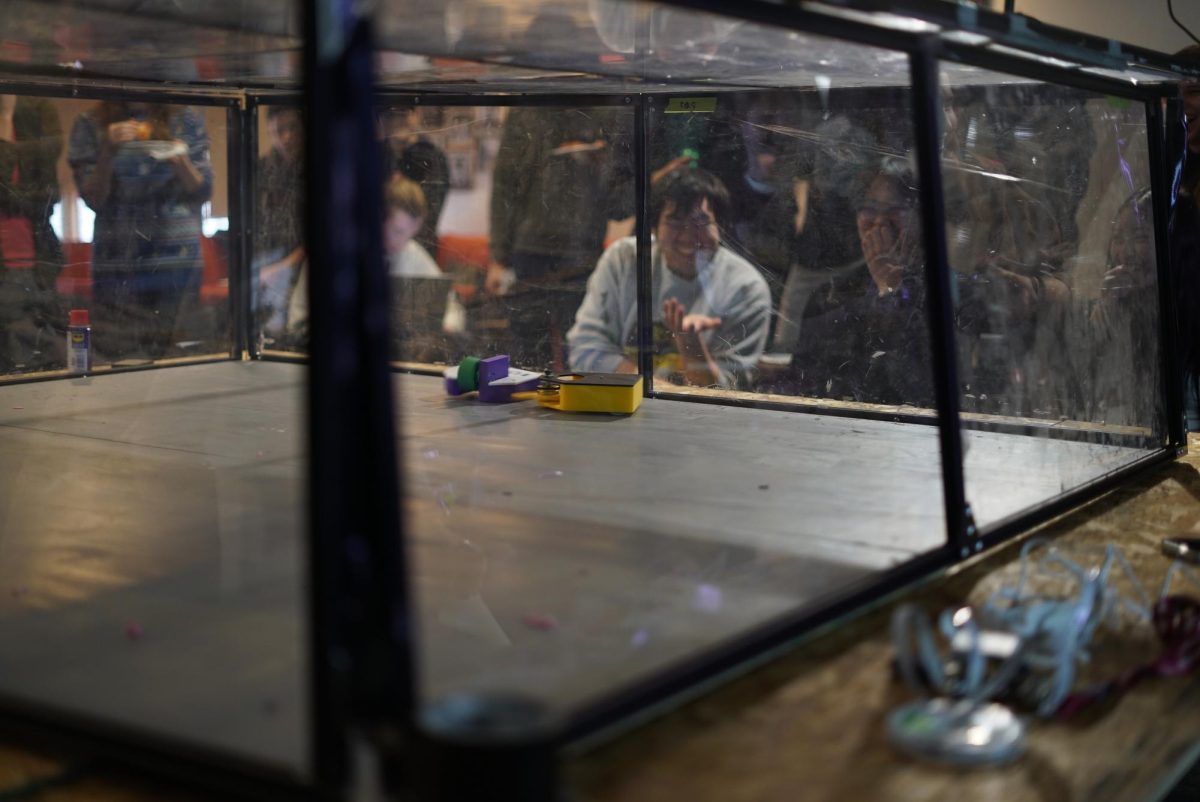
UChicago Robotics hosted a battlebot robot-fighting tournament on February 28th, an event where different teams compete with remote-controlled robots, winning if they destroy their opponent’s. The tournament gave club members the opportunity to practice their engineering and design skills using one-pound combat robots, ahead of larger competitions planned for the future.

Each round lasted three minutes, with a panel of judges scoring competitors on a variety of factors, including how much damage was done and how well the robots were able to maneuver around the arena. If a bot was rendered immobile during the fight, the other bot automatically would win the round.
UChicago Robotics has hosted battlebot fights before and is currently focusing on the development of a 30-pound robot to compete in national events, such as Robobrawl and the National Havoc Robot League early this quarter.

Before the event, UChicago Robotics RSO members set up the robot-fighting cage, a rubber mat ring fully enclosed by plexiglass panels. After the ring was set up, the competitors brought in their robots and a variety of equipment as they frantically made final adjustments.


The first round featured a pink robot going up against a purple opponent. Both robots had a rotating element, either a spinning outer shell or a smaller spinning hook. Looking at these two one-pound robots, you wouldn’t expect much of a spectacle. This expectation could not be more wrong.

The two robots made a dash towards each other, both their weapons rotating at maximum velocity. There was a sharp cut through the air, plastic smashing against plastic, and in the blink of an eye, the pink robot flew around the cage and slammed back down into the foam mat. The robots continued smashing against one another, with the referee shouting to keep their bots moving, until a countdown was issued and the round was over.
This was the experience across all of the fights. Shells were smashed, bolts were loosened, one started to smoke, and sparks flew. It was amazing.

After each round, competitors got right to work. They disassembled their bot and changed the batteries. They checked for any changes to the internal wiring and anything that had come undone or knocked out of place. Some competitors went back to their work stations, changing the shells or replacing screws that had gone soaring through the air. The floor quickly became littered with small plastic pieces from competitors’s repairs.


During these intermissions, we talked to Sasha Malysheva and Arouna, two competitors. Malyasheva’s robot had a weapon resembling a very large comma, with a sharp edge serving as the main source of damage. The circular body it was attached to housed the rotating motor. Many of the robots had a similar mechanism, some being longer than others, with varying “tail” sizes.

The other design we saw came from Arouna, whose robot had a rotating shell. The motor was in the middle of the body, having a turtle-shaped shell being placed over it with two curved spikes on either end. This shell rotated, making the whole body a weapon.

We then saw these two types of weapons in action. First up was Malysheva with the Rodrick Heffley. Rodrick was dropped into the arena against Jorge. Jorge’s weapon was a thick rectangular shape, connected to the main body with two plastic pieces, powered by a motor that allowed it to grab onto opponents.
They clashed, with another flurry of plastic falling through the arena. The bots had a little trouble moving, forcing Miles Chanbai, the Combat Robotics project lead, to push them closer together. There was a loud crunching sound as Rodrick smashed against the glass. The timer counted down; Rodrick had no way to fight back against the force of Jorge, the other bot.

Next, Arouna was up. His bot had a rotating shell and some wiring that needed fixing. Between the wiring and batteries, every bot had the possibility of exploding if struck in the right place.
In case a fire or explosion occurred, Chanbai stood near the arena with a pair of tongs, ready to grab any burning bot and toss it into a sand pit to extinguish the flames. This is what the spectators and competitors were hoping for.
“My bot is probably going to explode. It’s good, I’ll give the people what they came for,” Arouna said.

Arouna’s 2Chud2Handle bot went up against Carter’s Chud, which had a long, steamroller-style design. In the arena, the bots revved up their motors and faced off, waiting for the first move.

Chud ran backwards against the glass, with 2Chud2Handle smacking its weapon against the wall behind it. The bots didn’t budge; their weapons were at full power, but they would not move, forcing the referee to move them closer. They were two inches apart, eye to eye, weapon to weapon. They revved up once more; each competitor was scared their bot might lose.
Then 2Chud2Handle finally made contact, smacking its body into the weapon of Chud, flipping it up against the wall and letting it fall only to hit it once more. After 2Chud2Handle was done with its brutality, it loomed over Chud, victorious. Chud, on the other hand, was severely damaged, having broken its weapon, never to be the same again. Both bots were pulled out and each competitor approached the other, offering their congratulations and going off to repair their robots so that they may live to fight another day.


Overall, the event was a blast. It was great seeing everyone work on their bots together. People were talking through mechanical and electrical issues, explaining the process of how they designed their bots, and reflecting on what they would have changed. Each bot was unique to its builder. The fights were full of action. The sparks, crunching of plastic, and builders urging their bots to move were heard by all. Moreover, being in the crowd had no stakes; everyone cheered and was happy to see something as cool as a botfight. Battlebots was a great event displaying the commitment and engineering ability of UChicago Robotics. Not only was this a test and display of their skills in order to practice for their 30-pound competition next quarter, but also a way to bring the UChicago community together. In conversations with members and competitors, they voiced their excitement to have members of the community spectating who were interested in robotics and STEM or just wanted to see robots fight. This event serves as a great example for RSO’s to follow, serving as both something fun for people to come and watch and a low stakes way to get to know members to see if the club is the right fit for you.