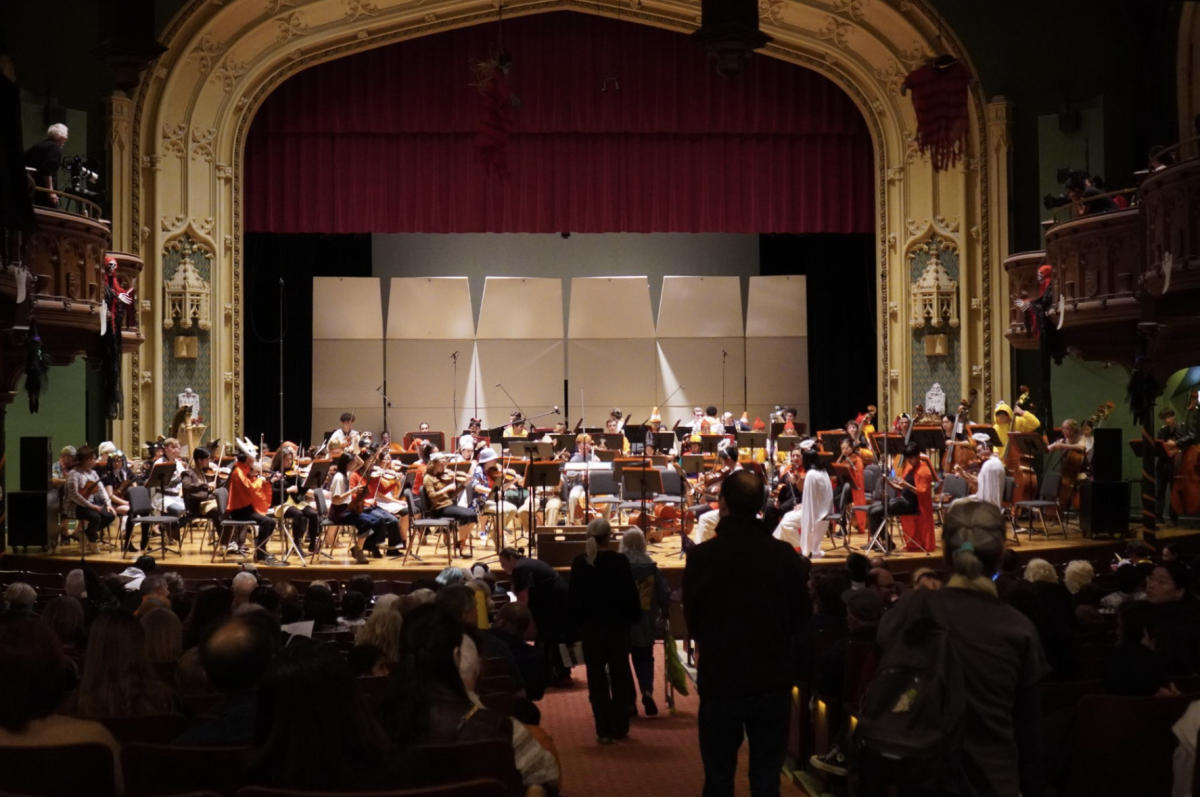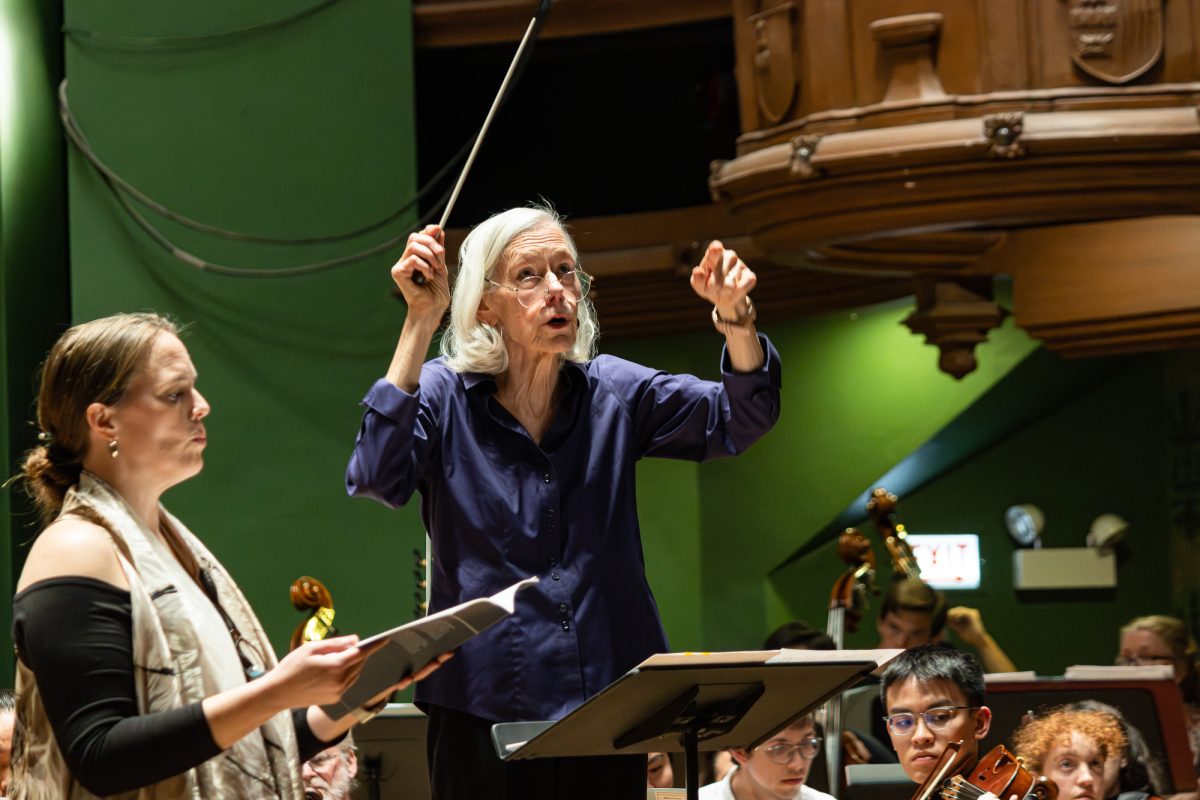
This year, the Department of Music celebrates the 50th anniversary of Barbara Schubert as Music Director and Conductor of the University Symphony Orchestra (USO). “Opus 50” will culminate with three days of festivities on campus, May 8-10, including a USO alumni mixer, Sunday afternoon picnic, and two performances of a special concert on May 9 and May 10. The program includes Johannes Brahms’s Academic Festival Overture performed by an Alumni Orchestra made up of former USO musicians and Gustav Mahler’s Symphony No. 2 in C Minor, “Resurrection,” performed by the USO, University Chorus, and Motet Choir, with soloists Camille Robles and Elisabeth Marshall. The Maroon sat down with Schubert to discuss her time with the USO, the “Opus 50” concerts, and the future of the arts at UChicago.
Note: This interview has been lightly edited for clarity and brevity.
Chicago Maroon: We’re here celebrating your 50th year with the University Orchestra, but let’s start at the beginning. What first got you into music? What inspired you to take on this challenging career of conducting an orchestra?
Barbara Schubert: At least you know the challenges of being a conductor, because they are significant. It’s an enormously rewarding field as well as an enormously challenging field. I first got an opportunity to conduct when I was in college. I had, well, not the most intense musical training, but a sort of good general musical training before college, but then I got deeply involved both in choral music and orchestral music, as well as studying music history and theory, and it really opened my eyes to the whole endeavor of making music.
Combining one’s intellectual and emotional interest in the art form was really compelling to me. I also got my first opportunities to conduct at college at the time. Of course, there were no models for women as orchestral conductors, and that was a significant factor in the early days. So I started out doing choral conducting and had a very fine role model. I went to Smith College, which is a women’s college, and I do think that if I had not gone to a women’s college, I probably would not have gotten the opportunities that I did. So, I was able to get a lot of experience, first with choral music, then with orchestral music, while I was in college. Then, immediately after, I started doing some workshops and doing further studies.
Some people say that conducting is like a fatal disease, that once you’re bitten by the bug, then you can’t get rid of it. And there’s some truth in that, because it just becomes an all-encompassing, lifelong pursuit. That’s another one of the enormously challenging and enormously fulfilling aspects: that you never feel like you’ve mastered the field. You always feel like you’re growing. There’s more to find out from any given piece of music. So from studying scores, I always try to start fresh and learn something new, [to] have some greater insight into what the composer’s intention was, what the details of the score are, and, most importantly, how I can bring it to life for performance in this day and age. All those aspects are important: figuring out what’s on the page, what it means, teaching it to the musicians, and then bringing it to life for the musicians and for an audience.
CM: You mentioned bringing together one’s emotional and intellectual interests. I’m curious to hear about how this plays out here at UChicago, and whether or not the intellectual atmosphere of this University plays a role in music-making.
BS: Well, it certainly does, and it has kept me here for all these years. I think this is the right place for me in many ways, because I have a fascination with a broad range of repertoire. I don’t believe in just doing the war horses or just the things acclaimed in the field. Exploring new corners of the repertoire and doing unusual projects is very important to me. I enjoy and am stimulated by reading about music and studying it and having historically informed and theoretically valid performances and interpretations. That is a little more of an intellectual approach, I’d say, than some conductors take. But it’s what I believe in, and I think that it resonates well with the students here.
Most of the students who are involved in music, both in the orchestra and in the other performance programs, are not planning to be professional musicians. Although some of them do go on in music, most of them are just making music a very important part of their life. Yet they definitely want to improve their skills, they definitely want to learn more about the repertoire, they want to explore new and different things. So, it’s a similar mindset to what I have, and I’ve been able to capitalize on that to keep people involved. I hope that creates a kind of excitement and performance that is palpable to the students and to the audience as well.
CM: You mentioned role models. Tell me a bit about your musical role models, and how interacting with them impacted your musical education. I know you studied at the Tanglewood music festival for some time, for example.
BS: First of all, I think you learn from every conductor with whom you study, or with every person with whom you study. You get to understand both their strengths, but also what might be their limitations, or their quirks and that kind of thing. It’s a synthesis of trying to discern those attributes and then make them a part of your own expression and your own life. At [Smith] College, the woman with whom I first studied, who was the choral director, was named Iva Dee Hiatt, and she was sort of a role model—although I didn’t realize it as much in the time—because but she built up a very, very strong performance program and choral program at Smith.
In terms of professional conductors, I studied with Herbert Blomstedt around 40 years ago, and he was a very fine teacher. Likewise, very thoughtful, very well read, knew a lot of repertoire, had thought deeply about how you transmit your intellectual understanding of a piece through gesture, and what you owe to the musicians, essentially, to help generate a good performance. I studied with him for a couple of years, and was profoundly influenced by him.
At Tanglewood there were a bunch of different conductors, very famous professional conductors who worked there at the time. The main teacher was a man named Gustav Meier, who was a very acclaimed conducting pedagogue who worked at University of Michigan and then at Peabody. Kurt Masur also came, as well as Seiji Ozawa, who was then conductor of the Boston Symphony so he was also one of the tutors. And of course, Leonard Bernstein was there. That was a few years before he passed away, and he was in his element of exuberance and really, really a master.
CM: You’ve spoken about the importance even for students who are not pursuing music professionally, of having music in their lives. What is so important about having music in one’s life? What can music do for us?
BS: Music, on a very simple level, provides a transformative experience. It stimulates the emotions, it captivates the intellect, it nurtures the spirit, it touches every part of what is at the core of being a human being. And I think that’s true of all music, whether it be popular music or folk music or simple or complicated. But with orchestral music, particularly because there’s such a vast range of colors and details, and because the music is, for the most part, a constructed work of art that somebody has, in some cases, spent years and years composing, it’s a very serious endeavor to try to understand the piece. You don’t just listen to it on the radio and understand a Mahler symphony, for instance. And as I mentioned before, no matter how well you can understand it, you always understand it more deeply the more you study and the more you experience it.
Beyond that, the act of playing together in an orchestra or singing together is the ultimate collaborative endeavor, because we are all focused at every single moment on optimum attention to detail. People talk about teamwork in sports, but music performance actually even goes beyond that because if somebody is having a bad day in the horn section, I can’t put them on the bench and bring in somebody else. We all have to be 100 percent or more focused from moment to moment, not only on the technical execution of the piece of music, but moreover, presenting a convincing performance. It’s the difference between reading something in a monotone and just going through it, or really delivering a passionate oratory. And we want to deliver that passionate oratory of a piece of music. The other thing about music that makes it so compelling is that there are so many different types of emotions that are engendered. There’s serious, agonizing, difficult, challenging music; there’s refreshing music, there’s happy music that makes you want to dance. I think it reaches every human being at some level.
CM: A lot of people go into classical music concerts not knowing how much work goes into bringing all of these forces together. Tell me about what a typical rehearsal looks like, as well as how you balance your roles as interpreter and also mentor and educator.
BS: First of all, there’s an enormous amount of preparation that a conductor should do before they even get to a rehearsal stage. In my conducting class, I liken it to a pyramid where the whole foundation, the bottom two-thirds, is the preparation, which means figuring out what’s on the page, looking into the life of the composer, learning about the historical period, and all this study that makes you hopefully understand the music itself. You also have to have training as a conductor in terms of the gestural technique, the rehearsal techniques for how you fix something. All that preparation goes before you step on the podium.
With an orchestra like ours, it’s a different experience from preparing a performance with an orchestra that’s full of professionals who have performed, say, the Brahms First [Symphony] each twenty times. Some of our student musicians may be coming to something like the Brahms First for the very first time. So they do need a little bit more technical instruction; we need to rehearse things slowly; we need to take it apart in a way that you wouldn’t have to do at the early stages of rehearsing with a professional orchestra. But I find that process fascinating. I like to be as efficient as I possibly can in terms of rehearsal. It’s a combination of leading them in rehearsal, of giving them the general picture and the overall idea, but also honing in on specific details, pointing out what to listen for, what has to be loud or softer, what the goals of the phrase are, what the details are, what’s important about the composer’s style, and so forth.
Sometimes, the longer people play, the more they understand that—it’s a sort of synthesis of their collective knowledge. We also have some older people, besides undergraduates in the orchestra: we have some graduate students, some faculty and staff, and a number of alums who have been playing for decades, actually. They’ve had more experience, so that helps the orchestra along in terms of becoming more familiar with the piece of music.
CM: Over 50 years, you’ve worked with a lot of repertoire and performed many concerts. What are some of your most memorable concerts?
BS: We’ve done so many special projects that are memorable: working with films, on some [Sergei] Eisenstein films, for example, and so forth. We did a production of Tom Stoppard’s Every Good Boy Deserves Favour with Court Theatre. We’ve done performances with professional musicians and with ensembles including Plena Libre, which [is] a Puerto Rican bomba group. In terms of what engages me most, it’s the concert that I’m working on at the moment—that’s what has to occupy my full attention.
Certainly, we’ve had some excellent performances in the past, and I remember them fondly. We have done Mahler’s Second [Symphony] before, we have done Beethoven’s Ninth [Symphony]. We have done all of those big ones. We’ve done some pretty good Brahms symphonies. Those milestone performances do live in my memory, but I also remember things like doing Frank Bridge’s The Sea, for instance, which is an unusual piece, or doing Bartók’s Dance Suite. I have not repeated repertoire that much; I do occasionally repeat the highlights because, of course, it’s important for students to get to play some standard pieces. So I do repeat some things, but probably not as much as most conductors. If I repeat something in 15 years, that’s frequent!
CM: Tell me about the USO’s upcoming concerts, specifically the “Opus 50” celebration in May, which will feature, as I understand it, a USO alumni performance.
BS: I’m really thrilled that this focus on my anniversary—which, in some ways is very embarrassing, and I’ve tried to sort of fend it off, but didn’t succeed—has given me the chance to reconnect with some alums and to hear from even people that I haven’t heard from in decades about how the University Symphony meant so much to them. The fact that music during the college years was really impactful for people is enormously fulfilling. We have about 100 alums coming back to play in an orchestra. I’ve sent them their music, and we’re going to rehearse just the night before, and do the Brahms Academic Festival Overture, which I thought was an appropriate piece for this concert—we’re at an academic place, it’s a festival that we’re celebrating. Plus, it’s a most enjoyable piece. And Brahms wrote it instead of giving a speech when he was given an honorary degree. So, you know, I feel like I should be presenting a performance as well, rather than talking about my years with the University Symphony.
Now, the Mahler Second is a glorious piece; I wanted something that involved the chorus as well as the orchestra, and the piece is enormously challenging, so we’re working on it, and, hopefully in another month, we’ll be ready to present a very compelling performance of that as well.
CM: Mahler’s Second is, in many ways, the apotheosis of the symphony. But why specifically Mahler Two for this special concert?
BS: Well, because it is such a powerful work. If I had to pick, I might say it’s my favorite Mahler symphony. I don’t like picking things like that because I love them all, just like I love all the Brahms symphonies and the Beethoven symphonies, and so forth. But also the fact that it involves a chorus in a way that is feasible for us—the Mahler Eighth would not be feasible for us to do, for obvious reasons, and the Mahler Three, likewise, is more complicated. Mahler said “a symphony must be like the world, it must contain everything,” and that sounds silly in a way, or simplistic, but it’s true too. So many emotions, so much pathos is involved in that piece, so much joy, so much poignancy. It covers everything, really, and then at the end, it is truly transformative and glorious. Many people are likely familiar with the piece, but not everybody. So I hope it’s a meaningful experience for those who haven’t heard it.
CM: Looking forward, what are some of your plans for the future here on campus and in the music program?
BS: I want the music program to continue to grow and to thrive and to be recognized as an important component of campus life and to be supported in terms of acknowledgement, audience, and finances. You probably know that with in conjunction with this, we’re also doing a campaign to set up a University Symphony endowment, which has been very, very successful to date, with, of course, a modest goal. I’m hoping that we will continue to be able to build that, because that’s the way to ensure the future of the symphony and the future of the arts.
In terms of the growth of the Symphony, I certainly hope that we will continue, hopefully for another couple of years under my guidance, but then into the coming decades, to explore a wide range of repertoire, present compelling performances, and involve a lot of students. I hope that’s true for all of the performance organizations.
And then I think we also need to develop our community engagement and community outreach more. That’s something that’s hard to fit in with a very busy academic schedule. We have artists-in-residence that come and work with the different performance groups. Last year, we had a wonderful violinist, Will Hagen, who came and performed with the Symphony, and he also did a lot of work in the community—went to different schools, performed at the hospital, this kind of thing. So, reaching out to people who might not otherwise have a chance to get up close and personal, so to speak, with performing musicians, or who might not have heard classical music, is very important as well. I think that’s one of the important avenues for growth for the performance program in the future. I think that advocacy for the program that we have, and advocacy for classical music is really important.
Some people lament, “only three percent of people like classical music.” Well, you can look at it another way: everybody likes classical music, but they just don’t know it yet because they haven’t had a chance to hear it, or they haven’t had somebody invite them into the concert hall. They haven’t been offered a hook that brings them into the concert hall. Maybe there are financial barriers. Maybe they just don’t even know it exists. But again, I think that music can touch every human being at some level. And so bringing people into the concert hall, making them aware of the orchestral experience and the incredible richness of symphonic music is an important primary goal. We all have to be advocates for the arts. If we all focus more on developing our artistic sensibilities, and the kind of communication and understanding that music can promote amongst different people, I think the world will be a far better place.
“Opus 50” will culminate with a full weekend of festivities on campus, May 8–10, including a USO alumni mixer, Sunday afternoon picnic, and two performances of a special concert on May 9 and May 10.