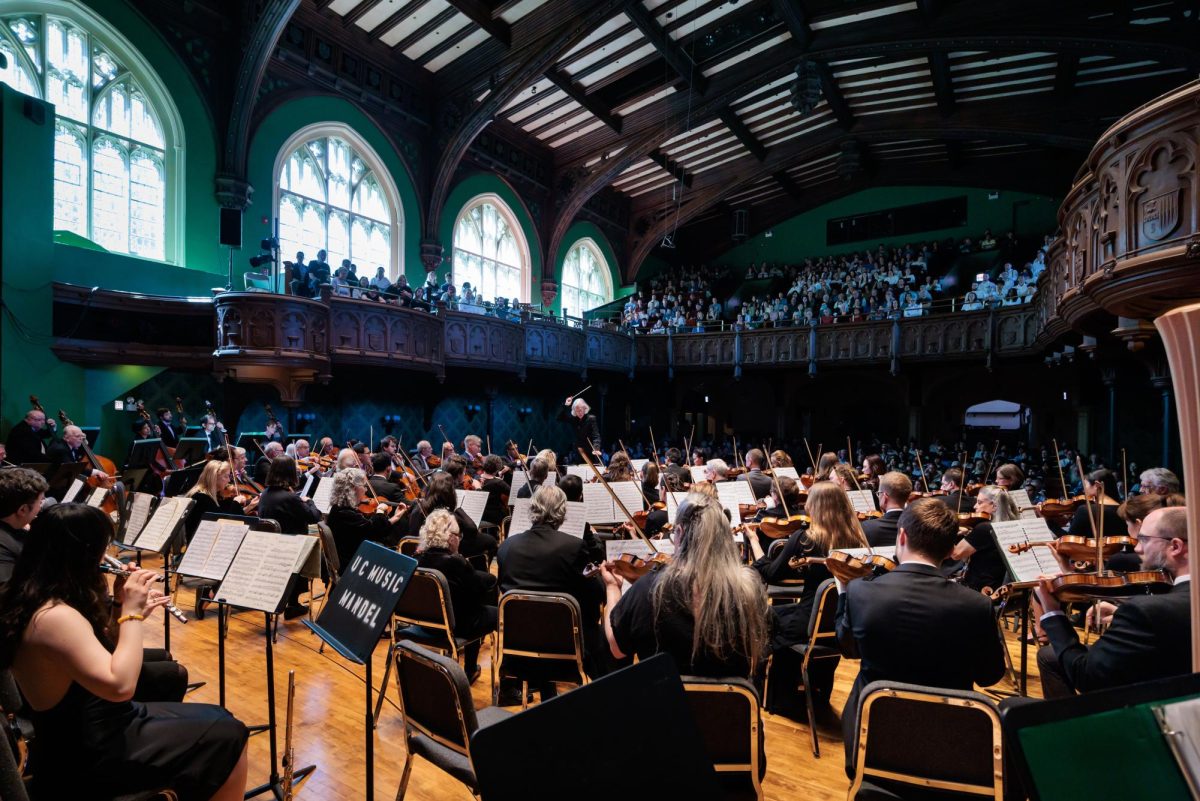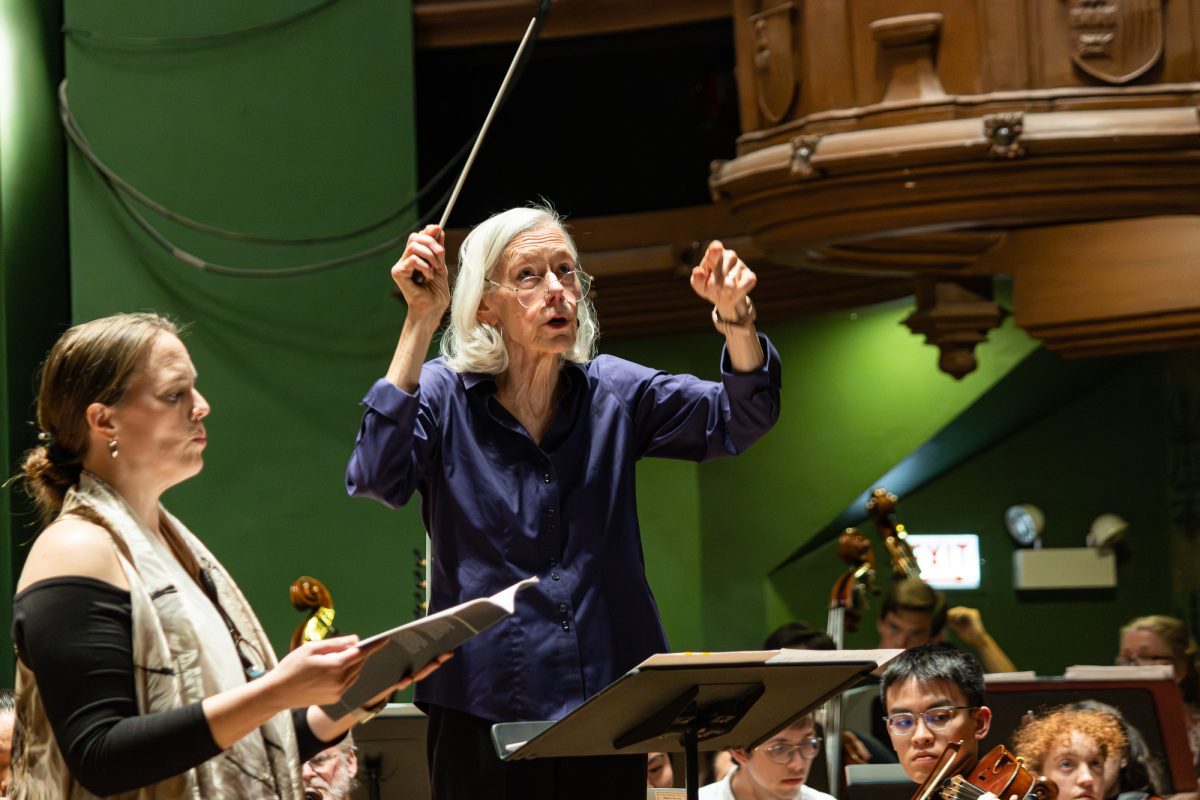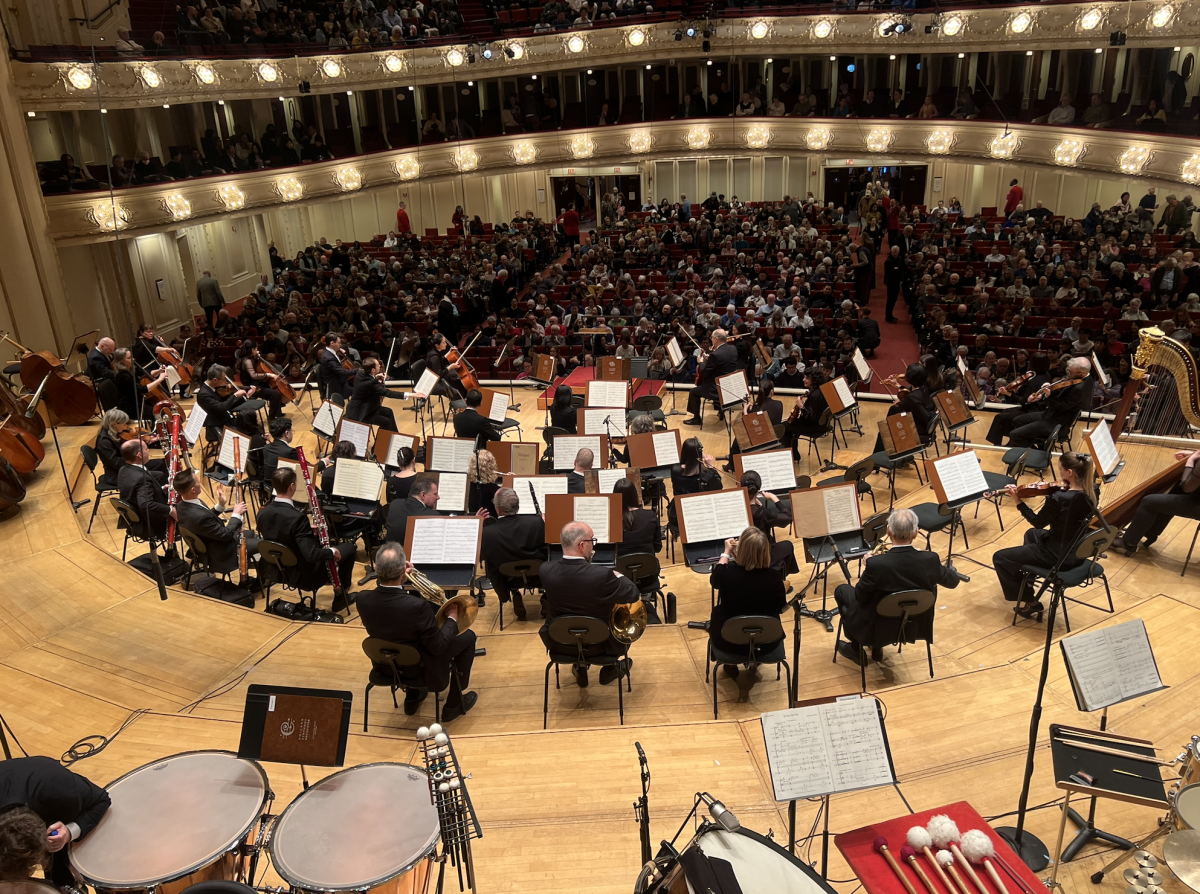
In one of the most highly anticipated concerts of the season, guest conductor Jaap van Zweden led the Chicago Symphony Orchestra (CSO) in a multifaceted program featuring music from the Classical, Romantic, and contemporary eras. He was joined by Himari, the Japanese violin prodigy who, at only 14 years old, has already made her debut with prestigious orchestras such as the Berlin Philharmonic and Philadelphia Orchestra.
The concert opened with contemporary composer Joel Thompson’s exegesis for orchestra, To See the Sky. Thompson is part of The Blacknificent 7, a network of seven Black composers who strive to use their music as engines for social activism. He centers his music on the experience of Black men in America and around the world. To See the Sky, which spans three movements totaling 20 minutes, is based on a line from Cécile McLorin Salvant’s song “Thunderclouds”: “Sometimes you have to gaze into a well to see the sky.”
“I’m trying to do less documenting—and to dream a little more,” wrote Thompson in the program notes. “The movements outline a nonlinear journey towards healing.”
This idea of looking inward to find clarity and relief is nothing new in classical music—it’s a recurring message in many of the most important works in the canon, from Beethoven’s symphonies to Wagner’s operas. But in To See the Sky, Thompson attempts something new and radical. He incorporates rhythms and tunes from his youth into the score, mixing Black music with the character of the Classical tradition in bold and inventive ways. The result is a piece that is wholly original, blending the composer’s influences and showcasing his expansive capabilities.
That said, combining these distinct elements at times created a sense of disorganization. For example, toward the end of the third movement, immediately after one of the lushest and most melodic sections of the piece, Thompson included a rather sudden percussive passage, featuring hand clapping, chimes, and other percussion instruments producing spirited syncopations. Perhaps it was Thompson’s intention to highlight the stark contrast between these styles; regardless, the transition certainly disturbed the flow of the music.
All in all, To See the Sky is exactly as Thompson himself described in his program note: “an experiment.” It shows flashes of creativity and brilliance, but ultimately comes off as a string of distinct musical ideas, rather than one cohesive oeuvre—as though Thompson had more ideas to include than time to thoughtfully put them together.
Following some minor adjustments in the constitution of the orchestra, van Zweden returned to the podium, this time alongside Himari—the latter so young that her entrance drew audible gasps from the audience—for a performance of Max Bruch’s Violin Concerto No. 1.
When reviewing so-called prodigies, it is very tempting to simply marvel at their age and technical prowess and forget to critique the playing itself. In reality, there is no shortage of young musicians who can accurately play the notes on the score. What matters—as with any performance—is the quality with which they are played.
When the great Anne-Sophie Mutter made her debut recording with the Berlin Philharmonic under Herbert von Karajan at age 14, critics were similarly stunned by her prodigious talent. But when that recording was nominated for the prestigious Grand Prix International du Disque award, she was judged not as a child prodigy but on the merits of her performance. Every musician, whether 15 or 50, deserves to be judged as an artist in their own right.
In Himari’s case, one could tell from her first note that this was no ordinary prodigy. Her technique was not only mature for her age, but by any standards of violin-playing; she masterfully maneuvered the most challenging sections of the piece, never falling out of sync with the orchestra.
Though Himari does not have a big sound yet—that is, her bowing does not produce the sort of forceful sound that can overpower an orchestra at will—her sense of phrasing is exceptional. Her melodic lines were gentle and smooth, underlined by a lush vibrato and clear tone. This was clearest in the transition between the second and third movements: Himari clearly contrasted the airiness of the second with the outburst that opens the third, moving from one to the other with poise.
Where Himari still has room for growth is emotional depth. The world’s best violinists connect with and embody the music in ways that make their interpretations fresh and captivating. For Himari, the promise is undoubtedly there—though it is important not to settle too early, but rather to refine and develop her artistry.
The prodigy label is both a blessing and a curse. On the one hand, early success opens doors and opportunities that late bloomers often miss out on. On the other hand, if one becomes known as a prodigy, public interest tends to dwindle once one ceases to be a prodigy. In order to sustain success, one must outgrow the label and be valued for musicianship rather than age. Prodigies only last so long; musicians last forever.
The program concluded with a symphony by one of the most famous prodigies of all time, Wolfgang Amadeus Mozart. Every conductor, orchestral musician, and classical music fan can recognize his Symphony No. 41 (Jupiter). It is one of the most famous and frequently performed works in the canon. The downside of this is that interpretations often become predictable, and the symphony is not always afforded the meticulous preparation it demands. Unfortunately, this rendition succumbed to that tendency.
Mozart demands a certain lightness and elegance that felt missing from this performance. Van Zweden, a known master of heavier repertoire such as the works of Gustav Mahler and Richard Wagner, seemed to let some of that affinity for weightiness spill into his interpretation. For instance, the emphatic three-beat tutti that opens the first movement was immediately contrasted with a sharp tempo change, with the lyrical response of the strings sounding noticeably slower than the opening. This sort of rubato felt out of character for the Jupiter symphony and disturbed the spirit of the piece.
The second movement, labeled “Andante cantabile,” (literally, “slow and singable”) sounded anything but. The soft moments came off as tight rather than natural, and the entire movement was unusually fast. Where Mozart demands grace and lightness, this performance had a weightiness more appropriate for Brahms.
The third movement was an improvement. Van Zweden seemed to let the orchestra breathe freely, and the different sections were well balanced and unified. The woodwinds produced a chamber-like intimacy, giving the music an improved flow and cohesion.
The fourth movement, with its breathtaking harmonies and climatic fugue, is one of those pieces that does half of the work for you—even a mediocre performance won’t fail to amaze. Thankfully, van Zweden and the CSO were at their best here, finally loosening up to produce a thrilling rendition of the infamous finale.
This concert successfully promoted Thompson and Himari, with Mozart playing the role of box-office bait. The music itself was satisfactory; not bad per se, but below the CSO’s typical standards.