Unbeknownst to me, the exhibition I walked into 30 minutes before a reception was celebrating its last day. Located a few streets north of Wicker Park’s bustling main street, the Chicago Sculpture International’s (CSI) Project Space hosted Zsófia Ötvös’s exhibit People from February 7 to 27. Poking in on the last day, I was instantly greeted by Melissa Kolbusz, a jewelry artist and decades-long friend of Zsófia Ötvös. Kolbusz informed me that I was free to look around at the paintings as they set up the party. Soon afterwards, Ötvös entered with an exuberant energy. She instantly began organizing items around the space. Soon after greeting me, she gently appointed me an impromptu volunteer in their effort. I stayed at the gallery for two hours, gaining magnificent insight into Ötvös’s worldview.
I was tasked with connecting the iPad to a speaker, an assignment which had a few false starts. I figured acoustic pop by French and Spanish female singers fit the surrounding artwork. Many of the portraits featured women with a “great energy,” according to Ötvös.
On this eve of the exhibit’s closure, the two artists busied themselves with laying out charcuterie and building a coat rack. At one point, Ötvös glanced at her phone. “Oh, shit!” she proclaimed. “Sorry, it’s from work…” Ötvös is a cosmetic artist for The Bear, a TV show which will air its fifth season in 2026 and shows the dark yet comical reality of a fine-dining kitchen in Chicago. She said that she “was very lucky” to be able to finish work on the set early that day.
As the two artists traveled in and out of the main room, I was mesmerized by the exhibition. The title, People, describes the focus of Ötvös’s portraits on tapestry, screens, and canvas. Vignettes from past decades filled the space. On the front walls, two fresh series were revealed. A piece that drew my eye was “The Path is Open,” which depicts a young woman dressed in black wearing a spider-shaped pendant similar to those being sold at the show by Kolbusz. The figure strides assuredly in the evening dusk.
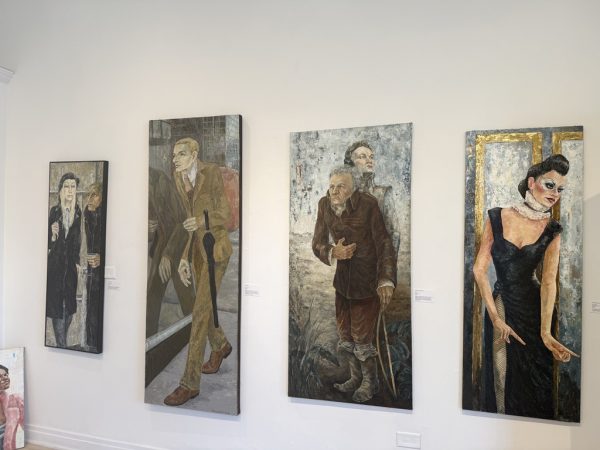
Facing forward were more such strangers spotted during her recent trip to her hometown of Budapest, Hungary. She placed each figure on the right of the canvas. The compositions represent “all that we lived and… the moment of moving forward,” Ötvös explained to me. Emulating the movement with loose brushstrokes, she brilliantly portrays resilience as a “spring in our steps.” She counsels, “It’s a challenging life, but what do you do from your challenges? You accept it.”
On the opposite side was a trio of oceanic oil paintings with graphite drawings overlaid on top. Ötvös recounted that the impetus for the work “Torn” came after a phone call with a friend. They commiserated that “life is good. Why do we feel so miserable—torn apart?” As the series progresses, the woman builds up the resolve to rise above the waves. In the final painting, “No Place for Worry,” she wears a confident smile and adopts assertive hand gestures.
As I praised her sense of empathy, she corrected my interpretation, admitting, “I don’t always have it.” However, she did promise, “I never made fun of people who are in a hard place outside of their choices.” To illustrate her comments, she pulled out a catalog. One painting depicted an elegant woman on a wheelchair in the airport. The other painting, “Little Thrifter,” portrayed a young girl “during an art show with a miserable face…. I thought she was so funny.” Ötvös said that although she sometimes pokes fun at people, she tends to adopt a more empathetic perspective.
The compassion is not merely an aesthetic view for Ötvös. She puts empathy into action. While she was preparing for the event, she got a phone call. I overheard her say, “Yes, we can discuss a payment plan.” She explained that a man who had previously visited the exhibit was enraptured by the painting “Indulge” and interested in purchasing it. As we were conversing, the caller from earlier, Daniel, ambled back into the exhibit. Asking if I was the painter’s daughter, Ötvös lightly replied, “No, we just met.” I appreciated how easily Ötvös makes strangers feel like family.
It did not take Daniel long to ogle the caricature. He confessed, “I really like this picture… Oh man!… It’s so expressive.” He asked my thoughts and I echoed his appreciation. The piece is unique in Ötvös’s repertoire since it shows interpersonal dynamics rather than an individual portrait. She describes it as “a skinny tall woman who [says], ‘I wish I had the pastry instead of the espresso.’” The exaggerated expressions and high eyebrows tell a story of tension amplified to be as clear as a cartoon.
Daniel mirrored this covetousness, but, unlike the starved lady, he did not hold back from indulging in his desire. He teased, “Today is the 27th of the month. I am a landlord. Do you think I am rich at the end of the month?” Ötvös agreed that he was likely not. Together, they drew up a payment plan that would allow him to purchase the artwork at the end of six months. He plans to display the work in a new Airbnb he will manage in Pilsen.
More people strolled in after Daniel. It was amazing to see Ötvös enliven each painting with personal anecdotes. To an elderly couple accompanied by their granddaughter, she displayed a silhouette screen where oscillating lighting shifts the perspective. The loosely woven linen fabric, painted with acrylic and charcoal pigments, allows for light to shine through. Moving the screen, she explored how the translucent property paralleled the oscillating quality of memories.
Before the gallery opened, we chatted about her outreach plans. She described how the landscape has changed from 20 years ago, when critics’ coverage of art shows in newspapers would serve as inadvertent advertising. Now, she uses a platform called evvnt.com. Together, we pored over the unwieldy website statistics including set traffic, engagement time, and clicks. Soon enough, we gave up trying to discern what the “clicks” metric meant. Instead, she shared her own experience with running exhibits: “There may be five people coming, but they are very engaged.” The premonition proved accurate.
Glued to my seat, I watched the first part of the reception. There was never a sudden rush, but each person seemed to linger. I watched Ötvös play hostess and curator. She offered wine to acquaintances and apple juice to children. She let people enjoy her work without being domineering. Her free-spirited attitude is echoed by her creative process. Instead of going into the studio with a prescribed vision, she lets the emotions guide her artistry. Ötvös noted, “I do the work that feels right and… once I put it up, I realize what brings it together.”
In a similar vein, her work recollects a momentary glance at a stranger rather than a stable portrayal of a personage. In the painting “Loaded Floated,” a woman treads past black tendrils and in another titled “Held at Breath” she is pictured again taking a breath of fresh air with wider lips. Explaining the inconsistency in her depictions she noted how “it’s more about the energy rather than the features.” The manifested images are intentionally filtered through her memory to fit the message of her piece.
During the reception, an admirer commented, “You must have studied people’s faces.” The praise captured both Ötvös’s masterful makeup artistry and portraiture. However, it also described her care and generosity for the community around her. The exhibit was a beautiful demonstration of how Ötvös stays engaged with her community. She expressed how her job in makeup and artistic practice is like “a zipper that builds off each other. You cannot have one without the other.”