What does it mean to want to be loved by others?
Jean-Jacques Rousseau called this amour-propre, the inescapable wish of humans in modernity to be more lovable than others. It is a love of oneself, a vanity in being perceived by others. Amour-propre is a type of mask that is donned, never to be removed. But what if the mask breaks?
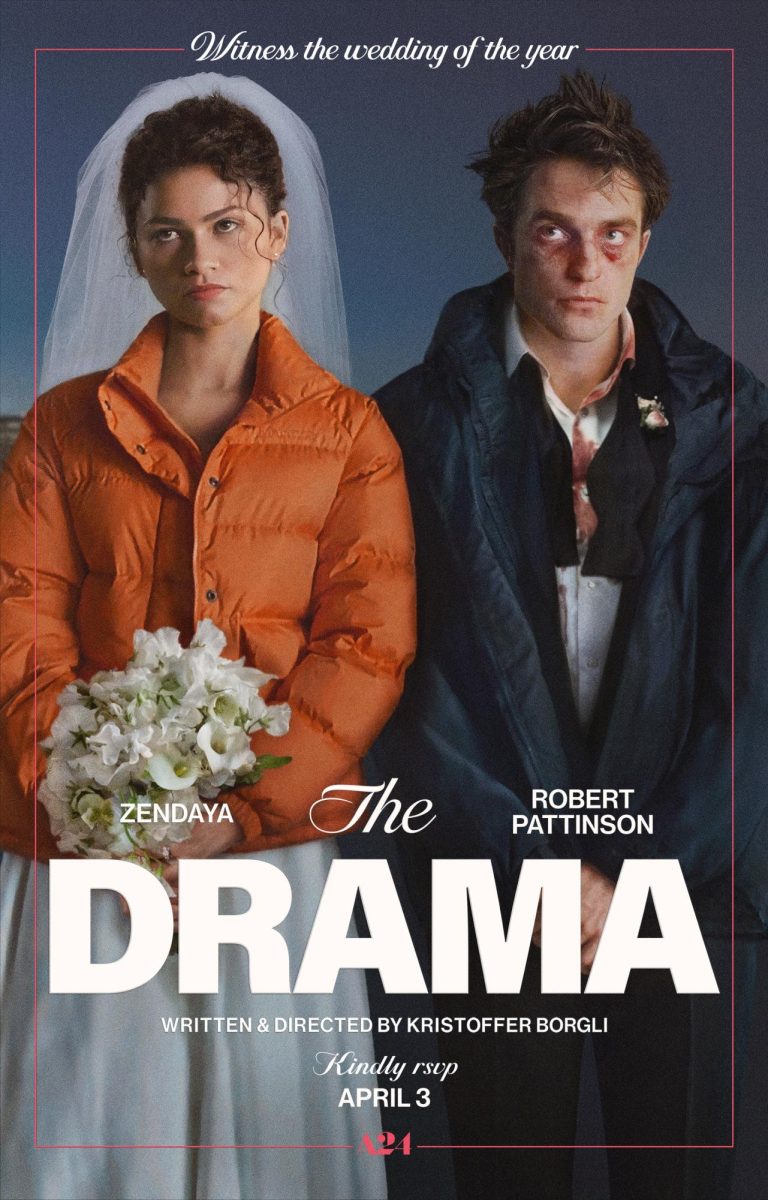
Kristoffer Borgli’s latest film, The Drama, explores this very question. The picture follows fiancés Emma (Zendaya) and Charlie (Robert Pattinson) in the lead-up to their wedding weekend, interweaving moments from their whirlwind romance and engagement. During an evening spent with friends, Emma and Charlie each reveal to each other the worst thing that they have ever done. In that moment, everything changes. Over the course of the film, the couple is forced to grapple with a genie that have left the bottle.
The Drama is a hilarious and terrifying modern meditation on the limits of romantic love, driven by directorial promise, astute editing, and captivating performances. Seemingly part rom-com and part wedding film, The Drama might read on paper as a rehashing of old territory. However, even before its captivating twists and turns, which at times make it feel more like a thriller than a romance, it is so much more.
As writer and director, Borgli meditates on love by leveraging familiar tropes: The butterflies of a meet cute. The awkwardness of a first date. The fireworks of a first kiss. Familiar? Yes, but Borgli never lets it feel boring. The tropes are captured and reborn. Each step in the script is subtly, or not so subtly, turned on its head. On top of its witty dialogue, the film’s levity and precise pacing are elevated by the magic of the editing room.
Borgli and Joshua Raymond Lee’s editing is the crown jewel of the film, adding a distinctive twist of irony to the final cut. The audience is left laughing against their will, either at or with the absurdity and brilliance of the lives unraveling on the silver screen. The film’s plot is simultaneously a secret whispered between friends, an embarrassing story one promises to take to the grave, and a terrible nightmare from which one cannot wait to wake up.
Despite the picture’s seeming discordance, the editing braids these contrasting tones together into a continuous tale you cannot bring yourself to look away from. Juxtapositions created through the Kuleshov effect between scenes, smash cuts for both humor and horror, and nested sequences that force the audience to reckon with the medium of the story and the film are all tools in Lee and Borgli’s arsenal, each deployed to perfection.
Both Zendaya and Pattinson deliver captivating performances. Watching the two fall in love on screen, the audience can’t help but fall for them too. Zendaya embodies Emma, a beautiful former outcast who has since come into her own. Pattinson as Charlie is a charming yet awkward, bantering yet stiff-upper-lipped British immigrant. Of the two, Charlie steals the show. Left to reckon with his decision to marry Emma and the horrible secret she has revealed, what is he to do? Who has he chosen to marry? Who has he chosen to love? The audience squirms and cringes and cries at Charlie’s dilemma, left pondering the very same question.
Who is it we have chosen to love? Who is it we want to be loved as? Like Emma, we all carry the burden of having parts of ourselves we would rather forget. What happens when our amour-propre is threatened? What are the parts of ourselves we hide behind the mask we show to others?
What do we do when our masks break?