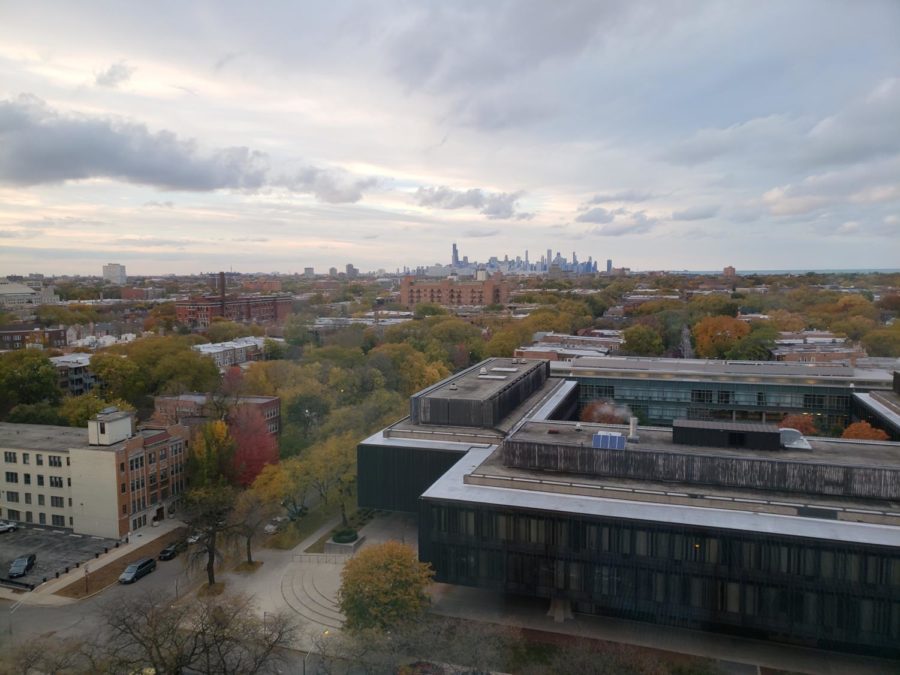
On the fourth floor of the Surgery Brain Research Pavillion at UChicago Medicine, mice run on small treadmills in a specially developed virtual reality (VR) rig. They were trained by researchers at the Sheffield Lab to complete laps on a virtual racetrack. Do they know that their reality is not what it seems? What are they thinking when they’re being pulled out of the VR rig? We don’t know.
When you enter UChicago as a first-year, you’re small, out of sorts, and overwhelmed by a mixture of fear and curiosity. That 9:30 a.m. class in Cobb Hall is not exactly a cold, bright lab, but it’s close enough. There are no waterspouts and electric shocks, but a mixture of rewards and deterrents teaches you to run metaphorical laps. And I don’t need to convince you that the quarter system can feel like a treadmill. You start to run.
But you’re not on a virtual racetrack; you’re in a lab—well, at least a carefully manufactured environment (just thank your stars you won’t be soon killed and dissected for science). And soon enough you’ll be set free, and there won’t be a treadmill anymore. What will you do then? Find a new waterspout to run toward? The real world has its own rewards and deterrents, and if you think they’re anything as simple as a waterspout or an electric shock, you’ll find yourself right back to being a lab mouse again.
Maybe that wouldn’t be the worst thing, though. The VR experiment works because it is immersive. It relies on trapping the mice in its effect. And really, what is so special about UChicago except that it is so wholly distortive? Arguing about Aristotle in your house lounge until 2 a.m., shrinking your world into a book, a club, or a class, and seeing everyone around you do the same becomes normal. To spend four years in the College is to find one’s perspective contorted and enraptured: wonderfully, beautifully, terrifyingly so. It is in that distortion that you truly learn and change—in the resolute grip that a Core class or passion project or study abroad program has on your reality. It is this distorting effect that makes UChicago so transformative.
It is crucial that, from time to time, you recognize your environment—not that it’s easy to see it. The VR screen is nice; you live in a beautiful place and in closer proximity to brilliance than you’ll probably ever be again. And, sometimes, the treadmill moves so quickly that you forget about everything else. But you must try. Most people don’t know or care about what an epsilon-delta proof is. There is a real world with pressing ethical problems beyond the difference between Heidegger and Hegel’s phenomenologies. For all the noise about academia’s ivory tower being systemic, the stakes here are remarkably individual. You’re a human with agency, and you’re not constrained by the treadmill. I do not write this to dismiss knowledge, whether for its own sake or for some other telos, but rather to say that there is more to life than the racetrack and that the world is so much bigger than a lab.
As it turns out, you’ve been acquiring the keys to see beyond this mirage the whole time. UChicago’s mission, accomplished in large part by the Core, is to teach you how to think from different perspectives. Wasn’t that hard Core class difficult because you were learning to reason in an unfamiliar way? Isn’t that why it felt so odd against the familiarity of your major? You were training to see beyond your comfort zone. The two years of Hindi I took will likely soon elude me, but I will never forget what it was like to understand poetry in a foreign tongue and to struggle so deeply with a subject I had always considered my weakest.
To move beyond your paradigm, to consider a position you don’t agree with, to employ a different faculty of thought—these are the fruits of your education that will stick with you long after you forget the thinkers on your sosc syllabus or the contents of your midterm. They are the antidotes to dogmatism and the colloquial grass to always plant your feet in.
You must remind yourself to think differently, forcefully if necessary, for you will certainly find your perspective distorted again. Maybe it will happen in graduate school, or on Wall Street, or in a book you open five years from now. It’s wherever the cutting edge is, where great minds come together, where life happens. But it’s also where reality becomes jumbled up, shrinking to the size of a treadmill and a virtual racecourse. This is especially true the closer you are to change or power, and it’s a dangerous phenomenon. From the West Wing to Silicon Valley to the world beyond, you cannot look at figureheads like Sam Altman or Donald Trump, or the circles they propagate, and miss the prognosis of severely distorted perspectives.
But you’ve been training for this. For now, there are laps to run and problems to solve. Run fast. Remember this experiment, and you will see through the screens ahead.
Nolan Shaffer is a fourth-year in the College and a former Arts and Culture editor for the Maroon.