Can a failing marriage rediscover its original purpose: to be two people in love and in awe of each other? Olivia Wilde’s The Invite addresses this question. Shot like a home movie, the opening sequence displays what appears to be a loving marriage but is instead a nostalgic figment of a couple’s past. Warm lightning and sporadic shots of joy capture Angela, played by Wilde, and Joe, played by Seth Rogen, happy and in love. The plot that follows ruptures their love, leaving only fragments of what they once had. The stark contrast between the opening sequence and the bickering dynamic we come to witness introduces the stakes of the film: Will Angela and Joe reconcile and rediscover the love they once had? At first, it seems unlikely. Sociologist Yifeng Wan predicts that 42 percent of marriages in the United States will end in divorce, making The Invite’s exploration of whether divorce is always inevitable within an unhappy marriage extremely relevant. On the other hand, Psychotherapist Esther Perel argues in her book The State of Affairs: Rethinking Infidelity that one can experience distinct relationships with the same person, suggesting that there are ways that couples can heal and begin again with the same person. The Invite teeters back and forth between the inevitability of divorce and Perel’s message of hope.
In an interview with the Maroon, Wilde explained that her films are “most interested in relationships,” whether between best friends, as seen in her first movie, Booksmart, or within a marriage in her newest film, The Invite, coming to Chicago theaters July 3. Wilde approached The Invite with what she called an “experimental process”: while her previous films were shot out of order and then re-stitched together in the editing process, she decided to film The Invite in chronological order on 35-millimeter film. Because each shot on 35-millimeter film costs more money than a shot on traditional film, the stakes for each shot were higher. However, Wilde voiced that raising the financial stakes encourages actors to depart from reality while playing within set boundaries. For The Invite, she explained this process “involved this level of engagement that [she’d] never experienced before, where everyone was plugged in 100 percent of the time for those six weeks.” Each day of filming informed the next, allowing the actors to sink into their roles and go beyond the script to establish complex and believable character dynamics.
Additionally, this process confined Wilde’s directorial vision to one location: a beautiful San Franciscan home. Wilde’s character, Angela, interrupts her marriage’s unhappy routine of bickering about their shared misery when she invites over a neighboring couple against Joe’s will. While Angela is a stay-at-home mom to their 12-year-old daughter, Joe is a music professor at a local conservatory. Their restlessness within these roles is palpable but covered by years of resentment and the practicalities of adult life. The neighboring couple is starkly different from them: Piña, played by Penélope Cruz, is a free-spirited psychotherapist and sexologist, one year into a loving relationship with Hawk, a calm yet witty figure played by Edward Norton. Although the movie takes place over the course of less than two hours, the cast of four each experiences a character arc of their own.
Cinematographer Adam Newport-Berra and production designer Jade Healy took advantage of nontraditional geometric architecture to provide viewers with a glimpse into Joe and Angela’s private life. The cinematography produced a feeling of voyeurism set against profoundly intimate moments, forcing the audience to oscillate between feeling a part of Joe and Angela’s marriage and a stranger to it. When Wilde told Healy, “We have one space,” Wilde recalls Healy responding, “we will create frames within frames. We’ll use architecture to reflect the emotional state of the relationship.” For example, one scene captures Joe’s office through a window, in what appears to be an intimate moment where he and Piña share a joint apart from Angela and Hawk. This shot produces a sense of excitement and tension as the audience peers down into something private. The next frame, however, places us back inside the office, where we realize what’s really happening: Piña’s honesty and self-confidence hold a mirror to Joe’s misery within his relationship with Angela. Throughout the film, the camera moves between wide and close-up shots of the individual characters, rarely holding two faces in the same frame. The dynamic framing exemplifies each argument as dynamic, each reaction striking, and each intimate moment something to be rooted for.
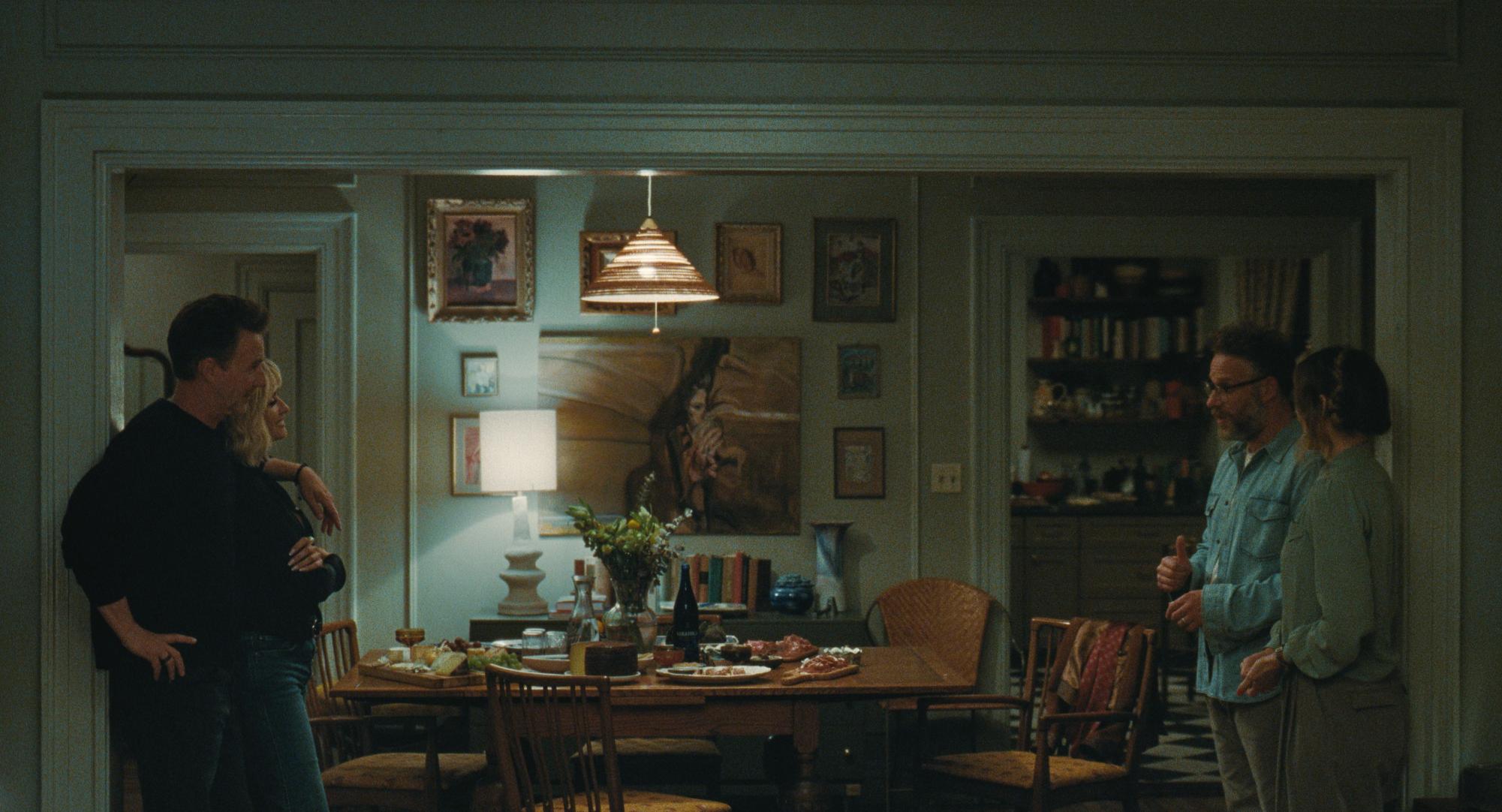
The set design does more than sit back and let the characters develop themselves. The contrast between Joe and Angela’s volatile relationship and their beautifully decorated home emphasizes the miserable state of their marriage. At the center of Joe’s character is insecurity over his failed music career that led to him settling into a career as a music professor. He has internalized the belief that he did not earn the beautiful San Franciscan house he inherited from his parents, and the chic set design emphasizes that failure; Joe and Angela can only afford the new renovation that Angela wants to show off to their neighbors because Joe never had to buy the house in the first place. Joe projects his misery onto Angela while she projects her frustration and anxiety over not working and being stuck at home onto him. Because the film was shot in one location over the course of one night, Wilde articulated that she aimed to “traverse quite a wide range of emotions in order to make the audience feel like they’ve been somewhere.”
The classical score written by Devonté Hynes led the audience on an emotional journey. Hynes is best known as the artist behind the genre-bending sound of Blood Orange, an alias under which he performs and creates music. He specializes in music that is at once melancholic and danceable, heavily featuring the cello alongside electronic sounds. Although the cello plays a prominent role in the score of The Invite, the film’s sound is completely distinct from that which Hynes creates as Blood Orange. Hynes’s score builds what feels like a life-or-death tension. Yet the reality is mundane for the couple: the threat of divorce that permeates through Joe and Angela’s everyday life.
The score reflects the feelings of each character in an intimate way, providing a lens into their interiors. In one scene, Joe teases that he’s going to confront the neighbors about their loud sex life. Angela’s anxiety builds as Joe moves to officially confront Piña and Hawk; meanwhile, the music intensifies in tempo and volume, causing the audience’s anxiety to heighten alongside her. The score is not partial to one character; instead, as Wilde said, “It felt like the score was the Greek chorus in the room.” Acting as the Greek chorus, the score serves as a friend of the audience, emphasizing the emotional truths each character struggles to convey. For Joe and Angela, the score accentuates their misery as well as the ways in which their marriage may be worth saving. At the end of a journey filled with anxiety and tension, Angela rests her head on Joe’s shoulder as he plays the piano for the first time in years. This final musical choice brings hope that Joe and Angela will rekindle their relationship.
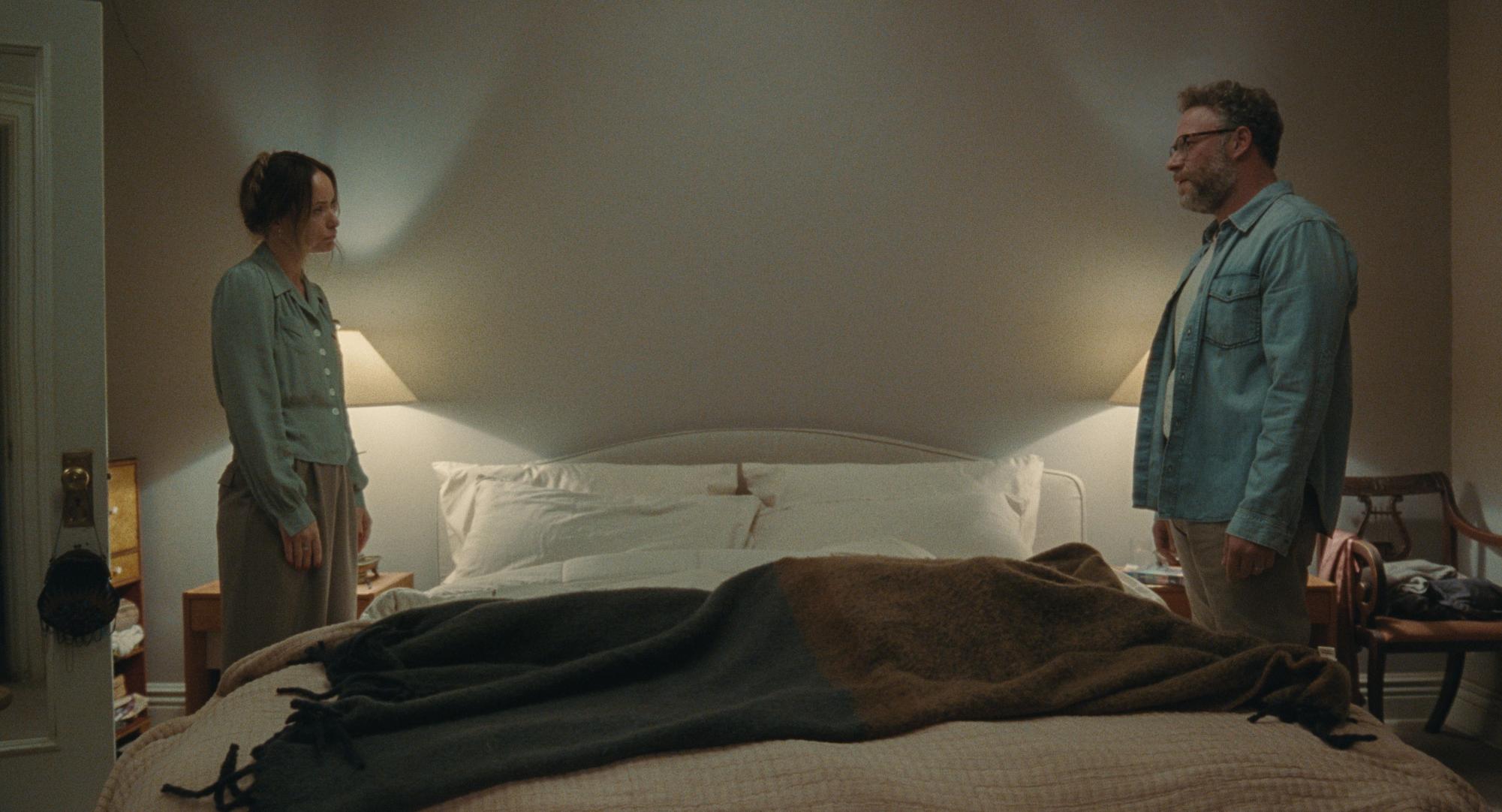
What drives this night forward are four fluid performances, accentuated by the dynamic shots and classical score so that each piece of character nuance acts as a plot twist. The characters’ dynamics twist and shift as they move between the roles of lovers, neighbors, therapists, enemies, and friends. The performances of Wilde, Rogen, Norton, and Cruz are playful yet true to life, enacting these differing dynamics in a simultaneously exhilarating and real way. Piña transitions fluidly from awkwardly dancing with Joe in his office to casually sitting in the living room opposite the main couple. There, she explains that their relationship is at a juncture. One path goes toward a site of irrevocable damage, and the other back to what we witnessed in the opening home video sequence: two people in love. What starts as simply inviting neighbors over to see new renovations divulges into a fast-moving, depressing-yet-optimistic take on marriage. Invoking Esther Perel’s take on marriage and divorce, Piña promises a bit of hope to the couple: Angela and Joe can repair their current relationship by treating it as a new one.
During the interview, Wilde posed a question: Within a miserable marriage, “are you holding back on a conversation that could lead to rupture or repair?” Inviting Piña and Hawk over breaks Angela and Joe’s pattern of blaming each other for their own misery, forcing them to have that conversation. We are left knowing that Joe and Angela will not continue in their state of misery: they will either fix their relationship or split.