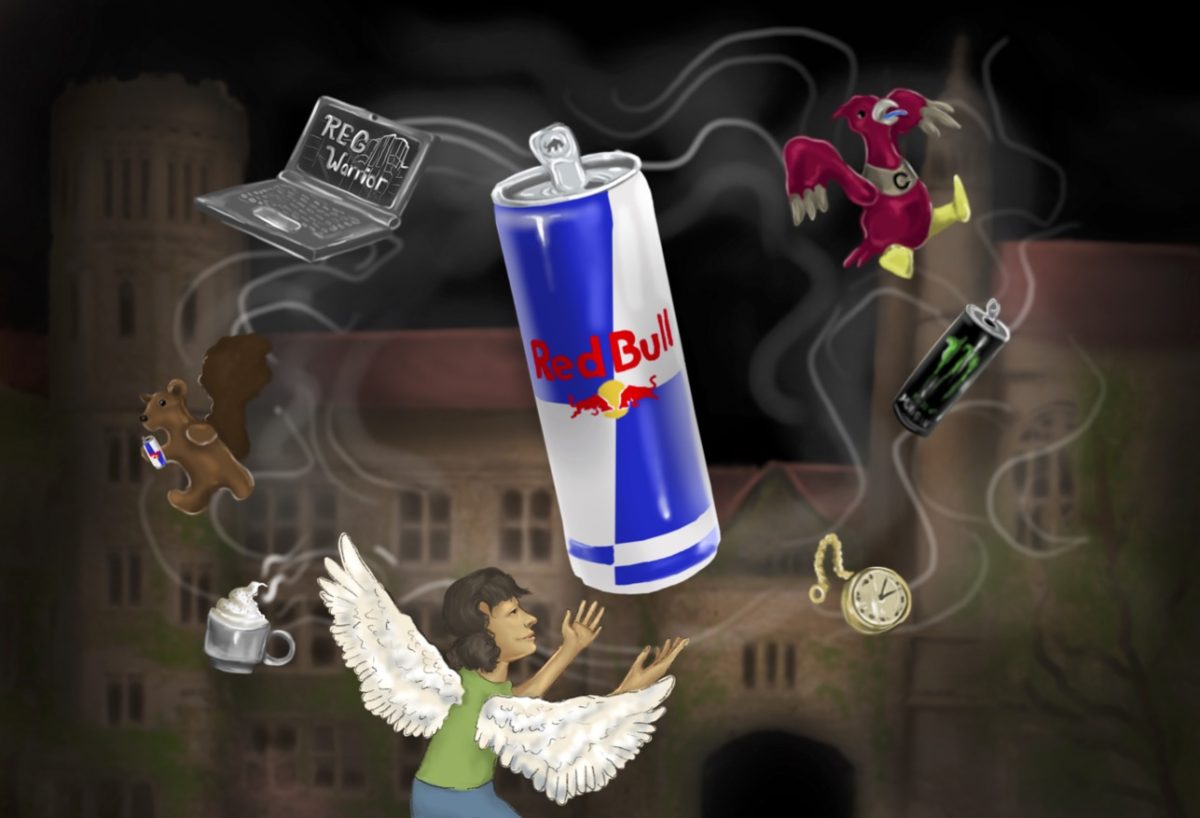
There’s hair plastered across my forehead, finding its way into my eyes as I line my foot up with the ball, uranium green and taunting. Everyone is counting on me, chanting my name. I take a deep breath, swing with all my might, and—miss. But then, a thud.
Screams of horror erupt from the crowd.
The sight is grotesque, almost too unpleasant to recount. There on the ground, just five feet from where I stand, is my foot. Giant, maroon, and feathered.

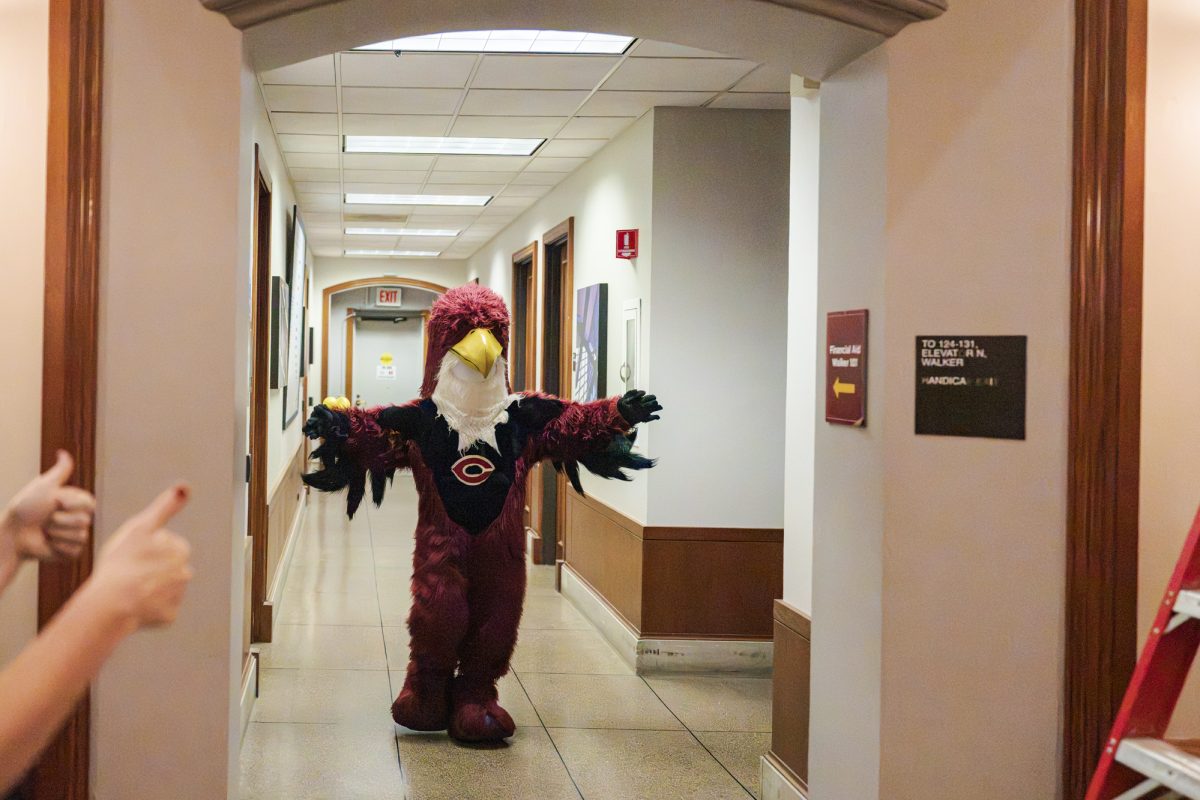
Earlier this month, I took up the sacred mantle of Phil the Phoenix, the University of Chicago’s beloved—at least by those who know of his existence—mascot. At a university not exactly known for its school spirit, being a mascot is a curious calling.
Becoming Phil
As I discovered through months of trial and error—attempts to track down Phil during admitted students weekend, stolen visits to the admissions office to plead with tour guides for leads, even a trip to Ratner, of all places—becoming Phil is something you have to want.
According to Brian Bock, senior associate athletic director for recreation and fitness, who also moonlights as Phil’s handler, aspiring Phils typically approach him. “I don’t really go out looking for Phils unless I’m told, ‘Hey, I’m interested,’ and I’ll reach out to the individual,” Bock said. “There’s no audition.”
The only other way to land the gig is to encounter an elusive job advertisement on the UChicago Athletics website. Phils are paid minimum wage for their efforts. (I refused payment, of course. The honor of being Phil was more than sufficient for my troubles.)
Phil’s duties typically fall into two categories: “one-off student-facing events” like admitted students weekend and orientation week, or wellness and athletic events, Bock said. He also tries to have Phil at every home game.
“Phil’s a great representative of fitness, and Phil’s pretty swole,” Bock explained. “Phil does work out at Ratner, so any type of fitness or wellness or community building event is what Phil appears at.”
At these events, Phil’s main job is really just to be present. The wearer of the suit walks around, interacts with attendees, and poses for photos.
Once I had secured a spot in the suit, Bock explained the rules of Phil work, the most important of which is maintaining Phil’s anonymity. “In the legend that is Phil the Phoenix, Phil has no gender, Phil does not talk, and… [Phil should] try to keep their identity private,” Bock said.
You may have already noticed, but by writing this piece I am violating the cardinal tenet of Phil-ship. Fortunately, after some back-and-forth with Bock, I was granted an exception on the condition that my time in the suit would be a swan song, so to speak. One and done.
Before stepping into the suit, I sat down with a current Phil—one of three returning this academic year, whom we’ll call S.P. (Secret Phil) to preserve their anonymity—to understand what I was getting into.
“It’s pretty top secret. I mean, my parents know, but that’s pretty much it,” S.P. explained. “I haven’t told any of my close friends or my partner or anything like that.”
“I sometimes will wave or definitely try to approach people I know when I’m in the Phil costume, so they’re more aware of Phil,” S.P. added. “In those moments, I wish I could signal or say something, but, for the sake of Phil, I can’t sacrifice [my secret identity].”
There are rules beyond keeping Phil’s identity secret. “Taking off the head in public, again, speaking [while in costume], endorsing any political party, alcohol, cigarettes, vapes, any[thing] like that—Phil shouldn’t be posing for pictures with any of those things or really holding any of those things as well,” Bock said. “Phil is very neutral when it comes to taking a stance on issues.”
According to S.P., keeping the costume on is one of the more difficult parts of the role because of how stifling the costume can get. Past Phils have described the suit as “hot, sweaty, and stinky” and as “smell[ing] like a stuffed animal.” Bock told me he makes sure the suit is sanitized after each use. (In my experience, it didn’t really smell like much when I first put it on, but by the end of a shift it will have taken on the scent of whoever was inside.)
My day in the suit was approaching quickly: Wellapalooza, the annual Student Wellness event featuring free flu shots and various destressing activities. As everyone knows, it’s the biggest social event of the academic year.
The Phoenix (Phil) Rises
The phoenix has been a part of the University for nearly as long as this newspaper has existed. The Board of Trustees first adopted the University’s coat of arms, in which the phoenix is the central element, in 1910. Though the original documentation has been lost, the prevailing theory is that it was a reference to the Great Chicago Fire of 1871 and the subsequent “rebirth” of the city.
Phil himself, though, didn’t appear until much later. As Bock put it, “Phil just rose from the ashes one day.”
The earliest known photo of Phil is from 1993, when the costume was described only as a “Phoenix mascot.” He wasn’t christened, at least in the available record, until 2006, when Molly Parrott, an assistant women’s basketball coach who oversaw the cheerleaders and mascot, was known to call the costume “Phil.”
Despite his decades of cheering on the University, Phil remains an unfamiliar sight to many students. “A lot of people are not really aware that we have a mascot, surprisingly,” S.P. said.
S.P. attributes Phil’s relative obscurity to the University’s tenuous relationship with “school spirit,” or perhaps lack thereof, noting that “there’s not as much school spirit as maybe some other DI schools.”
Discussions of UChicago’s school spirit often invoke the University’s withdrawal from Big Ten football in 1939 and its subsequent departure from the conference as a whole in 1946. But the University’s struggles with traditional “school spirit” might trace back even further.
“Ask any one who has been around these quadrangles for quite a while, and he will tell you that there isn’t any such thing as school spirit around this place,” the so-called Charley the Spaniard wrote in a 1928 column in the Maroon. “The most evident lack of school spirit is in the football arena.”
Nearly a century later, Phil faces the same challenges on game days. “When it comes to the homecoming game and that sort of school spirit, I think we might be a little bit lacking,” S.P. added. “That’s what, I guess, I try to make up for in being Phil.”
According to fourth-year Madison Copeland, co-captain of the cheerleading team, that does not mean students lack pride in their university.
“We definitely have a lot of school spirit for our academics and doing well and our career potentials,” Copeland said. “There is definitely a lot of pride in coming from such a prestigious university.”
UChicago students have historically taken pride in doing things that are “quintessentially University of Chicago”—bringing up philosophers at parties, building working nuclear reactors in their dorms, et cetera (read: et ke-te-ra). Phil, by contrast, is a more conventional symbol of school spirit.
For Bock, Phil’s purpose isn’t to transform the University’s relationship with school spirit. As he puts it, “Do I think that it produces hundreds of additional people because Phil’s going to be there [at an event]? No. But do I think it adds to the student experience and the atmosphere and the environment at our home athletic contests? I do.”
P-Day
Wellapalooza arrived on October 6. I made my way, with no small amount of anticipation, to Ratner to face my destiny.
Though I had been thoroughly warned by both S.P. and the Phils of academic years past, the suit’s lack of ventilation was still sobering. I noticed it from the moment I stepped into Phil’s comically large shoes.
I emerged from my egg—a storage room tucked in the far reaches of Ratner—already perspiring.
My first steps in the suit were difficult, as all first steps are, and I found myself tripping over my own feet, unused to how large they suddenly were. Wearing a mascot costume, I imagine, is not a terribly different experience from being transformed into some great beast; your limbs are suddenly not your own, your sight is limited, and onlookers point and gasp as you pass by.
I had to lift Phil’s head every few minutes (just a bit, so as not to betray my identity to the public), both hands gripping the sides of Phil’s great maroon maw. But by the end of my two-hour shift, I still looked and felt like I had spent the entire time in a sauna.
Keeping quiet was difficult at first, but I quickly became adept at charades, if you can call my arsenal of nods and various thumb movements that. The head of the Phil suit is mounted on a bicycle helmet that the wearer can buckle to keep the head secure; I, foolishly, opted out of doing so, meaning a simple jump or nod was enough to send Phil’s head teetering off mine.
Despite the restrictions of the role, there is still room for creative expression—Phil takes on the spirit of whoever chooses to wear his skin.
My Phil performed the “Brazil dance”—a popular trend on TikTok—at the request of a social media intern from Student Wellness, and occasionally executed the tree pose or broke into the Macarena between awkward photo-ops (my only pose was a thumbs-up). S.P. prefers “finger guns or moves like that.”
“I think I’m kind of awkward as a person in general, so that comes through in my Phil appearance,” S.P. said.
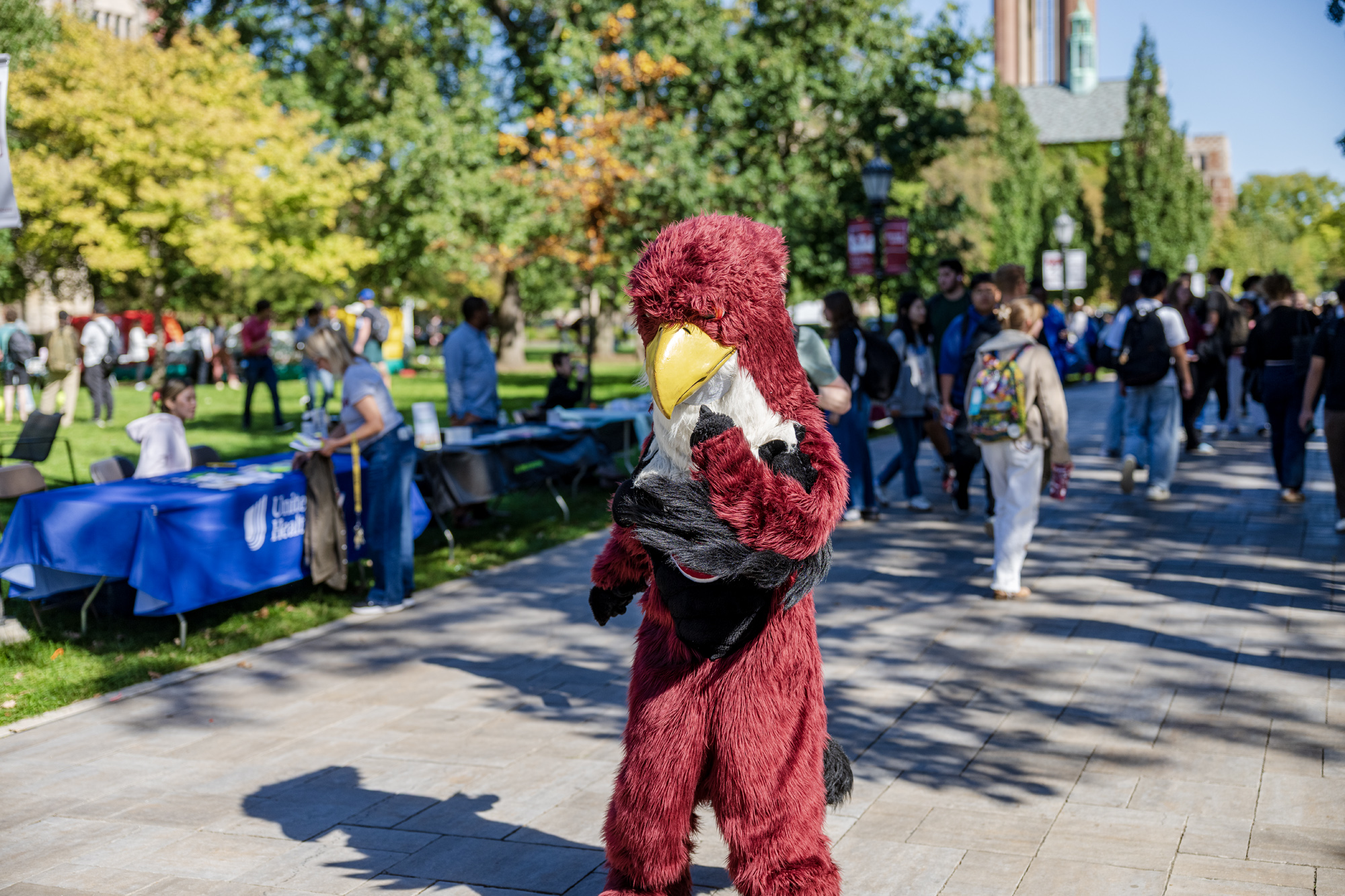
Phil also, unfortunately, shared my athletic abilities. When a social media intern asked me to kick a ball at a target (one of the Wellapalooza activities) for an Instagram reel, my foot came flying off instead.
But the most immediately recognizable difference between each Phil is their height. The shortest working Phil stands at just five feet tall, while Bock, who dons the suit himself on occasion, towers at over six-and-a-half feet. Built-in leggings allow for a more elongated Phil without breaking the contiguous chain of maroon.
Bock is actually able to identify each Phil by their “gait, the way they walk, their dance moves. I can tell who our Phils are,” though it also helps that he always knows who’s on Phil duty for a given day, he said.
“It’s just really nice getting to be yourself, but no one recognizes you,” S.P. told me. “You’re walking around, making everyone really happy, and no one knows it’s you. There’s kind of a beauty or a joy in that.”

As Phil, my main job was to walk around and act as a harbinger of joy and whimsy. I high-fived, I fist-bumped, I posed for photos. I even received a piece of fan art for my efforts—a miniature felted Phil the Phoenix. It was the closest I have ever come to being a campus celebrity. I expect this is what former Dean of the College John Boyer must feel like when he bikes past his adoring fans.

For Bock, the best part of being Phil is “the smiles that Phil gets. I think people light up when they see Phil. When I’m walking Phil across campus or I am Phil, it’s exciting to see people light up when they see Phil.”