The Dan Ryan Expressway exists mostly in the periphery of UChicago students’ minds. We may know it from the scenic move-in day drive or the blustery rush of cars alongside the Red Line platform. In my first ten months in Hyde Park, I never stopped to wonder about the history of the highway. When, why, and at whose expense was it built?
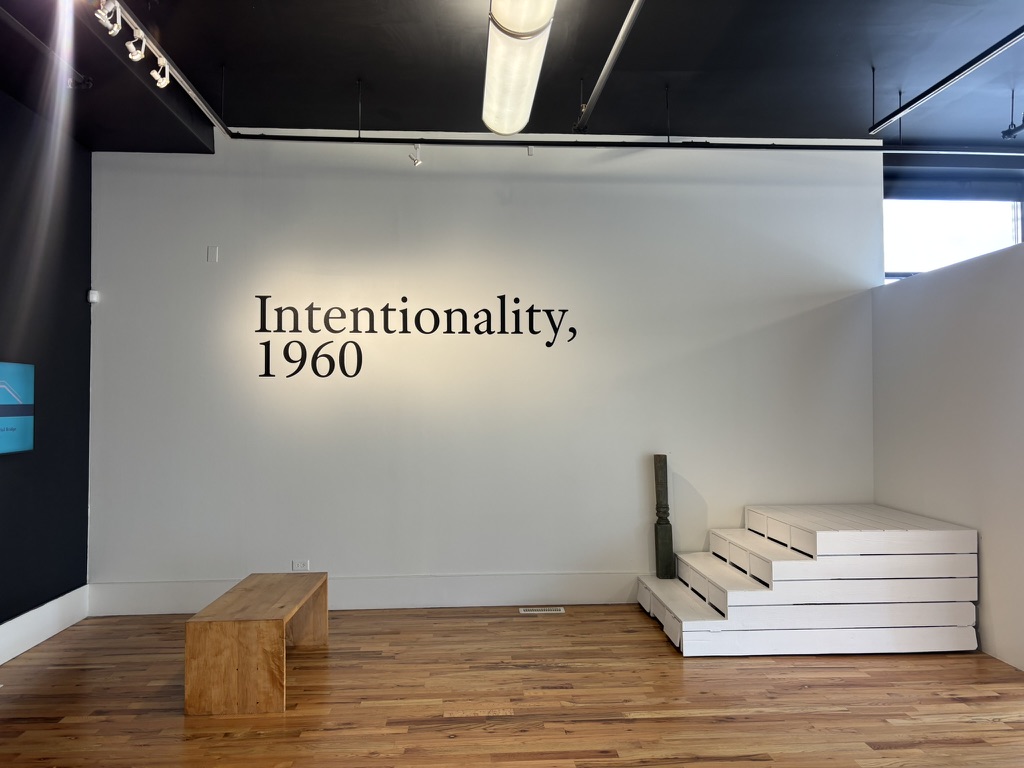
One answer can be found in the Arts Incubator, a cozy one-room gallery just steps from the Garfield Green Line station. Candace Hunter’s exhibit Intentionality, 1960: Whose Dreams? explores the impact of the Dan Ryan’s construction on the predominantly Black, low-income local community that it tore through. Named after the Cook County Board President who originally proposed its construction, the highway was built in the late 1950s and early 1960s, finally opening fully in 1962. The highway, along with other infrastructure projects on the South and West sides, ultimately displaced more than 81,000 people, of which 64% were Black (despite making up only 23% of the city’s total population).
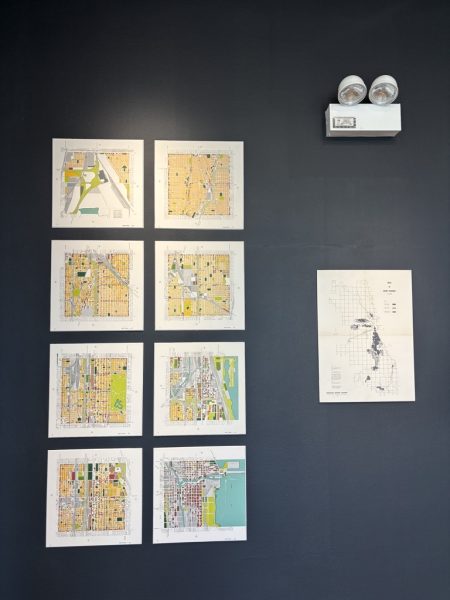
The first piece at the exhibit depicts the abstract infrastructure of the Dan Ryan that visitors may instinctually conceptualize. It consists of eight original maps from the Chicago Land Use Atlas, a collection of Chicago street maps published by the Department of Development and Planning. The intensity and brightness of the colors seem almost cheerful, presenting a hopeful vision of progress, while the carefully defined grid creates a sense of order and certainty. It is a constellation of empirical data—lines, numbers, and shapes that alienate any consideration of residents. In contrast, a single map to the right describes “Areas of Negro Residence in Chicago” in the early 1950s. Drab shades of black, white, and gray seem stark in comparison, emphasizing the concept of black-and-whiteness—a dangerous worldview, a suggestion of racial division. A gallery handout explains that the geography of Black life clearly maps onto the path cut by the Dan Ryan, which was constructed over “the everyday lives of the people who stood in its way,” not “empty land.”
To the right is a shelf with books, records, and magazines that reflect a wealth of Black culture. Among them is Richard Wright’s Native Son, a critique of systematic determinism; Black Orpheus on vinyl, the soundtrack to a 1959 romantic tragedy with a predominantly Black and Afro-Brazilian cast; and a copy of Ebony Pictorial History of Black America, a chronicle of Black history from Reconstruction to Brown v. Board of Education. “I always have some kind of library or reading space as part of the work that I do,” Hunter said in an interview with the Maroon. “It was going to be no exception here that there would need to be ephemera, books, music, that people could browse through and imagine what that moment would have been in someone else’s house, how it would have sat on someone’s coffee table.”
Indeed, the exhibit feels as though one has stepped into someone’s backyard. With a book in hand, I took a seat on a set of front steps that lay against the wall. The gallery design combines functionality, aesthetics, and education by physically incorporating parts of buildings into the exhibit. Other pieces include full doors, doorknobs, and windows culled over the years. On one hand, there is a sense of being disjointed, ripped out of place, just as the Dan Ryan uprooted communities. On the other, the stoop is positively reminiscent of a community gathering place. In fact, the gallery is hosting a series of three talks (the third of which is with Roy Kinsey on December 11), called “Threshold: Conversations on the Stoop,” which uses the steps in an active community-building practice.
The stoop also faces a TV screen, which plays a short, home movie–esque film on loop. It includes the testimonies of real individuals who were displaced by the construction of the Dan Ryan as children. Hunter calls the conversations “Memory Teas,” and said she finds the participants through happenstance. She doesn’t direct the conversations, asking only if they are native Chicagoans and where they lived. “I try to hold on to those memories because those first-place conversations about displacement aren’t in anyone’s archive,” she said. “I’m trying to grab those memories before they’re completely gone.” Although the film felt a bit slow-paced and makeshift, it was well-connected to other conversational motifs and aims in the exhibit.
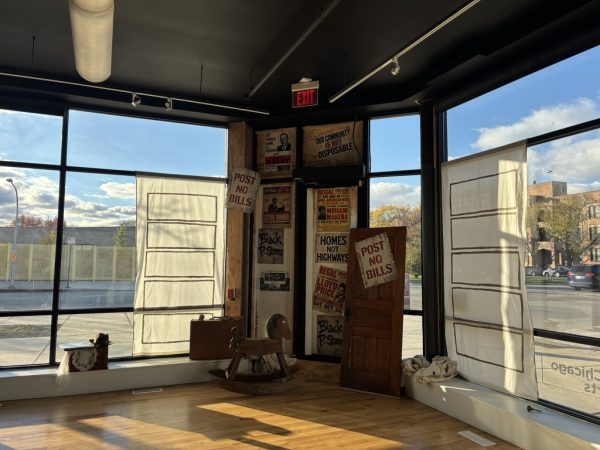
Towards the far side of the gallery is The Cacophony of a City in Transition: a mass of wood, posters, and household objects. Floor-to-ceiling windows face the street, transforming the outside world into another spectacle in an exhibit of which it is already the subject. A suitcase suggests movement. A baseball, some children’s books, and a rocking horse recall child’s play (those who remember the displacement today were all kids at the time). These innocent signs of life contrast the defiant conversation that emerges between “Post No Bills” and protest messages, promotions of Black musicians, and campaign signs. Another piece features an elementary school class portrait. A flame licks up from the bottom, where more planning maps line the frame. The arrangement hints at the expressway marring the idyllic classroom image. In both works, a tension emerges between daily joys, the encroaching infrastructure project, and a determination to preserve the community’s dignity.
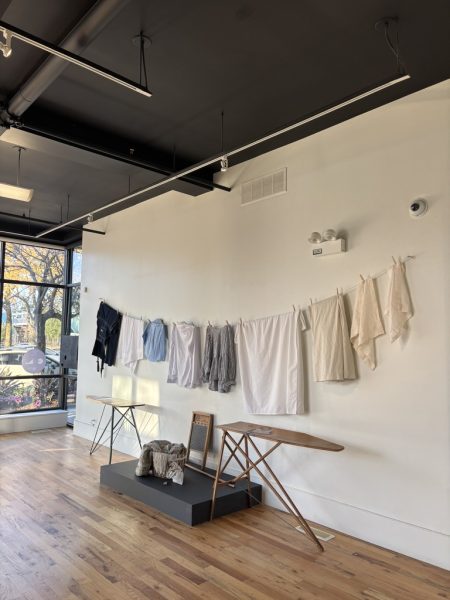
A laden clothesline is strung along the final wall of the gallery. A basket, washboard, and broom lie beneath it, as well as two ironing boards with phototransfer collages of women ironing. A radio plays in the background. Like fresh laundry, the piece is tidy and light, more visually clean than the last piece. Again, Hunter responds to the gallery’s architecture by wrapping a second clothesline around a pillar. While other pieces draw us into the street or the classroom, this domestic image, Women’s Labor / Saturday’s Sound resurrects the woman’s sphere by engaging multiple senses. This contingent of the labor force continued working on the weekends, the gallery handout explains, but had “the voice of Ed ‘Nassau Daddy’ Cook coming through WVON—“The Voice of the Negro”—keeping company with the women who kept households, families and communities moving.”
The exhibit continues into a dimly lit hallway, where the mood shifts significantly. Two collages on painted canvas evoke images of buildings crumbling away, while cutout faces appear pushed out of the frame. Grid patterns dominate as in the first piece, but these lines are uneven and imperfect, disordered. Another two collages mix images of buildings and faces, pieces of corroded metal, and a doorknob. All four pieces seem less composed than the works in the central room and feel out of place. Hunter explained that these were taken from the previous two chapters of her ongoing art project, 50,831 +/- Dreams, which is visibly evident in the progression of the pieces. Hunter moves from more rudimentary collage to reconstructing the lives of those affected by the Dan Ryan on a fuller scale.
Overall, Hunter succeeds at resurrecting material and spiritual components of community while constructing a counternarrative to the apathy of the Dan Ryan. The size of the gallery itself adds a layer of effectiveness: visitors can slowly consider each piece, instead of feeling pressured to “get through” the show. The inclusion of visual, auditory, and tactile multimedia elements produces a uniquely immersive experience. Through authentic testimony and physical buildings, Hunter places the audience in a conversation with the past that raises issues of race, class, gender, and age.
“A lot of the stories of those people are left out of history books, and I don’t know that it’s my responsibility to tell those stories,” Hunter said. “But it is, because it was brought to me. When the unanswered is given to you and you answer it, then it’s your duty to share it. We don’t leave things unsaid.”
The exhibit is open Thursday to Saturday from 1 to 5 p.m. through December 12.