In John Berger’s highly influential work of art criticism, Ways of Seeing, he articulates an argument against mystification in which the viewer’s moment of interpretation of a piece of art is taken away by an explanation of that which occurs. Jim Jarmusch’s Father Mother Sister Brother struggles under the weight of its own themes of estrangement and decay and fails to avoid mystifying itself.
In Ways of Seeing, Berger defines mystification as “the process of explaining away what might otherwise be evident.” This, for Berger, eliminates the opportunity to create meaning from art from its appreciator (or detractor). The artist is still the artist and the admirers are still the admirers, but if art remains un-mystified, meaning can be made collaboratively, even across time and space.
A lesser but still significant concern is the potential for what I will call “demystification” or the process of obscuring what would already be obscure. When dealing with sufficiently complex subject matter, failures of artistic communication reflect demystification insofar as meaning-making is made unnecessarily difficult. Grappling with a difficult work has inherent value, but struggling through its arbitrary difficulty can only serve to diminish the meaning found through that grappling.
Through its own mystification and demystification, Father Mother Sister Brother tells three distinct, thematically resonant stories of aging, love, and loss in estranged families. The anthology film’s failings obscure its power.
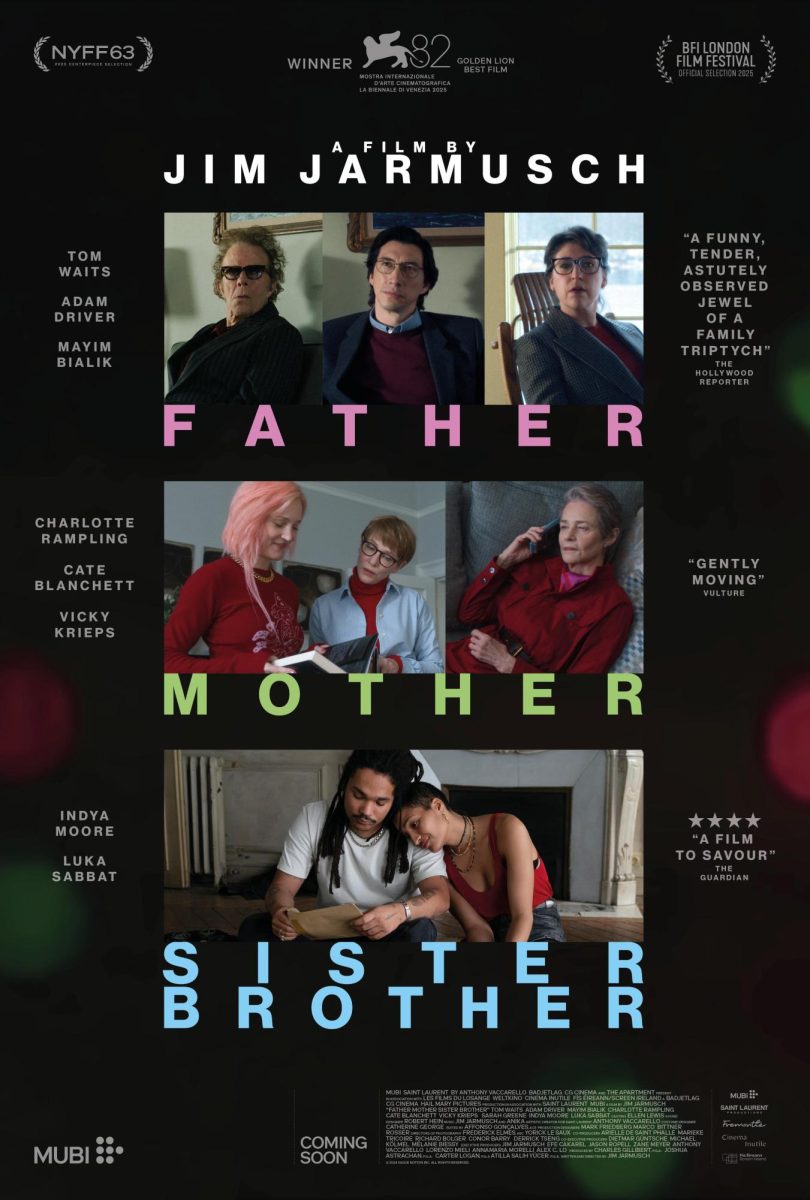
In “Father,” the film depicts the visitation of a father (Tom Waits) by his children (Adam Driver and Mayim Bialik). In “Mother,” a writer (Charlotte Rampling) hosts her daughters (Cate Blanchett and Vicky Krieps) for the one time a year they all see each other despite living in the same city. In “Sister Brother,” siblings (Indya Moore and Luka Sabbat) reunite to mourn the loss of their parents by visiting the now-empty Parisian apartment they used to call home.
Connections are obvious and bountiful. Each serves as a picturesque if meandering familial portrait. Collectively, however, they leave the viewer wanting. The triptych itself mystifies insofar as ideas that are explored with a semi-deft touch in individual stories serve to bludgeon the viewer with the weight of a sledgehammer when combined. Repetition explains that which was already evident.
Whatever meaning could be derived from the film is certainly obscured by the fact that the film functionally serves as an advertisement for Rolex and Yves Saint Laurent. In each story, characters show off Rolexes with varying levels of authenticity. Yves Saint Laurent designed all the clothes for the film and was a financial backer. Though the label’s involvement serves to provide some aesthetic clothes, that Tom Waits’s or Cate Blanchett’s characters would be wearing such clothes stretches believability. The focus on non–thematically relevant aesthetics demystifies, it obscures themes that don’t need further obscuring.
At points, the film’s craft leaves a lot to be desired. Moments of simple beauty in the relations between characters are paired with exceedingly wooden and hollow moments of dialogue. Moments of contemplation are interrupted by dialogue explaining which room of the house the characters are in. The evident is explained obscuring both the obscure and the confronting. There is a thought-provoking film somewhere in here, but Jarmusch does enough to both mystify and demystify it that it is hard to become sufficiently invested to struggle with its ideas. It is difficult to wrap one’s hands around it due to its failures, not its successes.
Berger wrote that “when we ‘see’ a landscape, we situate ourselves in it. If we ‘saw’ the art of the past, we would situate ourselves in history. When we are prevented from seeing it, we are being deprived of the history which belongs to us.” Father Mother Sister Brother reflects the promise of a shared artistic history that remains unrealized due to its mystification and demystification of itself. The film’s friction aptly speaks to its themes: everyone gets older, even auteurs.