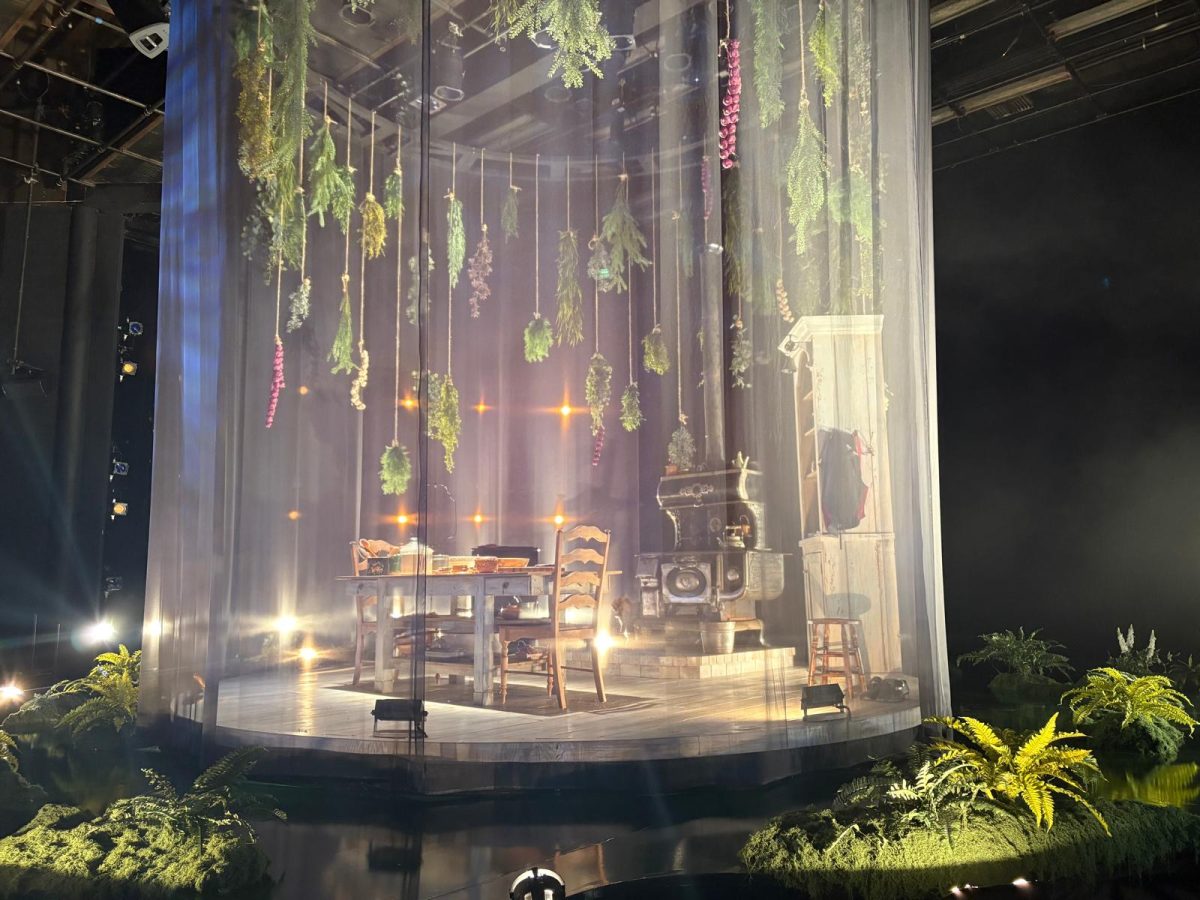
Court Theatre’s rendition of August Strindberg’s 1888 one-act drama Miss Julie, staged from February 6–March 8, was a provocative performance that explored the power dynamics that illustrate the very worst of human nature. Upon entering the theater, I was struck by a set designed by John Culbert, blending the natural and the domestic. The exterior was bustling with foliage and featured a beautiful effect of plastic on the floor that resembled water, which drew our focus toward the central room. The room contained a table, three wooden chairs, an old-fashioned stove, and evidence of a lived-in space: worn shoes in the corner and jackets hung on the coatrack. Although our attention was anchored there, a screen separated the audience from the room and created a visual blur, which accentuated the surreal viewing experience.
Set on a wealthy Count’s property, Miss Julie centers on the Count’s daughter Miss Julie and household servants Jean and Kristine. The small cast of three interacts within a single room, amplifying their tensions as they collectively descend into madness.
The play opened with Kristine, played by Rebecca Spence, who set the stage for the madness to follow. Upon her entrance, she began making bread in front of the audience using real ingredients. Spence’s clear knowledge of the space demonstrated that Kristine had performed this act dozens of times before. This fragile, quiet domesticity was broken by the juxtaposition of loud techno music in the background, heightening the scene’s tension. Spence’s movements were mesmerizing as she folded the dough in tempo with the music. She carried that familiarity into her conversation with Jean, played by Kelvin Roston Jr., when he returned from work. The banter between Roston Jr. and Spence was electric, evoking the feeling of an old married couple’s gossiping. The audience laughed after Kristine messed with Jean’s hair, and he muttered that he was “touchy about that hair.”
However, we were reminded that they are not married when Mi Kang, as Miss Julie, pranced onto the stage. Raquel Adorno’s design of her costume was reminiscent of the costuming in the 2019 Midsommar: Kang wore a leaf crown paired with a white, flowy dress. Adorno’s costuming effectively reflected the free spirit of Miss Julie. Kang immediately established Miss Julie as an unlikable character. She moved through the space chaotically, climbing on the table with no regard for the environment Kristine and Jean had cultivated. This behavior sharply contrasted Kristine’s care for the space, serving as an emblem of the class tensions central to the play.
In a scene between Miss Julie and Jean, Miss Julie sat on the table and commanded Jean to kiss her foot, waving it provocatively in an attempt to goad him into sex. She forced on the forcing herself upon him so intensely that he had to shift to avoid being pressed against her. This interplay harped on the obvious power dynamic between them. This interplay Despite Miss Julie’s unlikability, Jean shared immense chemistry with her. I could feel his stress and deterioration as he tried to reason her out of her proposition to run away together. He commanded “No” in a deep, gravelly voice that emphasized the distress caused by the combination of her persistence and his own long-hidden and forbidden desire for her.
The tension finally broke in a wild and desperate sex scene. The scene moved through various stages of intimacy as the lighting shifted to orange and the erratic techno music returned. Miss Julie and Jean gave in to their most animalistic desires, irreversibly shifting the tone of the play. Afterward, Miss Julie paced the stage in silence as Jean attempted to make sense of the crime he had committed in coupling with his boss’s wife, their disheveled appearances emphasizing their guilt.
Bottles piled up as Jean and Miss Julie debated their situation. Jean’s frustration was palpable as Miss Julie curled herself into a ball and shut out his pleas, representing the inversion of their hierarchical relationship and leaving him stranded in their crisis. He was left with the mess they created. Rather than doing something productive to reverse its effects such as cleaning up the room that had been ravaged, he paced and monologued about their crisis. The tension became palpable as he found no solution.
While we previously saw a lighthearted relationship between Jean and Kristine, her re-entry signaled the weight of Jean’s betrayal. As she rapidly began cleaning the bottles, she didn’t need to speak as her silence and the way her tongue rubbed the inside of her cheek suggested, “I’m not mad, just disappointed.” Regardless, she assumed her role, demonstrating that in contrast to Jean, she continued to perform her place in her class.
Over the course of the play, it was undeniable that Miss Julie caused the central problems of the play by disturbing their social order, and yet I felt as if I should have had a more nuanced view of her, given her turbulent backstory. She was raised by a mother who believed in a full rejection of gender roles. This upbringing left Miss Julie in a state of gender confusion, and she was later forced to assume the very gendered role of the Count’s daughter after her mother passed. Kang’s performance in relaying this backstory fell flat, and, in turn, I did not feel nuanced emotions toward Miss Julie.
Kang’s performance was most impactful during Miss Julie’s descent into madness. In the final scene, she circled the table facing Jean with a clear mania in her eyes. While she had previously been playful while standing on the table, it now appeared like something inside her had snapped; the audience held its breath, unsure of her next move. This unpredictability illustrated Kang’s ability to make us feel as if Miss Julie herself did not know her next move. In the end, the teapot whistled eerily and she stepped down. The conclusion mirrored the beginning, with Miss Julie moving through the stage just as Kristine had, disturbingly mimicking the actions of her servant.
Court Theatre’s Miss Julie included all the hallmarks of a great play. The incredible performances, combined with the dreamlike set design and unsettling music, left a haunting impact on the audience that lingered long after the show ended.