What does it mean to be human? Aristotelians would have you believe that the essence of humanity is that we are rational animals. And yet, too often we set animality and rationality in tension, if not treat them as entirely contradictory to each other. Fredrik Værslev’s The Joy of Painting, an exhibition of eight paintings at the Neubauer Collegium for Culture and Society, reconciles the two in a visual joyride.
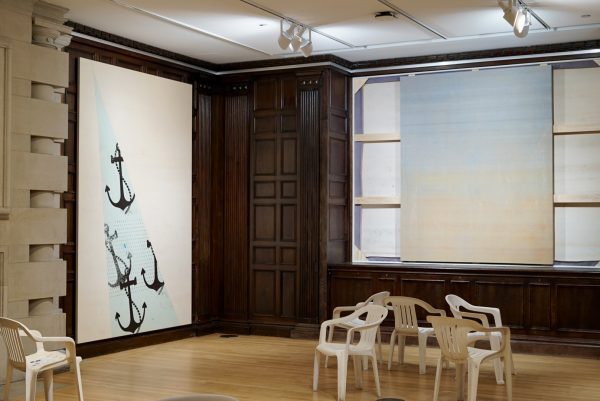
In each painting, there is something trying to break through. Elements reminiscent of the natural world are hidden under human artificiality. The animal is buried in favor of the rational. In Untitled (2016), a white canvas is cut diagonally to reveal black anchors on a light blue background. Evocative of the sea, the silver starkly contrasts with the white purity and sterility reminiscent of scientific artificiality.
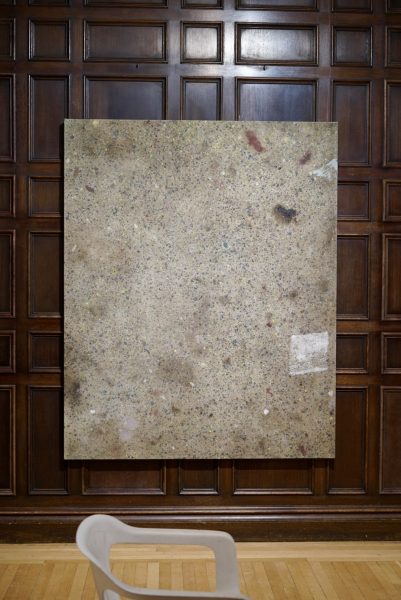
In Untitled (2010), bright green and yellow splotches are set against a bleak gray foreground and black dots. The piece, reminiscent of a terrazzo floor, evokes nature and growth through its verdant hints.
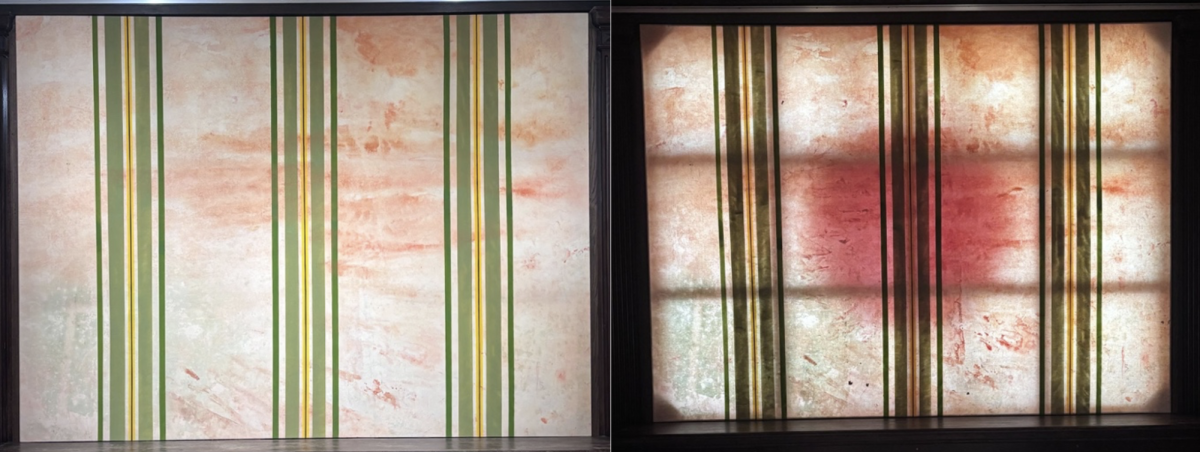
Two paintings are hidden, revealed only when the gallery lights are dimmed and sunlight is allowed to filter through. This isn’t obvious at first. The pieces are listed in the gallery guide, and their location is revealed only when the viewer asks a gallery attendant to switch off the lights.
One of these pieces, Untitled (Japan), is a recreation of the Japanese flag, hidden behind Untitled (2025), which features strong, crisp lines imposed on a cloudy orange background. The artificiality of Untitled (Japan) breaks through the natural cloudy background of Untitled (2025).
However, Untitled (2025) on its own creates the opposite impression. Its man-made lines are imposed upon a sky-like background, allowing the natural to come out of the artificial. There are three layers to the two pieces: the imposed lines, the clouds breaking through these lines, and the Japanese flag that underscores everything. And yet, there’s arguably another layer: to see the flag, the viewer must return to nature—turning off the lights and letting the sun peek through.
Of course, reducing the exhibit to nothing more than a natural-artificial dichotomy is too simplistic. It removes much of the nuance from the paintings. After all, the anchors depicted in Untitled (2016) are just as man-made as my computer. There’s another tension within the pieces: that between order and disorder.
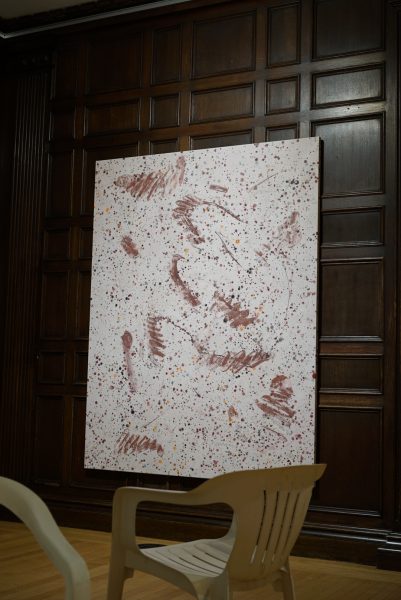
Untitled (2022) portrays random chaos versus ordered chaos; that is, the difference between nonsensical chaos and chaos that can be understood and predicted. The painting displays colored dots on a white background with brushstrokes of deep maroon that look as random as the dots. This chaos is ordered: the dots may appear random, but they’re consistent, evenly spaced, similarly sized, and harmoniously colored. The brushstrokes, on the other hand, resist easy comprehension and arrangement. They are spread randomly, lacking a shared shape beyond what their technique implies. Both elements are stochastic. However, one is predictably so, and in some sense ordered, while the other is entirely random.
Returning to Untitled (2016), the piece with the anchors on a silver background, notice that it exhibits a similar interplay between ordered and unordered chaos. The dots are organized in three lines, while the anchors are randomly placed, overlapping, and cut off by the white edge of the canvas.
However, this piece seems to defy reduction to either of the proposed themes. It can’t be only natural versus artificial, as part of the “natural” would include an anchor and lines of dots. It also can’t be only ordered versus unordered, as the unordered element, the blue, appears in a straight diagonal line, contradicting the notion of random chaos. The anchors could theoretically represent disorder based on their placement, but anchors are meant to hold ships in place and counteract the random nature of the waves—they don’t scream disordered stochasticity. But the lack of simplification to either theme may point to a broader one of animality versus rationality.
Both the conflict between humans and nature, as well as that between order and chaos, can be linked to the clash between the animalistic and rational parts of humans, as conceived by Aristotle. By showing both naturality and random chaos peeking through the unnatural and the ordered chaos respectively, the exhibit portrays the animal in us. However much we might try to hide it beneath rationality and all its artifices, our animality shines through regardless. We are as irrational as we are rational.
Throughout this analysis, I have ignored a crucial aspect of the exhibit: its title, The Joy of Painting. Simply knowing the title, one might walk in expecting to see a representation of the painting process itself. And yet, nothing in the exhibit is clearly related to painting. This raises the question: what is the joy of painting? For Værslev, it seems to be the very rebellion of animality against the imposition of the rational.
Looking at Untitled (2010), the piece akin to a terrazzo floor, the green and yellow dots, along with the random brushstrokes and darker patches, tell of a floor well-used by a painter. Untitled (Japan), the painting that hides the Japanese flag, is composed of green and black straight lines imposed over orange clouds. The clouds look more painted than the lines, and, if you look closely, they go over the lines, not under. The clouds reclaim the area of the lines. Even Untitled (2016), the anchor piece, whose “rebellion” consists of black anchors and dots on a blue background, feels triumphant against the pure-white background of the rest of the piece. If the white is conceived as the canvas, it’s easy to see the connection between the triumph of the painted blue onto the white. Each of these pieces rejects artificiality and constraint in unique ways. The paint itself seems imbued with rebellion.
When we consider the act of painting itself, the rebellion against the rational doesn’t seem so far off. What is painting but an expression of human emotions, the least rational parts of ourselves? In a world that’s increasingly mechanistic, returning to what cannot be ordered or controlled is a genuine joy. The joy of painting, the exhibit seems to say, is that of being fully human.
Fredrik Værslev: The Joy of Painting was on view at the Neubauer Collegium through March 27.