This week’s Undergraduate Student Government (USG) election has put a spotlight on USG’s complex finances. All four of the executive slates have promised more budget transparency, and this year has been marked by a quickly dwindling budget for RSOs and disagreements over funding guidelines.
So where does USG’s more than $2 million budget actually go?
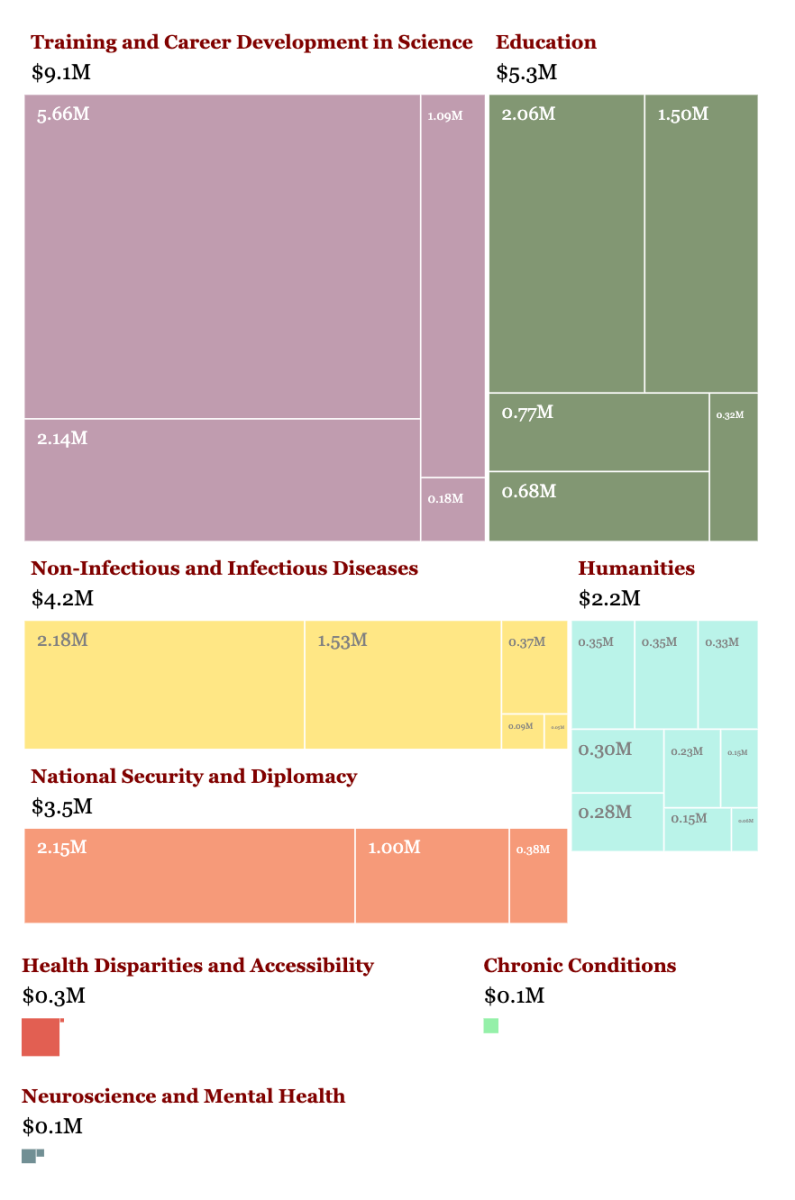
The Maroon used internal funding documents provided by both current and former members of USG to compile a record of most of Student Government’s spending in the 2024–25 academic year. The vast majority of USG’s money goes to RSOs, but the question of which ones—and how that funding is allocated—is more complicated.
Overall Budget
RSOs primarily get funding from USG through one of five finance committees: the Student Government Finance Committee (SGFC), which also runs the Annual Allocations (AnnAl) process for most RSOs; the Program Coordinating Council (PCC); the Coalition of Academic Teams (CAT); the Sports Club Fund (SCF); and the Community Service Fund (CSF). Together, these five committees comprise more than 98 percent of USG’s budget.
USG also has an “administrative budget” that its Cabinet can use at its discretion. The remaining line items are small: the Committee on Marginalized Student Affairs (COMSA) awards a few grants, typically of $1,000, to projects benefitting marginalized students; the Committee on RSOs (CORSO) grants student leadership recognition awards (SLRAs) to students and RSO awards to student groups; and College Council (CC) and the Student Advocate’s Office (SAO), a branch of USG, each receive some funding.
Which RSOs Get the Most Funding?
USG allocates funding to RSOs in two ways: during the academic year for specific events, and annually every spring to cover regular expenses for the following year.
Most RSOs fall under the jurisdiction of SGFC, whose budget was rapidly depleted this year, but some are overseen by other funding committees. Large, mostly arts-focused RSOs that put on programming for students—like the Major Activities Board, which hosts Summer Breeze, and Doc Films—are funded by PCC, while academic teams like debate and mock trial, which tend to have high travel costs, receive money from CAT. Those committees have much larger budgets per RSO they oversee. SCF funds sports clubs, and CSF funds RSO expenses that primarily seek to benefit members of the wider community outside the University.
Because funding decisions are approved by CC and CC’s decisions are public, RSO allocations are theoretically public as well. But USG doesn’t publish most of them anywhere, nor are they compiled in a single document internally, with academic-year allocations in publicly available SGFC minutes being the lone exception. Last month, CC passed the CLEAR Act, which will require USG to publicly release RSO funding data beginning next academic year.
The Maroon obtained records documenting USG allocations to RSOs last year, including academic-year funding—meant to cover expenses during the 2024–25 academic year—and annual funding allocated in spring 2025, meant to cover regular expenses in the 2025–26 academic year.
Administrative Budget
USG’s administrative budget—about $26,000 this year, including unspent rollover from last year—can be spent on projects and events as the USG Cabinet sees fit.
Last year, the largest discretionary expense by a large margin was the free shuttles USG runs to airports at the end of each quarter. Other large expenses included the annual Taste of Hyde Park event, a partnership with the Phoenix Sustainability Initiative (PSI) to offer composting in dorms and in off-campus apartments, and food for some USG meetings.
Editor’s note, April 20, 9:23 p.m.: A previous version of this article incorrectly stated that none of USG’s allocations to RSOs were public. Some are available in SGFC minutes.