

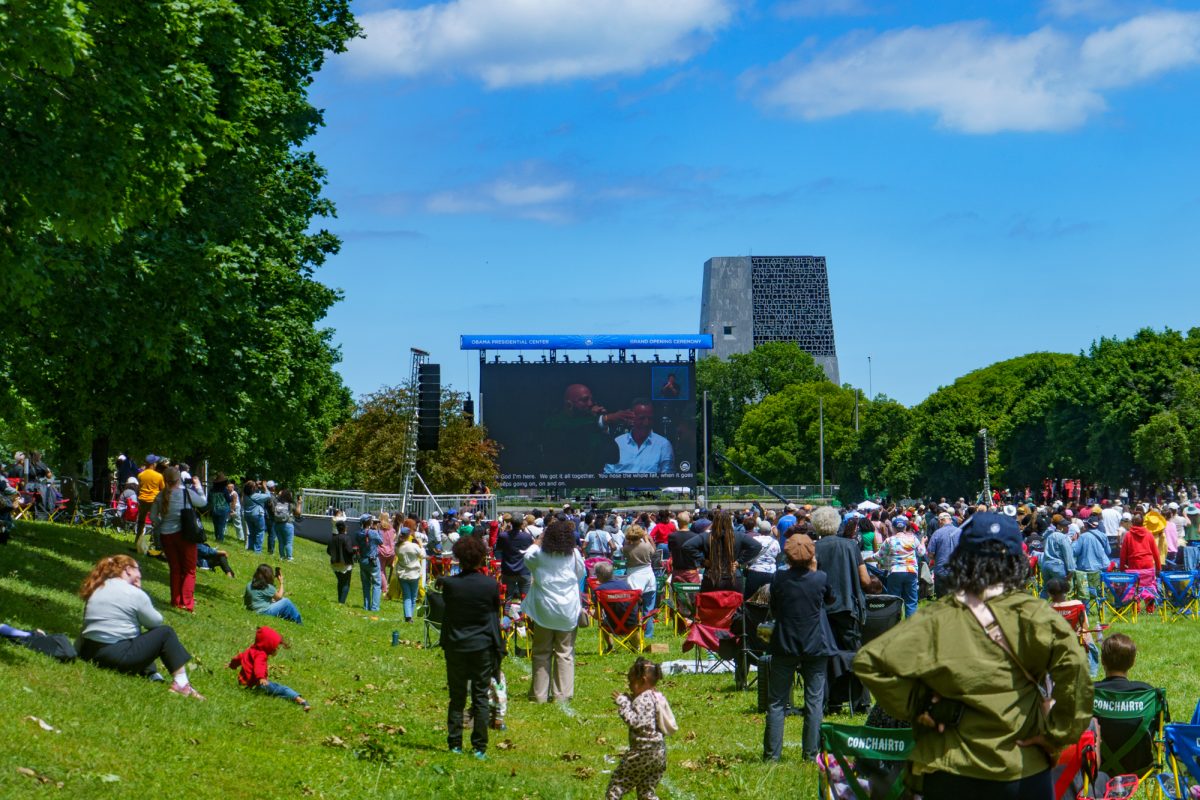
The Obama Presidential Center (OPC) held its grand opening celebration Thursday, bringing visitors from across the nation to the South Side for a day of speeches and musical performances.
Several hundred invited guests—including celebrities, politicians, and staff from former President Barack Obama’s campaign, administration, and foundation—gathered in the Center’s John Lewis Plaza for the event, while hundreds more packed into the eastern half of the Midway Plaisance, where several large screens had been set up to broadcast the festivities.
Former Presidents Bill Clinton, George W. Bush, and Joe Biden; Governor J.B. Pritzker and Lieutenant Governor Juliana Stratton; and celebrities including George Lucas, Stephen Colbert, and Oprah Winfrey were in attendance.
Musical icons including Jennifer Hudson, John Legend, and Marc Anthony performed some of their biggest hits, and Stevie Wonder sang “Higher Ground” to close out the show, with the rest of the artists joining him on stage. The Obamas and Obama Foundation executives spoke about their hopes for the Center and reflected on political changes over the nearly 20 years since Obama was first elected president.
The library, museum, and civic center in Jackson Park will officially open to the public on Friday morning. Tickets to the museum, which cost $26 for Illinois residents and $30 for other adults, are sold out through November. The rest of the campus, including a new branch of the Chicago Public Library, will be free to access.
“It was here in this city, a city of broad shoulders, that I found what I was looking for,” Obama said in his speech. “Day by day, block by block, I got to know the people who lived here, their hopes, their dreams, their tragedies, and their triumphs.” He called the Center “an expression of thanks” and an acknowledgment of how much he owes to the city and the South Side, where he began community organizing.
“This is a campus for everybody, whether you live down the street or on the other side of the world. And we hope you are gonna come back again and again,” Obama Foundation CEO Valerie Jarrett told attendees. “To our neighbors who showed up to countless community meetings and shared their hopes, and dreams, and yes, their concerns with us, we hope we have made you proud.”
“This is not a monument to the Obamas, you guys; this is a tribute to all those who made their journeys possible,” Jarrett continued, referencing a quotation from Obama’s “You are America” speech inscribed on the outside of the museum building. “This center may be named for the Obamas, but it is built for you.”
Obama Foundation Board Chair Marty Nesbitt (M.B.A. ’89), expanding on Jarrett’s theme, described the building as “a promise” to the world of what participation and civic engagement can create.
He called it a “promise that young people, regardless of where they come from, can make a difference in the communities and in the world. And a promise that the South Side of Chicago will continue to be a source of talent, innovation, and opportunity—and hope—for generations to come.”
Over the 11 years since the Obama Foundation announced the South Side as the future home of the OPC, some community activists have fought to prevent its construction and secure protections against rising housing costs. The Obama Foundation, for its part, has argued that the influx of visitors and associated economic activity will be a net benefit for the South Side.
“I love Barack Obama, and I’m glad that he built that center for the people to come together as one,” Wanda Scott, who was watching the event from the Midway, told the Maroon. Scott said that, as a Black Chicagoan, she believes the Center will bring jobs and opportunities to the city, along with a chance for people to learn the “history of our culture.”
Adrienne Simms, a Hyde Park resident and a former neighbor of the Obamas, told the Maroon that the OPC “means everything” to her. “It proves that he is a valid citizen, that what he did mattered,” she said.
There had been “cognitive dissonance” among some people, “not really wanting him to have it here, worrying about the rents going up,” she said. “But we need this, we really need this in Chicago, in the South Side of Chicago.”
Michelle Obama’s speech was both a celebration of the former president and his legacy and a call for Americans to reconnect with the values of respect, selflessness, and inclusion.
“Eight years in the crucible, and not once did you melt from the heat, not once did you let it harden you,” Obama said, referring to her husband. She touted his achievements, including expanding healthcare access, handling the economy during the 2008 financial crisis, and winning a Nobel Peace Prize.
She also subtly criticized President Donald Trump, referring to “these anxious and divisive times” and a refusal “to respect the contributions and experiences of people who aren’t exactly like us.” By contrast, she called the OPC a monument to the values of “equality, empathy, honesty, inclusion, and fairness.”
“That’s where the truth of this country lies: not in grabbing as much as we can get for ourselves or knocking folks down to prop ourselves up.”
She also warned that “failing to see the humanity in all people puts us all on a slippery slope,” alluding to the anti-immigration rhetoric of the current administration. “No one, and I mean no one, has the right to sit in judgement of who’s American enough.”
In the last hour of the event, Obama described the path that led him to the inauguration of his presidential museum, beginning with his 1985 arrival in Chicago.
The former president reflected on the Center’s role in celebrating and memorializing the people and achievements that have defined his presidency and American history, while acknowledging that he—and the country—have not always gotten everything right. He also cautioned against nostalgia.
“Of course, we did not accomplish everything we set out to do. No administration does. Some of the exhibits reflect unfinished business, in some cases, my own shortcomings and mistakes, in some cases,” he said.
Referencing a sign he kept on the Resolute Desk that read, “hard things are hard,” Obama said, “The exhibits in the Center are not meant to evoke nostalgia for some gauzy, bygone era, some unattainable past that we can dream about, and say, ‘Oh, we miss you, Barack.’ They’re meant to remind us of who we can be, to remind us of what’s possible, so we can forge ahead, clear-eyed and confident, and do the work that still needs to be done.”
Nicole Ochoa contributed reporting.


Built for you but not free for you / Jun 19, 2026 at 9:40 am
LBJ Library is free for UT faculty, staff, and students. Just saying.