

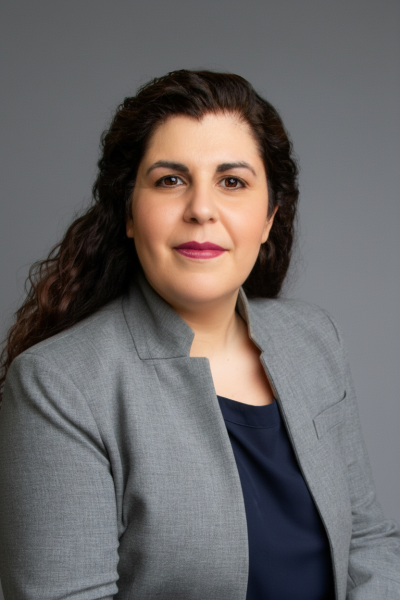
Talin Hitik, a lecturer at the University of Chicago Law School, was appointed executive director of the Chicago Forum for Free Inquiry and Expression on May 1. The Maroon spoke with Hitik about her work and plans for the Forum.
Note: This interview has been edited for clarity and brevity.
Chicago Maroon: Your career has centered on private and public international law. How has this experience informed your understanding of free expression on campus and beyond?
Talin Hitik: I would say public international law is the most relevant to free expression. We have lots of international conventions, like the Universal Declaration [of] Human Rights, [the] European Convention on Human Rights, and the other regional ones, like the Inter-American [Commission] on Human Rights, and these legal instruments all include specific language [centered] around freedom of expression. That background that I have in international human rights teaches me that freedom of expression is a human right, and I’ve always viewed it that way.
I’ve had a lot of involvements in my life. I’ve been fortunate enough to be part of building young democracies in former Soviet republics, and what that has taught me is that speech is absolutely paramount. So, when I say speech, I’m talking about the broader public speech that is important to civil society—speech that strengthens a democracy.… When you translate that to academic freedom and speech on campus, more specifically, again, it’s essential [for] a democracy to create [an] informed citizenry. That informed citizenry comes in large part from the university, so you have to have a quality education, and that quality of education isn’t going to exist without some modicum of academic freedom… so I feel like freedom on campuses eventually translates to healthy democracies.
CM: Given your international perspective, what do you think is something that American students and Americans in general might miss or misunderstand about free expression?
TH: We have the First Amendment here in the United States, obviously. When we talk about academic freedom and freedom on campus—[the] University of Chicago is a private university, so our own regulations are guided by the Chicago Principles and the Kalven Report, and those are internal to us. We are obviously not obligated to follow the First Amendment in the same way that a public university is, but as a society, we all have this notion of what the First Amendment is and what it protects.
[The Chicago Principles, adopted by the University in 2014, espouse a commitment to free expression on campus. The Kalven Report is a 1967 document prepared by a faculty committee about the University’s role in facilitating free inquiry.]
I think Americans, American students, and Americans in general really don’t understand just how broad the First Amendment is when you compare it to other democratic republics and other constitutional democracies…. I think [that’s] kind of lost on Americans, just how broad it is. For example, we don’t define hate speech, and there’s no such thing as hate speech in the United States. We have very, very finite and specific limitations on speech… from some dissenting opinions from the Supreme Court throughout the years; we’ve created some very broad guidelines around speech that’s not okay, like true threats or fighting words, but other than that, we don’t restrict speech in any way, and it is really the broadest interpretation of speech, I think, on the planet.
CM: Do you think that all that expansiveness is for the better?
TH: We have our wonderful and brilliant in-house scholar, Geoffrey Stone, at the Law School, who’s been instrumental in the work of the Forum and is a world-renowned First Amendment scholar. He would say that the only solution to bad speech is more speech, and that all speech is good speech because it’s speech, and, I think, that’s the orthodox American way of looking at the First Amendment.
On the other hand, we have scholars like the scholar who’s in residence right now… at the Forum; her name is Mary Anne Franks. I think [she] would say it’s simply not the case that all speech, no matter what the content of the speech, is for the better of American society. There is such a thing as reckless speech, and that speech deteriorates civic discourse…. There’s this concept of those whose speech is just designed to pollute the public square—it doesn’t actually have any value whatsoever. So we have to be careful about those kinds of speakers, too. If it adds no value whatsoever, and the speech is designed to just sort of mess up the system and not allow others to speak, that’s a problem. That’s speech that I probably wouldn’t welcome.
CM: You have represented marginalized and displaced communities as a human rights lawyer. If there was a speaker who caused marginalized communities to feel unsafe or targeted, how would you think about that conflict on campus?
TH: We have an obligation to our students. It’s not just an obligation that faculty have, but it’s an obligation that all members of the University of Chicago community have, myself included, to make sure that we are creating a safe environment on campus. That safety is not just physical safety—that safety is for everyone, no matter what background they have, no matter what their particular intersections are, to make sure that they feel that they are welcome to express themselves on our campus.
So how do we grapple with speakers that end up on campus that make those students feel unsafe? Well, we figure out the boundaries of that safety. So I think sometimes, in our modern era, we can conflate discomfort with safety. Are you really unsafe if you’re uncomfortable with the viewpoint that you hear from the speaker? Maybe that’s something that we can explore together. On the other hand, when there are threats and when there are people [who] are invited to campus that are actually threatening physical harm or may incite physical harm to students, that’s not something that the University should countenance, and that’s frankly in the Chicago Principles. One of the only exceptions to academic freedom… is where there is actual violence or where there is a true threat of violence on campus. We’ve already contemplated those [exceptions] in the Chicago Principles, and I think they got it absolutely right.
CM: How do you see the Forum’s role in defending free inquiry and expression at UChicago amid pressures from the federal government, donors, and students?
TH: I [have been] a lecturer in the Law School for a couple of years, and I was aware of the existence of the Forum for Free Inquiry and Expression, but I didn’t have intimate knowledge of everything about it. From the outside looking in, I was trying to figure out what it was all about, if it had a secret viewpoint or if it had a secret mission that wasn’t necessarily revealed at first. To be very honest with you, it doesn’t. The Forum is completely viewpoint-neutral, and it was clear to me when I was getting to know more and more about the Forum that it truly has an extraordinarily unique role not only [on] the UChicago campus, but, I think, frankly, nationally.
I don’t know another university that has a center similar to ours, that is better positioned to be a leader on campus when it comes to free inquiry and expression, and also that is poised to be a national leader on these topics. You can’t just go to a college or university and say, “I declare from on high that you guys are going to have academic freedom and that you are going to adopt these things called the Chicago Principles.” You can’t make it so. You have to have a culture that’s developed over years and over decades. We’re lucky that we have had that culture here, and so the Chicago Forum’s role is to move that culture forward to make sure that we are deepening conversations at every corner of our campus, so that we ensure that all faculty and students are discussing issues across differences and eventually becoming national leader on these issues.
CM: What would you say is the greatest threat to the Chicago Principles, both here at UChicago and at other institutions that have been adopting them?
TH: I think right now one of the greatest threats that we see to the Chicago Principles and generally to academic freedom is the crackdown from the federal government in a way that is frankly unprecedented. How do we grapple with our commitments to our own community of scholars while ensuring that even as a private university, we are not losing really, really essential funding, for example, to move scientific discovery forward in grants from the federal government?
Striking that balance is way above my pay grade, to be very honest with you, but striking that balance from the point of view of the University is really, really delicate. I think that the University of Chicago as a whole hasn’t been targeted by the federal government in the same way that some other universities have, not because we’re different or special, [and] not because our viewpoints are aligned with anyone in the federal government, just simply because of the culture that’s already been here—that we are committed to allowing everyone on this campus to express their viewpoint. We don’t censor, and the University, in and of itself, is neutral. We practice institutional neutrality, per the Kalven Report, and I think that our committed stance to the Chicago Principles is probably one of the reasons I would imagine why the federal government has not been able to come after us.
CM: Are there any voices or perspectives that you would like to bring to the Forum that have not been here as often?
TH: I’m always learning about speakers that have been invited in the past, and I’m thinking if they hadn’t been invited yet, I would have wanted to invite them, so I haven’t come up with anybody yet.… I think there are some issues that we probably haven’t explored or featured that I’d love to see more of. Religious debates might be interesting to have. Integrating more of the absolutely brilliant scholars from the physical sciences would be really fascinating to understand what [the issues are] in their domains.
CM: Do you have any goals you hope to achieve in reshaping this culture or expanding it even more?
TH: No. I’ve attended universities and taught at universities that were not UChicago. It is genuinely noticeable, the culture of free expression here on campus. I don’t want to change it at all. [But] I think there’s room for deepening.
One of the things that’s so special about the position of the Forum [is that it is] sitting here right off of the main quad, and it was set up in a frankly brilliant way to be coming directly out of the office of the President [of the University]. We’re not inside any department. It just so happens that the faculty director [Tom Ginsburg] and I both have a background as lawyers, but the Forum is the best positioned place on campus to allow philosophers to speak with religious experts, to have a conversation that’s truly cross-disciplinary in nature, and we don’t shy away from controversial topics, and sometimes the best way to really get at the truth is to invite all perspectives from across disciplines. You can look at any particular issue from 15 different sides.


Matthew G. Andersson, '96, Booth MBA / Jun 2, 2026 at 5:30 pm
The Law lecturer appears to misunderstand what free speech is, and isn’t. Her language suggests that her perception is strictly institutional, and that institutions grant, allow, and protect speech “rights.” They do not. She is also apparently unfamiliar with the University’s 2020 Letter memorandum, rejecting “safe space” ideology. This predated the Covid program, where the entire university was subsequently turned into a “safe space” and contrarian independent medical speech systematically rejected, as alumnus and Hoover Fellow Dr. Scott Atlas discussed in the WSJ. Similarly, a recent Law lecture from a senior Harvard faculty member, asserted that only “knowledge institutions” can properly filter facts and acceptable speech (see “How Government, Universities and Media Form a Single Political System,” 5.28.26, which discusses her logic difficulties). Law’s professor Lakier, asserts she is also “a proponent of strengthening institutions that can help citizens trust what is true” (11.14.23, UChicago News). She co-organized the ideological “Lies and Law” program at Columbia Law, which has since been discredited. She is joined by Chicago Law alumnus and NYU law professor Pildes, who advocated in the NYT (2.25.21) for the forced removal of political candidates whose speech and ideas are selectively judged “extreme” and not “moderate.” Noam Chomsky made an interesting remark relevant to such behavior, which is the motivation to ideologically narrow the contours of acceptable speech (“safe,” “allowed,” “non-threatening,” “true”) while encouraging debate within it, thereby sustaining the illusion of speech right, while insidiously guiding it. As for the Law lecturer’s adulation of Professor Stone, his track record in free speech is not convincing, especially in his amicus briefs, and by his White House Review Board work, endorsing speech suppression and punishment, including confusing speech and speech acts (e.g. Masterpiece). Professor Stone is also an eager advocate of biosecurity overrule of constitutional rights and privacy, as is R. Posner via speech control and selective national security. Stone’s Law colleague and federal appellate judge, Easterbrook, incorrectly upheld state enforcement of compulsory vaccination by a facile reading of Jacobson, 1905, setting new precedent for comprehensive First Amendment suppression. Law unfortunately doesn’t know what it actually stands for, except what is inter-institutionally directed, and state sanctioned, while over 90% of its faculty remain registered Democrats. Law, or its forums, are not legitimate sources of authority or expertise in free speech: you are. See “The University of Chicago Isn’t Living Up to Its “Principles,” James G. Martin Center for Academic Renewal, 5.12.23, and “Law Professors Hate Free Speech and Embrace Control,” NAS, 11.24.23